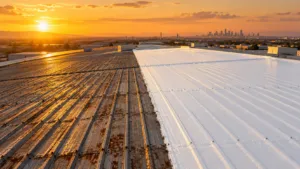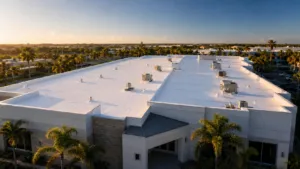


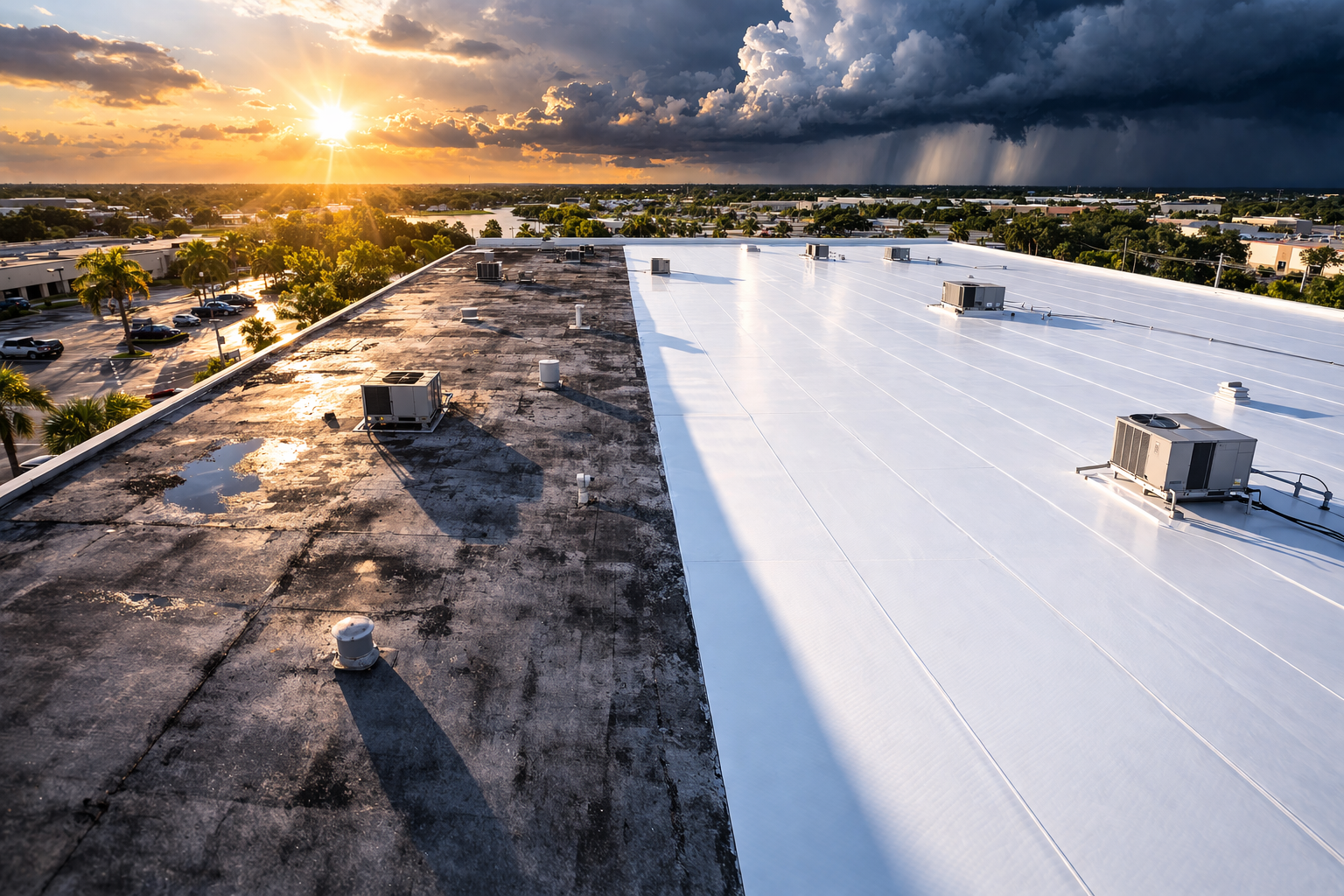
TPO (Thermoplastic Polyolefin) is the single most installed low-slope roofing membrane in the United States, and its dominance is even more pronounced in Florida. Its heat-welded seams, reflective white surface, and proven hurricane performance make it the default choice for commercial flat and low-slope roofs in the state. At CES Commercial Roofing, we install TPO across Florida for property owners ranging from warehouse operators to retail center managers, and it is the system we most commonly recommend for a full roof replacement.
This guide covers everything a Florida commercial property owner needs to evaluate TPO: market data, cost comparisons, energy savings research, Florida Building Code requirements, warranty structures, membrane thickness selection, and why the installer you choose matters more than the membrane itself.
Why does TPO dominate Florida’s commercial roofing market?
TPO’s rise over the past two decades has been steep. According to NRCA (National Roofing Contractors Association) market survey data, TPO captured 40% of all low-slope new construction and 30% of reroofing projects by 2015-2016. GAF, North America’s largest roofing manufacturer, puts the number higher, stating that TPO now accounts for more than 50% of the commercial roof market.
The SPRI (Single Ply Roofing Industry) trade association has confirmed that TPO is the fastest-growing segment of commercial roofing, driven by increased adoption in southern climates where cooling costs outweigh heating costs. Their 2022 shipment data showed thermoplastic membranes (TPO and PVC) growing by 24.5% relative to the three-year average, with the Southern region leading all markets at 32.5% growth.
In Florida specifically, TPO’s lead is even larger. The state’s year-round cooling demands, energy code requirements favoring reflective surfaces, and intense UV exposure make dark EPDM membranes impractical for most applications. NRCA regional data showed that in warm southern regions, EPDM had virtually no share of new construction, while TPO commanded over 50% of new installations.
How do heat-welded seams prevent leaks?
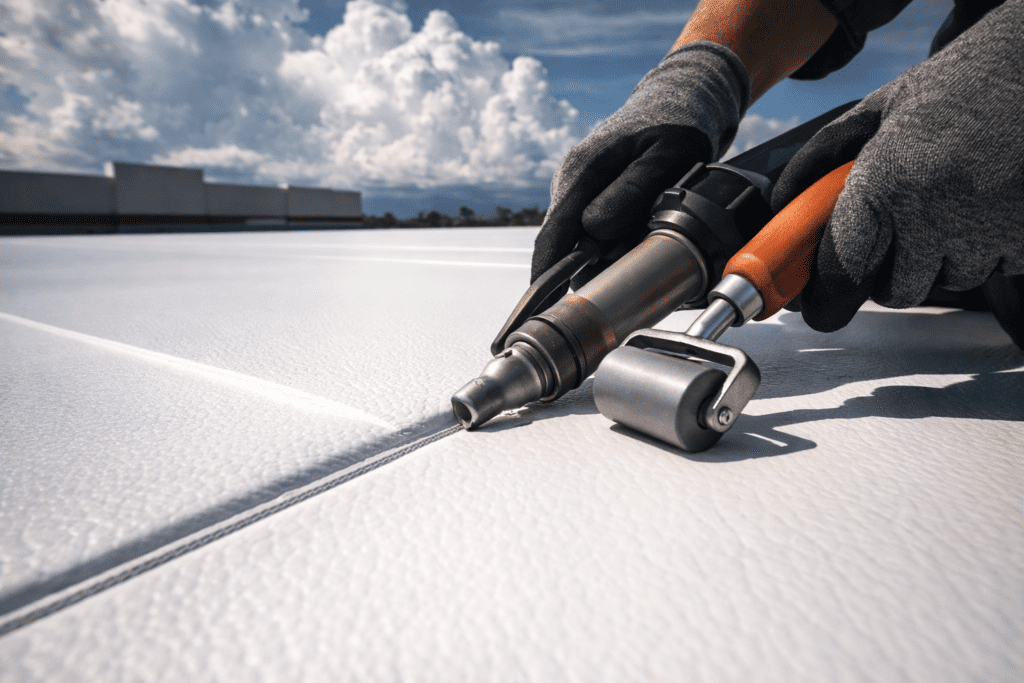
The defining technical advantage of TPO is its seam system. Specialized robotic welding machines direct hot air at approximately 900 to 1,100 degrees Fahrenheit onto overlapping membrane edges while a roller fuses them together. This creates a molecular bond in which the two sheets literally become one continuous membrane.
This matters because seam failure is the number one failure mode in single-ply roofing systems. Heat-welded seams are 3 to 4 times stronger than the adhesive or tape-bonded seams used in EPDM systems. Testing consistently shows that the heat-welded bond is equal to or stronger than the membrane itself. The membrane will tear elsewhere before a properly welded seam fails.
Unlike adhesive bonds that can degrade from UV exposure, moisture, and thermal cycling over time, heat-welded seams do not deteriorate because the connection is a permanent molecular fusion. Even years after installation, TPO can be re-welded for repairs, creating permanent patches rather than temporary fixes.
For Florida property owners, the practical takeaway is straightforward: a roofing system with inherently stronger seams dramatically reduces the most common source of leaks. That is particularly important given Florida’s average annual rainfall of over 50 inches and daily summer thunderstorms.
How does Florida’s climate test a TPO roof?
Florida is one of the harshest roofing environments in the continental United States. Understanding the specific threats helps property owners evaluate whether TPO is the right fit.
UV exposure. NOAA data shows Florida cities routinely record UV Index values of 10 to 11+ (classified as “Very High” to “Extreme”) from April through September, with 2,400 to 2,800 hours of annual sunshine. This relentless UV bombardment degrades unprotected roofing materials, causing cracking, chalking, and embrittlement. White TPO reflects 80 to 85% of solar radiation, keeping the membrane surface roughly 50 degrees Fahrenheit cooler than dark roofing materials and slowing UV degradation.
Hurricane-force winds. Ultimate design wind speeds under ASCE 7-22 (adopted by the Florida Building Code 8th Edition) range from 130 mph inland to 175 mph or higher in the High-Velocity Hurricane Zone covering Miami-Dade and Broward counties. RICOWI (Roofing Industry Committee on Weather Issues) investigations of Hurricanes Charley, Katrina, Michael, and Ian found that properly installed single-ply membrane systems generally held up well. The primary wind failure mode is edge and perimeter failure, not field membrane failure. IBHS analysis after Hurricane Ian confirmed that 71% of damaged membrane roofs showed damage at flashing and coping. Proper edge securement, not just membrane selection, determines hurricane performance.
Thermal cycling. Roof surfaces heat to 150 to 170 degrees Fahrenheit during afternoon sun and cool overnight, creating daily expansion and contraction that fatigues seams, flashings, and mechanical fasteners. TPO’s thermoplastic nature provides inherent flexibility through these cycles.
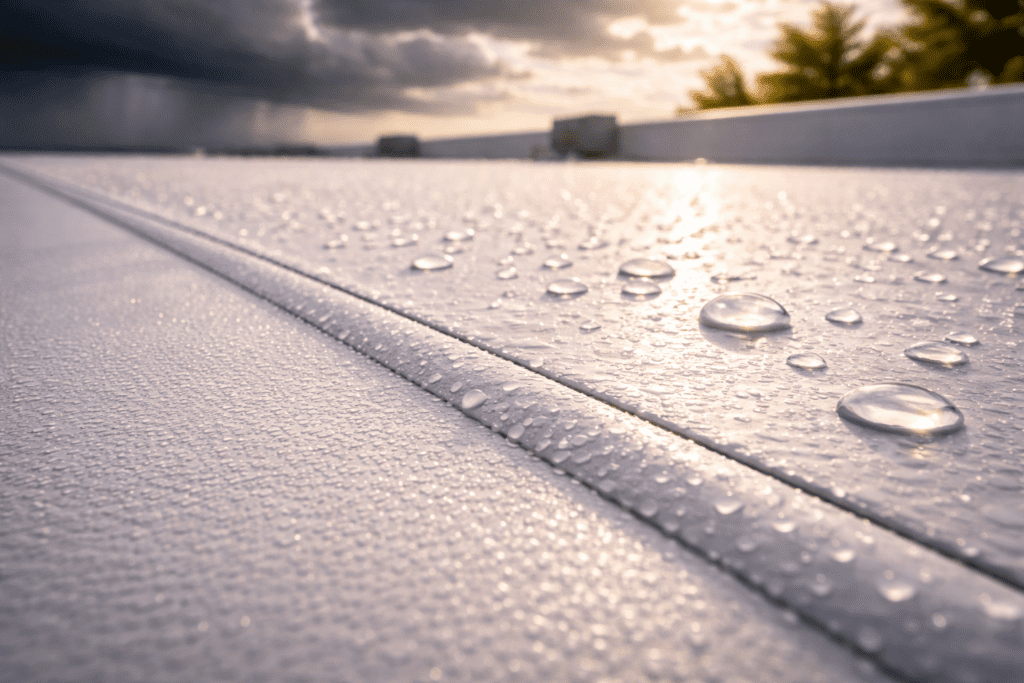
Rainfall. Florida averages 50 to 60 inches of rain annually with intense summer thunderstorms, making proper drainage design and ponding water prevention critical for any roofing system.
How much energy can a TPO roof save in Florida?
The energy case for TPO in Florida is backed by extensive government research, not just manufacturer claims.
The Florida Solar Energy Center (FSEC) at the University of Central Florida has conducted the most Florida-specific research available. Their field experiments on nine occupied Florida buildings with reflective roof coatings showed average air-conditioning energy savings of 19%, with individual results ranging from 2% to 43%. Utility peak demand savings averaged 22%. A separate FSEC study at a Cocoa Beach elementary school documented a 10% reduction in chiller energy (13,000 kWh per year in savings) and a 30% reduction in peak cooling demand after installing a reflective white coating.
Lawrence Berkeley National Laboratory data shows that cool roofs can reduce air-conditioning energy use by up to 15% in single-story commercial buildings. The Department of Energy notes that HVAC systems account for roughly 40% of commercial energy bills and that cool roofs achieve the greatest savings in ASHRAE Climate Zones 1 through 3, which encompass all of Florida. Oak Ridge National Laboratory found that consumers in the Southeast could save up to 40% on electric bills during months when they use air conditioning with reflective roofing.
To put numbers on it: on a 20,000-square-foot building with $30,000 in annual cooling costs, a reflective TPO roof delivering 10 to 20% energy savings produces $3,000 to $6,000 per year in reduced utility bills, totaling $60,000 to $120,000 over a 20-year service life.
White TPO membranes typically achieve an initial solar reflectance of 0.78 to 0.85, well exceeding ENERGY STAR’s low-slope requirements of 0.65 initial and 0.50 three-year aged reflectance.
What does TPO cost compared to other commercial roofing systems?
TPO occupies a favorable middle ground in commercial roofing pricing. It is less expensive than PVC and metal, competitive with modified bitumen, and typically delivers superior lifecycle value due to lower maintenance and energy savings.
| Roofing System | Installed Cost (per sq ft) | Typical Lifespan | Best For |
| TPO | $5.50 – $14.00 | 20 – 30 years | Energy efficiency, flat/low-slope, budget-conscious |
| EPDM | $4.00 – $12.00 | 20 – 30 years | Cold climates, budget projects |
| PVC | $6.50 – $15.00 | 20 – 35 years | Chemical exposure (restaurants, industrial) |
| Modified Bitumen | $7.00 – $12.00 | 15 – 20 years | Heavy foot traffic areas |
| Metal (Standing Seam) | $10.00 – $18.00 | 40 – 60 years | Long-term investment, sloped roofs |
| Spray Foam (SPF) | $4.75 – $10.00 | 40+ years (with recoating) | Maximum insulation, renewability |
TPO material costs vary by thickness: 45-mil runs $1.50 to $2.50 per square foot (materials only), 60-mil runs $2.00 to $3.00, and 80-mil runs $2.50 to $3.50. For a typical 10,000-square-foot commercial building, total installed TPO costs range from $80,000 to $150,000.
Florida installations tend toward the higher end of national ranges because wind uplift requirements demand denser fastener patterns or fully adhered systems, and post-hurricane demand periodically creates material scarcity and labor price spikes.
Beyond TPO, Florida property owners with existing roofs in structurally sound condition should also consider silicone coating restoration, which can extend a roof’s life at roughly one-third the cost of a full replacement with the same manufacturer warranty coverage.
What is the difference between material, system, and NDL warranties?
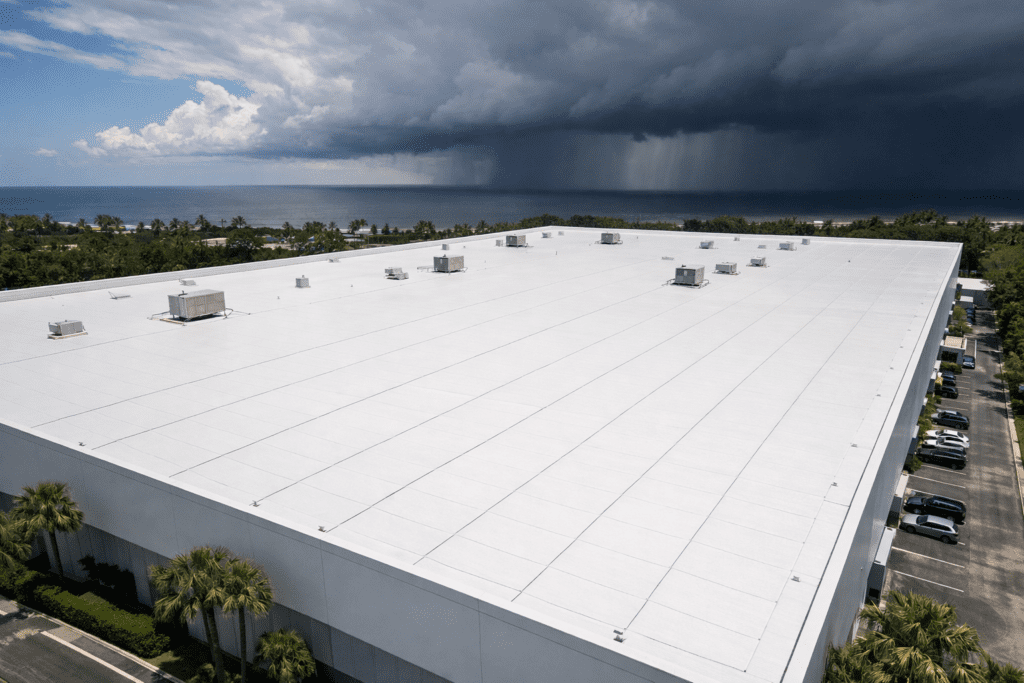
Understanding warranty types is arguably the most important financial decision in a TPO roofing project. The differences in coverage are enormous, and most property owners we talk to have never had them clearly explained to them.
Material-only warranties cover manufacturing defects in the membrane alone. No coverage for labor, accessories, flashing, or leak repair. These are often prorated (coverage decreases over time), last 10 to 20 years, and are available from any installer.
System warranties cover both materials and workmanship for 10 to 20 years. They require a manufacturer-certified contractor and typically include a manufacturer inspection before issuance.
NDL (No Dollar Limit) warranties represent the highest tier. They cover the entire roofing system, including membrane, flashings, drains, insulation, and edge metal, with non-prorated, full-cost coverage regardless of when a claim is filed. If a $100,000 roof needs replacement in year 19 of a 20-year NDL warranty and replacement costs have inflated to $185,000, the manufacturer covers the full $185,000. NDL warranties typically add approximately $0.20 per square foot, a modest investment for that level of protection.
The critical takeaway: NDL and system warranties are only available when the roof is installed by a manufacturer-certified contractor. A non-certified installer limits the building owner to material-only coverage. CES holds certifications with 14+ manufacturers, including GAF, Polyglass, Carlisle, Tropical, and Henry, which gives our customers access to the full range of warranty options across multiple product lines.
What does the Florida Building Code require for TPO?
Florida’s building codes, strengthened in the aftermath of Hurricane Andrew’s $16 billion in insured losses in 1992, set the most demanding commercial roofing requirements in the United States.
Every TPO product installed in Florida must carry a valid Florida Product Approval (FL number), searchable at florida product approval. In the High-Velocity Hurricane Zone (HVHZ) covering Miami-Dade and Broward counties, products must also hold a Miami-Dade Notice of Acceptance (NOA), which requires testing for impact resistance, cyclic pressure, and water resistance. NOAs must be renewed annually.
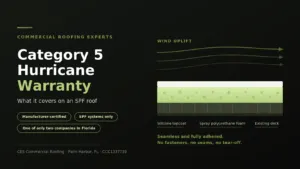
Wind uplift requirements vary dramatically across the state. Representative ultimate design wind speeds for Risk Category II buildings range from 130 mph in Jacksonville and inland North Florida to 175+ mph in the HVHZ. These wind speeds translate to roof uplift pressures that can exceed 80 psf at the corners of typical commercial buildings. Florida’s wind requirements generally favor fully adhered or induction-welded TPO systems in coastal and HVHZ areas because they distribute uplift pressure across the entire membrane surface rather than concentrating it at fastener points.
The 25% replacement rule is another important consideration. Under FBC Existing Building Section 706, if a roof was installed prior to the 2007 Florida Building Code and more than 25% is replaced in any 12-month period, the entire roof must be brought up to current code. This rule can significantly affect project scope and cost. A professional roof inspection that includes thermal imaging to measure moisture levels can help determine whether you need a partial repair or a full code-triggered replacement.
Should you choose 45-mil, 60-mil, or 80-mil TPO?
Membrane thickness is a strategic decision that directly affects durability, warranty eligibility, and long-term performance.
45-mil is the economy option with the lowest puncture resistance and shortest warranty eligibility. It is not recommended for commercial applications in Florida.
60-mil is the most common commercial standard. It offers a solid balance of cost and durability and qualifies for warranties up to 20 years. For most Florida commercial buildings, 60-mil is a solid baseline.
80-mil delivers superior UV resistance, puncture protection, and longevity. It qualifies for warranties up to 25 to 35 years. It is strongly recommended for roofs with regular foot traffic, heavy rooftop equipment, or buildings seeking maximum service life.
An IIBEC (International Institute of Building Enclosure Consultants) field study of aged TPO roofs confirmed that modern formulations, now in their 3rd and 4th generation since early commercialization in the 1990s, perform significantly better than early versions. Heat-welded seams on aged roofs maintained their integrity, and repairs via welding remained viable after years of exposure.
What are the most common TPO failure modes?
Understanding failure modes helps you ask better questions when evaluating contractors and maintain your roof proactively:
- Seam failures caused by improper heat welding. Temperature too high destroys polymer stabilizers. Too low creates bonds that detach over time.
- Membrane shrinkage from heat and UV, causing the membrane to pull away from edges, penetrations, and fasteners.
- Edge and flashing failures, the primary wind-related failure mode, accounting for 79% of FM Global insurance losses.
- Punctures and tears from foot traffic, fallen debris, hail, or HVAC maintenance activities.
- Premature UV degradation causing surface chalking, cracking, and brittleness, accelerated in high-UV environments like Florida.
- Ponding water damage where water persisting beyond 48 hours softens membrane and stresses seams.
- Heat aging that consumes antioxidants and UV stabilizers faster than expected, reducing service life.
- Adhesive incompatibility in fully adhered systems where some adhesives break down under sustained high heat.
- Reflected heat damage from adjacent walls, HVAC units, or solar panels focusing heat onto membrane areas.
- Fastener back-out in mechanically attached systems where thermal cycling gradually works fasteners loose.
Most of these failure modes are preventable with proper installation and a consistent maintenance program.
How should you maintain a TPO roof in Florida?
Preventive maintenance can extend roof service life by 30 to 100% according to NRCA guidelines. For Florida TPO roofs, we recommend a structured approach that accounts for the state’s hurricane season.
Pre-hurricane season (May/June): Full professional inspection of membrane, seams, flashings, edge metal, and penetrations. Clear all drains, gutters, and scuppers. Secure rooftop equipment and document conditions with photos for insurance purposes.
Post-hurricane season (November/December): Inspect for storm damage, including punctures, tears, and membrane displacement. Check for ponding water, verify seam integrity at perimeters and corners, and document any damage for insurance claims.
Year-round: Remove debris and biological growth, keep vegetation trimmed from roof edges, limit foot traffic, and clean drains quarterly. Inspect after any wind event exceeding 55 mph, the common warranty wind-speed threshold.
Most manufacturer warranties require documented maintenance to remain valid. Failure to maintain inspection logs and repair records can void even an NDL warranty.
Can you deduct a TPO roof on your taxes?
Two federal tax provisions offer substantial financial benefits for commercial property owners installing TPO roofing.
Section 179 allows immediate expensing of the full cost of a commercial roof in the year it is placed in service, rather than depreciating it over 39 years. The IRS specifically lists roofs as qualifying improvements to nonresidential real property. Following the One Big Beautiful Bill Act (signed July 2025), the maximum Section 179 deduction was permanently increased to $2.5 million with a phase-out threshold of $4 million, both indexed for inflation. For a property owner installing a $150,000 TPO system, the entire cost can be deducted in Year 1, creating immediate tax savings rather than recovering roughly $3,850 per year over 39 years.
Section 179D provides an additional per-square-foot deduction for energy-efficient commercial buildings. When prevailing wage and apprenticeship requirements are met, deductions can reach $2.90 to $5.81 per square foot (2025 rates) depending on the level of energy savings achieved. TPO’s cool-roof properties can contribute to meeting the 25% energy savings threshold. However, 179D construction must begin before June 30, 2026, under current law, making near-term project timing important.
Property owners should consult their tax advisor for specific guidance on their situation.
Why manufacturer certification determines the outcome
The single most consequential decision a Florida commercial property owner makes, beyond choosing TPO itself, is selecting a manufacturer-certified installer. This decision determines warranty access, installation quality, and long-term performance.
Without certification, the building owner is limited to material-only warranty coverage. With certification, the owner gains access to NDL warranties worth potentially hundreds of thousands of dollars in future protection, backed by the financial strength of major manufacturers.
Certification requires contractors to complete manufacturer-specific training, maintain good standing on warranty claim performance, carry adequate insurance, and submit to installation inspections before warranties are issued. After a typical two-year contractor responsibility period, the manufacturer assumes all liability for future defects and leaks.
This is why we emphasize our manufacturer certifications at CES. We hold certifications across multiple major manufacturers, maintain an active Florida Certified Roofing Contractor license, CCC1337739, and have a documented track record of passing both municipal inspections and manufacturer warranty inspections. Our installations have been verified by independent third parties including roofing consultants and manufacturer inspectors for 20-year warranties.
Beyond certifications, ask any contractor you are evaluating whether they carry standalone workers’ compensation insurance covering every person on the roof. Many contractors use employee leasing companies that only insure a single office employee, leaving roofing crews uncovered. If an uninsured worker is injured on your property, the liability falls on both the contractor and the property owner.
Get a free TPO roof evaluation
If you are considering TPO for your commercial building in Florida, we offer free, no-obligation roof evaluations that include on-site inspection and drone-assisted assessment. When conditions suggest potential moisture issues beneath the surface, we deploy thermal imaging equipment to measure the exact percentage of moisture present, giving you objective data to inform the decision between restoration and replacement.Call us at (813) 419-1918 or visit cesroof to schedule your evaluation.