


When you hire a roofing contractor in Florida, you assume their insurance covers the people actually working on your building. Often, it does not. CES Commercial Roofing carries a standalone workers’ compensation policy that covers every person on your roof, protecting you from a liability risk most property owners never see coming. It is one of several reasons Florida property owners choose CES Commercial Roofing for their commercial roofing services.
Not all workers’ compensation policies work the same way. Many roofing contractors obtain their certificates of insurance through employee leasing companies. These policies technically satisfy the requirement to show proof of coverage, but they often cover only a single employee, such as an office worker. The crews doing the actual roofing work on your property are left without coverage. A standalone workers’ compensation policy is issued directly to the contracting company and covers all employees, including field crews.
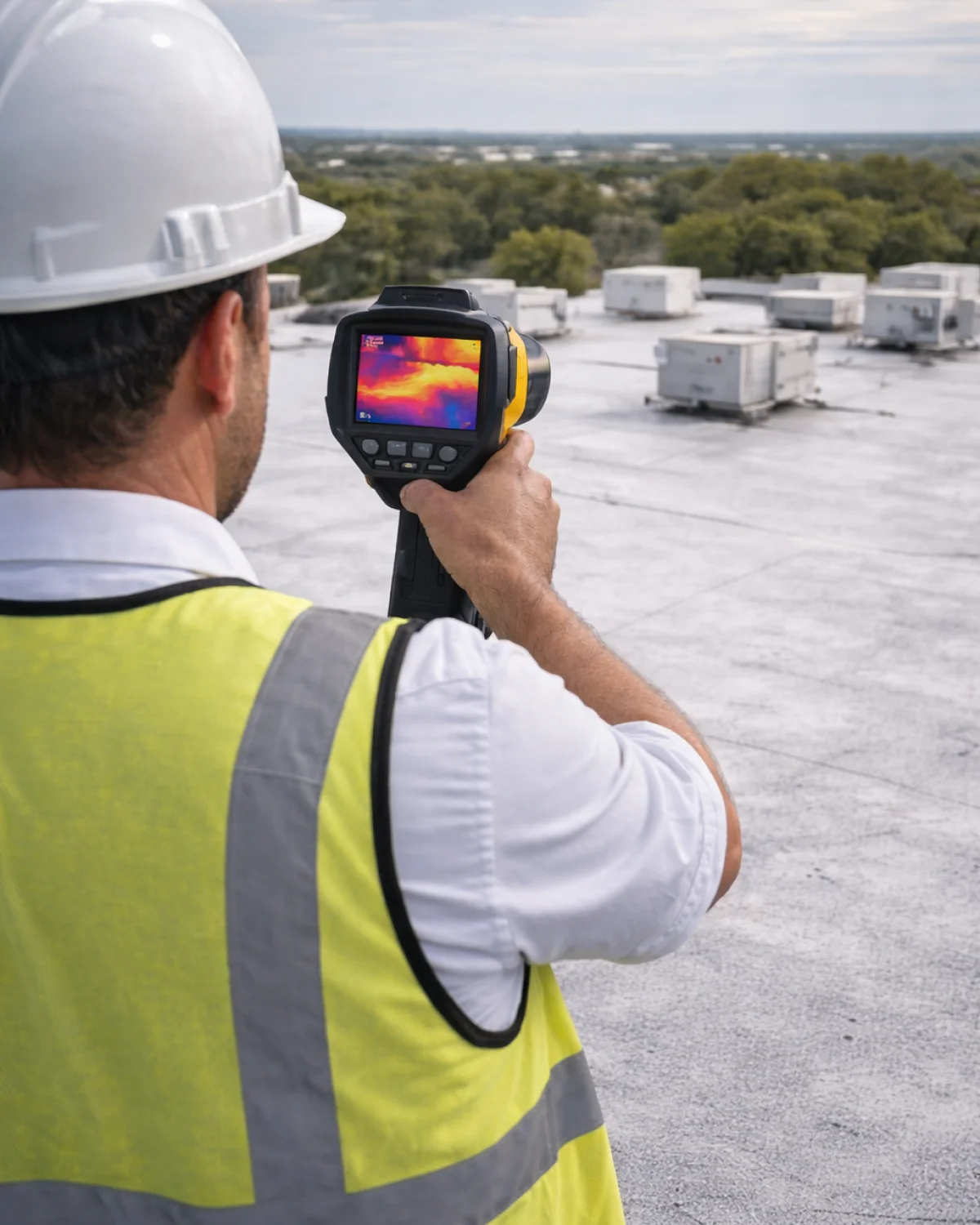
On a flat commercial roof, water can enter at one point and travel far before it shows up as a visible leak inside the building. By the time you see it on the ceiling, the damage may already be widespread. Thermal imaging finds the source, not just the symptom.
Covers the leasing company’s employees, typically one office worker. Satisfies the certificate of insurance requirement but often leaves field crews uninsured.
Issued directly to CES Roofing. Covers every person working on your roof, including all field crew members on-site.
An employee leasing certificate looks legitimate. The gap in coverage is not visible until a worker is injured and the claim lands on you.
Florida law can hold property owners liable when injured workers on their site have no workers’ comp coverage.
A valid-looking certificate can still leave roofing crews completely uninsured. Verification requires looking beyond the certificate itself.
Most property managers check that a certificate exists. Few know to ask whether the policy actually covers field crews.
Every person CES Roofing puts on your roof is covered under our standalone policy. There is no gap in coverage.
Before hiring any commercial roofing contractor in Florida, ask these questions directly:
At CES Roofing, we carry a standalone workers’ compensation policy covering every person on your roof. We provide documentation confirming this before work begins. Every project starts with a free roof inspection and insurance verification is part of what we bring to that first conversation.

An employee leasing arrangement allows a company to outsource HR and payroll to a third-party employer of record. Workers’ compensation coverage under these arrangements typically covers only the leasing company’s registered employees. In the roofing industry, that often means one office worker, not the crews performing physical labor on your roof. A valid certificate of insurance can be issued under this arrangement, which is why it frequently passes routine verification without anyone realizing the field crews are uninsured.We have thermal imaging equipment available on every free roof evaluation and deploy it when needed. There is no separate charge for the thermal scan as part of a free evaluation.
Not necessarily. A certificate confirms a policy existed at the time it was issued. It does not confirm which employees are covered or whether field crews are included. Ask contractors directly whether their workers’ compensation policy covers all persons working on-site, including field crew members. CES Commercial Roofing is glad to provide written confirmation before any work begins.
CES Commercial Roofing carries a standalone workers’ compensation policy issued directly to the company, covering all employees including field crews. We provide documentation confirming this coverage before work begins on your property.
CES Commercial Roofing carries a standalone workers’ compensation policy issued directly to the company, covering all employees including field crews. We provide documentation confirming this coverage before work begins on your property.
Workers’ compensation requirements vary by state, but the employee leasing gap is common wherever trade contractors operate in large numbers. Florida’s construction industry has a well-documented history of insurance compliance issues. Our standalone policy ensures our customers have genuine protection, not just paperwork.