



Repairs start with a free, no-obligation roof evaluation. An inspector walks the roof, runs a drone survey over the areas that are awkward to reach on foot, and brings out the thermal imaging scanner when conditions suggest water has gotten under the membrane. You get the findings in writing with photos, then a scoped repair quote. No guessing at what is wrong, and no pressure to buy a roof you do not need.
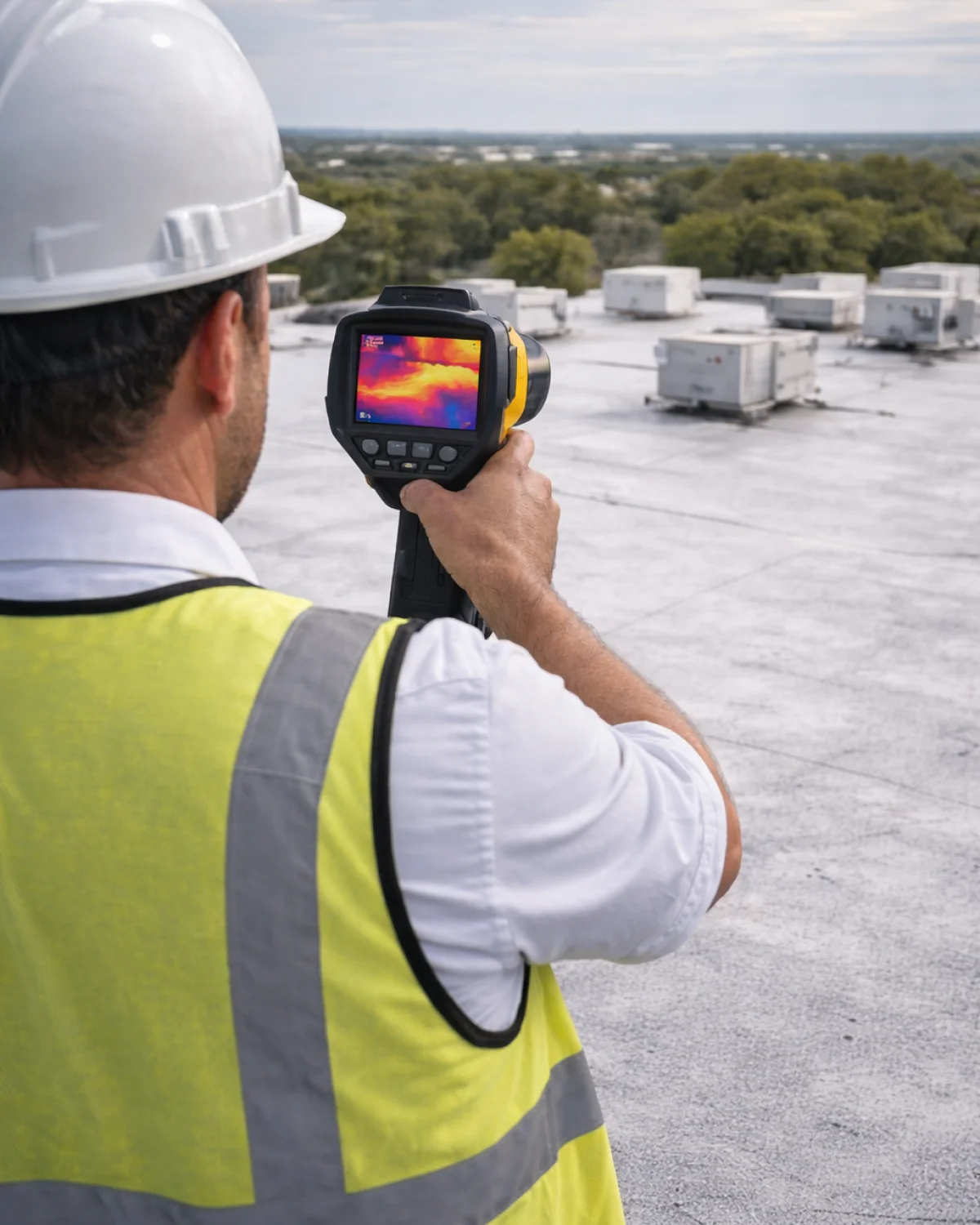
Repairs start with a free, no-obligation roof evaluation. An inspector walks the roof, runs a drone survey over the areas that are awkward to reach on foot, and brings out the thermal imaging scanner when conditions suggest water has gotten under the membrane. You get the findings in writing with photos, then a scoped repair quote. No guessing at what is wrong, and no pressure to buy a roof you do not need.
and source location Water enters a low-slope roof far from where it shows up inside. We trace the leak back to its source before patching.
and tears HVAC crews, satellite installers, and other trades puncture roof membranes regularly. These are among the most common repair calls we take.
Curbs drains, vents, and parapet walls fail before the open field of the roof does. We rebuild those details to manufacturer specification.
Lifted panels, displaced flashing, and debris strikes after Florida storms, documented for your insurance claim.
After a breach When a storm opens up a roof, temporary waterproofing stops further damage until permanent repairs can be scheduled.
A ceiling leak in an occupied building damages inventory, interrupts tenants, and creates liability you have to answer for. Fast repair keeps that from becoming your problem.
A repair call is a good time to find out whether the roof has five years left or five months. Thermal imaging gives you a number instead of an opinion.
Most commercial roof warranties require documented annual maintenance. Skip it and coverage is voided, and that condition is written into the manufacturer’s terms, not ours.
CES carries standalone workers’ compensation covering every person on the roof. Contractors who lease their labor can leave that exposure sitting with the property owner.
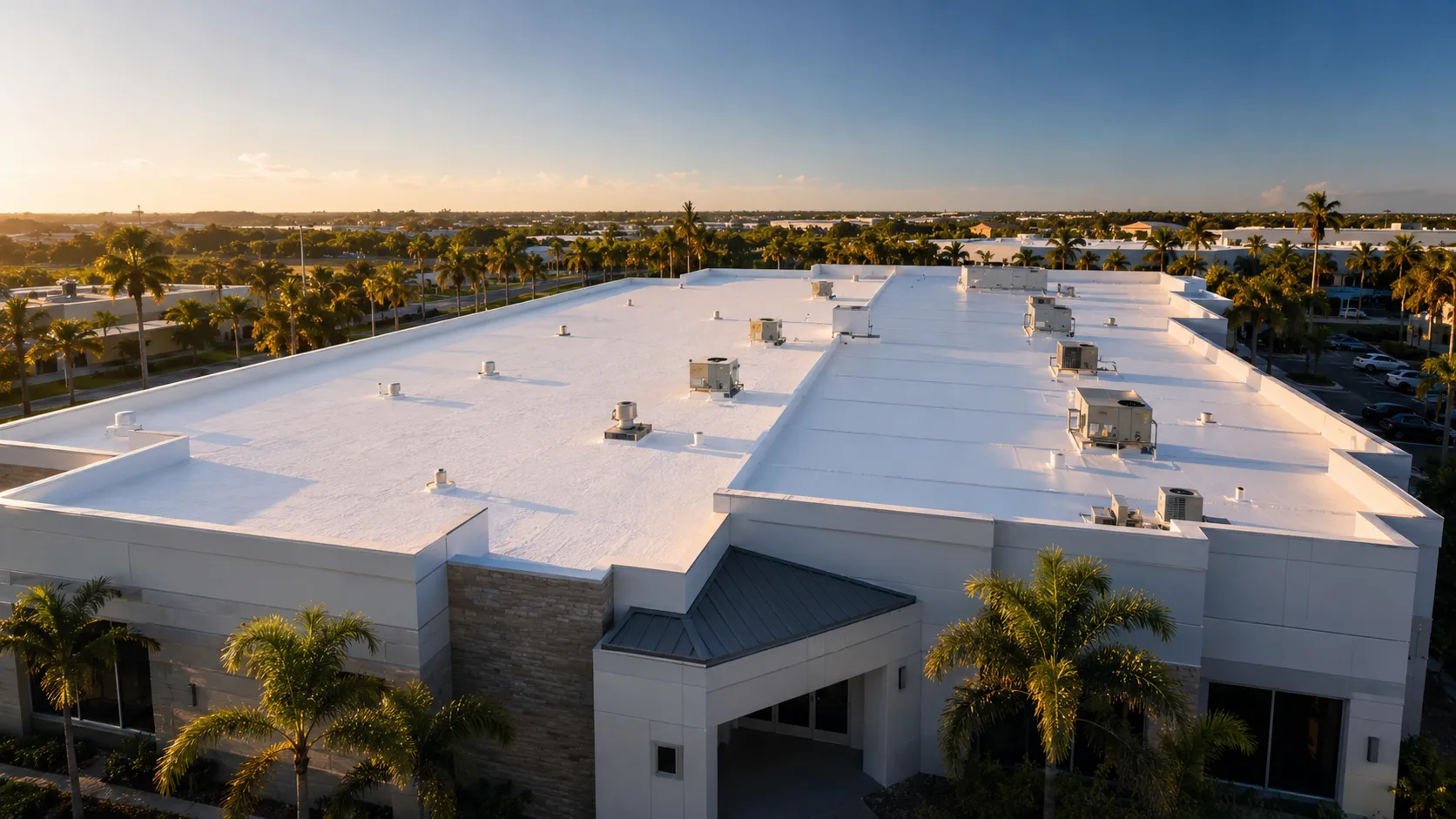
Florida building code requires a full tear-off once more than 25% of a roof is wet. Below that threshold, a restoration or coating is usually still on the table at roughly one-third the cost of a full replacement. Above it, there is no restoration option. Most commercial roofing contractors do not carry thermal imaging equipment, which means the number deciding your budget is being estimated rather than measured. CES keeps a thermal scanner and drone on the truck and deploys them when a roof shows signs of trapped moisture.

Our standard is same-day response to your call and a same-day or next-day site visit. If we cannot get someone on your roof the day you call, we treat that as a failure and make sure someone is there the next morning. After hours, a 24-hour answering service takes the call and logs it, and the response goes out first thing the following morning. We do not send crews onto roofs in the dark, which is standard practice across the commercial roofing industry for safety reasons.
It depends on how much water is already sitting in the system. Florida building code requires a full tear-off once more than 25% of the roof is wet, so that threshold usually decides the answer. A free evaluation with drone imagery and, where conditions call for it, thermal imaging tells you the actual moisture percentage. If the roof is below the threshold and otherwise sound, a coating or spray foam restoration typically runs roughly one-third the cost of a full replacement. If it is above, we will tell you the roof needs to come off, even when that is not what you were hoping to hear.
Not by itself, but who does the work and whether your maintenance is current both matter. Most commercial roof warranties, including the Category 5 Hurricane Warranty and the Manufacturer Lifetime Renewable Leak-Proof Warranty, require documented annual maintenance to stay in force. That requirement is written into the manufacturer’s terms, not the contractor’s. CES holds active certifications with 14 or more manufacturers, so repairs are performed to the manufacturer’s specification, and our annual maintenance program issues a certificate confirming your warranty obligations have been met.
That is between you and the trade that caused the damage, but documentation usually decides it. Rooftop HVAC service, satellite installs, and similar work are among the most common causes of the repair calls we take. Our evaluation produces dated photos and a written description of the damage and its likely cause, which is what you need when you go back to that contractor or to your insurer. We repair the roof either way. Getting the damage documented accurately is the part that protects you.
No. Roof evaluations are free and carry no obligation. The visit includes an on-site walkthrough and a drone-assisted survey, with thermal imaging deployed when conditions suggest moisture has gotten under the surface. You receive the findings with photos and a clear recommendation: targeted repair, restoration, or replacement. If the honest answer is that your roof does not need work yet, that is what we will tell you. CES has lost bids by saying exactly that.
Yes. CES is headquartered in Palm Harbor with a second office in Tampa, and the core service area runs across central Florida through Tampa Bay, Orlando, and Sarasota. That includes St. Petersburg, Clearwater, Lakeland, Brandon, Riverview, Wesley Chapel, Bradenton, Fort Myers, and the surrounding communities. We also serve the east coast of Florida including West Palm Beach, Fort Lauderdale, and Naples, where projects of roughly 10,000 square feet and above justify the additional travel.
Tell us what you are seeing and we will get an inspector out. The evaluation is free, the report comes with photos, and you decide what happens next.