

The most cost-effective commercial roof is usually the one you don’t have to fully replace. When an existing roof is structurally sound but aging, a silicone coating or spray polyurethane foam (SPF) restoration applied over the top runs roughly one-third the cost of a full tear-off and replacement, and it can qualify for 10, 15, or 20-year manufacturer warranties. Cost-effectiveness in commercial roofing comes down to the lowest total cost over the life of the roof. The lowest bid and the lowest cost are rarely the same number.
At CES Commercial Roofing, silicone coating restoration is the service we perform most, and we’ve installed more than 15 million square feet of commercial roofing across Florida. On one Florida metal roof, a foam-and-coating restoration cost the owner about $500,000 where a full reskin would have run roughly $1.2 million. That is about $700,000 kept in the building’s budget for the same watertight result and a manufacturer warranty.
The rest of this guide covers what actually drives commercial roofing cost in Florida, how to tell whether your roof can be restored instead of replaced, the most cost-effective systems when a new roof is genuinely needed, and the warranty and tax factors that decide your real cost of ownership.
What “cost-effective” means for a Florida commercial roof
A low upfront price on a system that fails early in Florida’s climate is the most expensive roof you can buy, because you end up paying for it twice.
Three conditions make Florida one of the hardest roofing environments in the country, and each one shortens the life of a poorly chosen system:
- Intense year-round UV and thermal shock. Surface temperatures can reach 160°F in the afternoon, then drop fast when a storm rolls through. That constant expansion and contraction fatigues seams and backs out fasteners.
- Ponding water. Low-slope commercial roofs hold water after heavy rain. Any water sitting on the roof more than 48 hours accelerates degradation and punishes materials that were not built to handle it.
- Hurricane wind uplift. Coastal and high-velocity zones demand high fastening densities and strict adherence to the Florida Building Code.
A cost-effective roof survives all three for as long as possible at the lowest total spend. That total includes the install, the energy the roof costs you every month, the repairs it needs, and whether you can avoid a second full replacement down the road.
The biggest lever on cost is restoring instead of replacing
The single largest decision on any commercial roofing project is whether the existing roof has to come off at all. A full tear-off is the most expensive path in commercial roofing, and it is often unnecessary.
Tear-offs are costly for reasons that have nothing to do with the new membrane:
- Demolition and disposal. Crews strip the old membrane and insulation, and you pay escalating landfill tipping fees to haul it away.
- Insulation upgrades. Once a roof is stripped to the deck, the new assembly has to meet current Florida energy code, which usually means thicker, pricier insulation than what was there before.
- Downtime and exposure. The building sits open to the weather during the work, with real risk of interior damage if a storm hits before the roof is dried in.
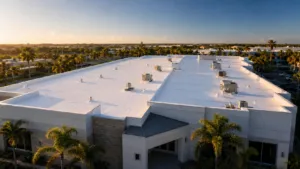
A commercial roof restoration skips the demolition phase entirely. By coating or foaming over a sound existing roof, you strip out the labor, disposal, and insulation costs that make tear-offs so expensive. The building stays fully operational during the work, and the finished result is a seamless membrane that can qualify for 10, 15, or 20-year manufacturer warranties. Across Florida markets like Tampa and Orlando, most commercial buildings have flat or low-slope roofs that are strong candidates for this approach.
This is our lane. Silicone coating restoration is the work we do more than any other, and the savings are real. The $500,000 metal roof project above is one example of what avoiding a tear-off does to a budget.
The honest catch is that restoration only works on a sound roof. If the deck is failing or the insulation is soaked, coating over it is a waste of money, and we will tell you that before you spend a dollar.
How to know if a commercial roof can be restored
A roof qualifies for restoration only if three things are true: the structural deck is sound, the existing membrane is well-adhered, and the insulation underneath is dry. The first two are straightforward to assess. Moisture is where most owners get it wrong, and where the Florida Building Code draws a hard line.
The moisture threshold that forces a tear-off
Under the Florida Building Code, you cannot legally recover or coat a roof if the assembly holds too much water. The code sets two limits: no more than 5% moisture by weight in the roofing membrane, and no more than 8% by weight in the insulation. Above those levels, a tear-off becomes mandatory.
The reason is physical. Seal a wet roof under a new coating and the trapped water boils under the Florida sun. The vapor pressure blisters the membrane, destroys adhesion, rots the deck, and leaves the roof vulnerable to wind uplift in a storm. Compliance is confirmed through a formal moisture survey run under Testing Application Standard (TAS) 126, which uses non-destructive scanning plus physical core samples to measure actual moisture content.
Why thermal imaging matters here
When a roof’s moisture level is in question, thermal imaging maps where water is hiding under the membrane, because wet insulation holds heat differently than dry insulation and shows up on an infrared scan. Many coating proposals are made without a formal moisture survey, and we bring thermal imaging in when a roof’s condition calls for it. That gives you an objective answer on whether restoration is viable, instead of a guess that turns into a failed coating a year later.
When Florida’s 25% rule can force a full replacement
Even on a sound roof, one Florida regulation can force a full replacement, and it is widely misunderstood. Florida’s “25% rule” is triggered by how much of the roof is worked on, not by how much of it is wet or damaged.
Under Florida Building Code Section 706.1.1 and Florida Statute 553.844, if more than 25% of the roof area or roof section is repaired, replaced, or recovered in a 12-month period, the entire existing roofing system or roof section must conform to current code, unless an exception applies. You can read a plain-language breakdown of the rule from the building consultants at J.S. Held.
There is an important exemption. If the existing roof was permitted and installed under the 2007 Florida Building Code, meaning a permit issued and closed after March 1, 2009, the 25% rule does not force a full replacement. On those newer roofs, only the damaged section has to be repaired, no matter how much of the total area that represents. Before you accept anyone’s demand for a total tear-off, verify the roof’s permit history with the local building department. That single check can be the difference between a targeted repair and a six-figure replacement.
The most cost-effective new roofing systems for Florida
When a roof is genuinely past restoration, the goal shifts to the lowest total cost over the life of the new system. The table below shows current 2026 installed cost ranges, typical lifespan ranges, and the best-fit use for the systems we see most on Florida commercial buildings.
| Roofing system | 2026 installed cost (per sq. ft.) | Typical lifespan (conditional) | Best-fit use |
| Silicone coating (restoration) | $2.00 to $5.00 | 15 to 20+ years | Flat, ponding-prone roofs; restoring a sound existing roof |
| Acrylic coating (restoration) | $1.50 to $3.50 | 10 to 20 years | Sloped roofs with positive drainage; not for standing water |
| TPO (white single-ply) | $8.00 to $12.00 | 20 to 30 years | Flat and low-slope commercial; strong value on a new install |
| PVC (single-ply) | $9.00 to $14.00 | 20 to 30+ years | Roofs exposed to grease or chemical exhaust (restaurants, plants) |
| EPDM (rubber membrane) | $7.00 to $11.00 | 20 to 25 years | Budget single-ply; black surface absorbs heat, less ideal for Florida cooling |
| Modified bitumen | $4.00 to $14.00 | 15 to 25 years | Heavy rainfall and moderate foot traffic |
| Built-up roofing (BUR) | $5.00 to $10.00 | 15 to 30 years | Durable multi-ply asphalt; heavy and increasingly phased out |
| Exposed-fastener metal | $7.00 to $10.00 | 20 to 30 years | Agricultural and light industrial buildings |
| Standing seam metal | $14.00 to $25.00+ | 40 to 60+ years | Premium sloped commercial; best wind resistance and longest lifecycle |
Every lifespan above is a range, not a promise. Actual longevity depends on the specific material, the quality of the installation, how much sun and ponding the roof takes, and whether it gets regular maintenance. Two identical membranes can last very differently depending on those factors.
A few practical takeaways for Florida:
- For most flat and low-slope commercial buildings, TPO is the current value leader on a new install. It is a reflective, heat-welded single-ply membrane that balances cost, durability, and energy performance.
- Standing seam metal carries a higher upfront cost but the longest lifecycle and the best wind resistance. Near the coast, salt air and wind-driven moisture can shorten a metal roof’s life, so real longevity depends on the metal type, the coating system, installation quality, distance from saltwater, and maintenance rather than a single fixed number.
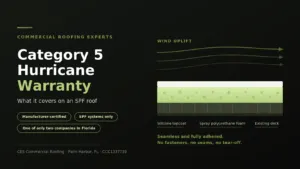
- Where a building needs both waterproofing and added insulation, an SPF system is worth a close look. It is also the basis for our Category 5 Hurricane Roof, and we are one of a very limited number of Florida contractors authorized to offer a manufacturer-certified Category 5 hurricane warranty on SPF. That warranty covers the foam roofing system, not the building structure, against Category 5 wind, and it stays in force as long as the required annual maintenance is kept up.
You can compare the full range of options on our commercial roof installation page.
The cost figures above are national industry benchmarks for 2026, not our quotes. Dense coastal Florida markets often run higher than the national average because of labor rates and logistics, and soft costs like permits, insurance, and overhead typically add 15% to 30% on top of the hard construction cost.
Reflective roofs lower your operating cost too
On a new install, color is a cost decision. A dark roof absorbs heat and drives up cooling bills, while a reflective white membrane sends that heat back. According to U.S. Department of Energy research from Lawrence Berkeley National Laboratory, a highly reflective white roof on an air-conditioned commercial building can save up to $0.20 per square foot per year in cooling costs. On a 50,000-square-foot building, that is roughly $10,000 a year, every year, straight off the energy bill.
System warranty vs material warranty
Two roofs can carry “a warranty” and protect you completely differently. The distinction decides who pays when something fails, and it is one of the most overlooked cost factors in commercial roofing.
| Warranty type | What it covers | The catch |
| Material (defect) warranty | Factory defects in the roofing material only | Excludes labor, tear-off, and workmanship. Most leaks come from workmanship, so it protects little. |
| Labor and material warranty | Material defects plus the original installation | Often prorated or capped; coverage shrinks as the roof ages |
| Full system / No Dollar Limit (NDL) | The entire system: membrane, flashings, fasteners, accessories, materials, and workmanship, with no cost cap | Only available through a manufacturer-certified contractor after a factory-audited install |
The point for cost-effectiveness is simple. A full system (NDL) warranty is only available through a manufacturer-certified contractor. The manufacturer issues it only after a factory-certified crew installs the system to spec and a technical rep inspects the finished roof. We hold more than 14 active manufacturer certifications, backed by 125+ years of combined experience across our team. That is what lets us offer true system warranties. A material warranty alone would leave you paying for the labor when a seam fails.
Section 179 and the tax side of cost-effectiveness
Federal tax treatment changes the real cost of a roof, and it is one more reason restoration and replacement should be evaluated differently.
A full roof replacement is a capital improvement. Historically that meant depreciating the cost slowly over 39 years. Section 179 now lets qualifying businesses expense the full cost of a commercial roof improvement in the year it is placed in service, up to $2,560,000 for 2026, with the deduction phasing out once total qualifying purchases exceed $4,090,000. On a $200,000 roof, a business in a 25% tax bracket would cut its tax bill by about $50,000, bringing the net cost down to roughly $150,000. The current-year figures are published at Section179.org.
Restoration can be treated even more favorably. Because a coating applied to maintain and seal an existing membrane is often classified as maintenance rather than a capital improvement, it can frequently be deducted in full the year it is incurred, without navigating Section 179 limits at all. That treatment depends on the specifics of the project and your tax situation, so confirm it with your CPA before you plan around it. Our Section 179 commercial roof restoration page covers this in more detail.
The most cost-effective move is a straight answer
Getting the most roof for your money starts with an honest read on whether you need a new roof at all. A restoration on a sound roof at roughly one-third the cost of replacement, an accurate moisture assessment before anyone coats anything, and a system warranty backed by a certified installer will almost always beat the lowest sticker price.
That honest read is what we lead with. We back our restoration and installation work with a price-beat guarantee of $2,500 on SPF systems and $1,500 on silicone coatings, and we keep roofs under warranty on track with an ongoing maintenance and repair program. If you want to know whether your building’s roof can be restored or genuinely needs replacement, we will walk it, run the moisture diagnostics, and give you the real answer.
Schedule a free commercial roof inspection with CES Commercial Roofing at (813) 419-1918.