


A commercial roof restoration costs roughly one-third the price of a full replacement. Under Section 179 of the IRS tax code, the entire project cost may be deductible in the year it is completed. For Florida property owners evaluating their roofing options, that is a combination worth understanding.

A commercial roof restoration applies a liquid silicone coating over an existing structurally sound roof after completing all necessary repairs, addressing seams, penetrations, flashings, and problem areas. Because it extends the life of an existing roof rather than replacing it, it is classified as a repair or improvement under the IRS tax code, not a capital expenditure.
That distinction matters. Capital expenditures, like a full tear-off and replacement, must be depreciated over many years. A restoration that qualifies under Section 179 can be written off entirely in the tax year the project is completed.
Metal, modified bitumen, TPO, and other structurally sound existing commercial roofs
Full repairs, seam and penetration treatment, and application of a liquid silicone coating system
Repair or improvement, not a capital expenditure
Entire project cost in the year of completion (consult your tax advisor for guidance on your specific situation)
10, 15, or 20-year manufacturer-backed system warranties, the same terms available with a full replacement
At CES Commercial Roofing, silicone coating restoration is the service we perform most frequently across Tampa, Orlando, and throughout Florida. With 15 million square feet installed statewide and 14+ active manufacturer certifications, we are positioned to deliver restoration projects that meet both warranty and tax documentation requirements.
When a commercial roof is fully replaced, the IRS typically treats it as a capital improvement. The cost is depreciated over the useful life of the asset, spread across many years rather than deducted immediately.
A restoration classified as a repair under Section 179 is treated differently. If it qualifies, the full project cost can be deducted in the same tax year the work is completed. For owners of multiple properties or buildings with larger roofs, the difference in tax treatment can be significant.
This does not mean every restoration automatically qualifies. Eligibility depends on the scope of work, the condition of the roof, and how the project is documented. The IRS publishes guidance on repairs vs. capital expenditures at irs.gov. For a deeper look at how Section 179 applies specifically to roof coatings, see our Section 179 roofing tax guide. Property owners should confirm specifics with their tax advisor or CPA before making decisions based on tax treatment.

A silicone coating restoration costs roughly one-third the price of a full tear-off and replacement, while delivering equivalent manufacturer warranty coverage.
A qualifying restoration may be written off entirely in the tax year completed, rather than depreciated over many years like a full replacement.
CES offers 10, 15, or 20-year manufacturer-backed system warranties on a restoration, the same terms available on a brand-new installation.
Restoration is applied over the existing roof. No demolition, no landfill costs, and typically no interruption to building operations.

Did you know?
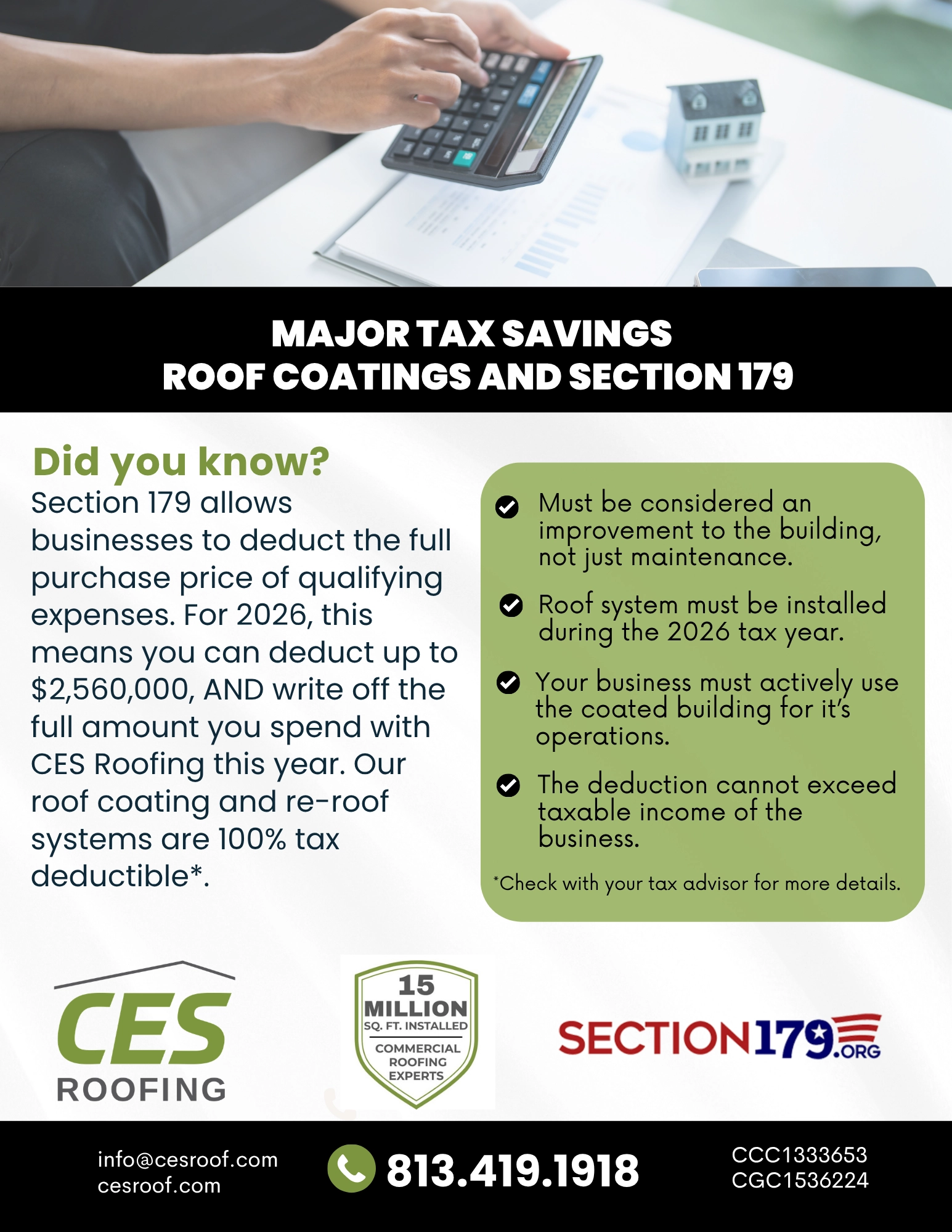
Section 179 allows businesses to deduct the full purchase price of qualifying expenses. For 2026, this means you can deduct up to $2,560,000, AND write off the full amount you spend with CES Roofing this year. Our roof coating and re-roof systems are 100% tax deductible.
Not automatically. Eligibility depends on how the project is scoped, the condition of the roof, and how the work is classified. The IRS distinguishes between repairs (which may qualify under Section 179) and capital expenditures (which must be depreciated over time). Your tax advisor or CPA can confirm whether your specific project qualifies and how to document it properly.
A full roof replacement is generally treated as a capital improvement and depreciated over many years. A restoration that qualifies as a repair under Section 179 can potentially be deducted in full in the tax year the work is completed. The classification depends on scope and documentation, not just the type of work performed.
Silicone coating restoration is performed on existing commercial roofs that are structurally sound but aging or worn. Eligible systems include metal, modified bitumen, TPO, and others. CES provides a free on-site evaluation, including drone-assisted inspection, to determine whether a roof is a good candidate for restoration. Learn more about commercial roof coating options.
Yes. CES can offer 10, 15, or 20-year manufacturer-backed system warranties on coating restorations, identical to what you would receive on a new installation. These system warranties cover both labor and materials, but are only available through manufacturer-certified contractors. CES holds active certifications with 14+ manufacturers. For a breakdown of how these warranty tiers compare, see our commercial roofing warranty guide.
CES provides free, no-obligation roof evaluations that include an on-site inspection and drone-assisted assessment. The evaluation gives you a clear picture of your roof’s condition and which options make the most sense. CES serves commercial properties throughout Florida, including Tampa Bay and the Orlando area. Schedule your evaluation or call us directly.
A free evaluation costs you nothing and gives you the information you need to make a confident decision, including whether a restoration makes financial sense for your property this year.