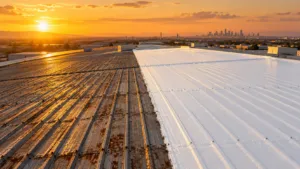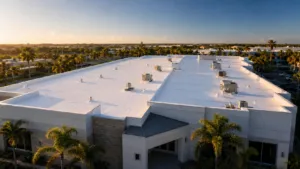


A properly installed Spray Polyurethane Foam (SPF) roof in Florida typically lasts 20 to 30+ years, and the underlying foam itself can last indefinitely when the protective top coat is renewed on schedule. That range comes from the longest-running independent study of SPF roofing on record, which tracked 1,600 foam roofs across the United States and found that 97.6% of them were still leak-free after decades of service, with some specimens still performing at 26+ years old. At CES Roofing, SPF is the system we install most often on hurricane-exposed commercial buildings across Florida, and the lifespan data below closely aligns with what we see on roofs installed 15 and 20 years ago.
The short answer is useful, but the more important question for a commercial property owner is what actually determines whether your specific SPF roof lands at the 20-year end of the range, the 30-year end, or keeps going indefinitely. This guide walks through the data, variables, and maintenance protocol that keep an SPF roof performing for as long as the building beneath it stands.
The Short Answer: 20 to 30+ Years, With Indefinite Life When Recoated
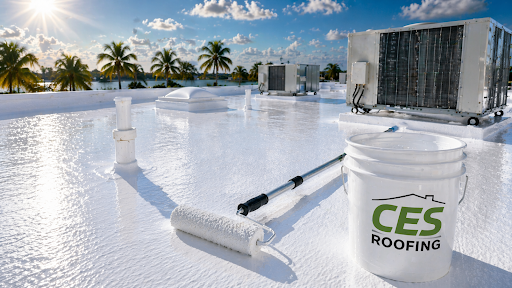
An SPF roof is a two-layer system. The foam is the waterproofing and insulation layer. A protective elastomeric coating, silicone in Florida for reasons covered below, sits on top of the foam and protects it from UV exposure. The foam and the coating have different life cycles:
- The foam layer. Closed-cell polyurethane foam does not degrade significantly with age when it remains protected. Long-term studies have found that its physical properties do not measurably diminish over time.
- The coating layer. The top coat needs to be renewed roughly every 10 to 20 years, depending on coating chemistry, mil thickness, and UV exposure.
When the coating is renewed on schedule, the foam beneath stays protected, and the roof continues to perform. This is why the National Roofing Foundation’s longitudinal study concluded that SPF roofs have a “very high degree of sustainability with an indefinite life expectancy when properly maintained with periodic recoating.”
In practical terms, you install SPF once, recoat it every 10 to 20 years, and you can reasonably expect the roof to outlast the building.
What the Research Actually Says About SPF Lifespan
The numbers quoted for SPF lifespan come from two of the most frequently cited independent studies in commercial roofing, plus one more recent follow-up.
The Arizona State University study (Dr. Dean Kashiwagi, 1996). This survey of 1,600 SPF roofing systems across the U.S. remains the largest longitudinal study of SPF performance ever conducted. The findings:
- 97.6% of surveyed roofs were not leaking
- 93% showed less than 1% surface deterioration
- 55% had never been maintained at the time of inspection
- More than 70% were applied as recovers over existing roofs
- The oldest specimens exceeded 26 years of service
The National Roofing Foundation study (Dr. René Dupuis, 1998). A follow-up study of 160 SPF roofs across six U.S. climate zones confirmed ASU’s findings and added the “indefinite life expectancy” conclusion when recoating is performed on schedule.
The 2013 ASCE follow-up (Gajjar, Kashiwagi, and Sullivan). A more recent study published in the ASCE Journal of Performance of Constructed Facilities tracked 37 urethane-coated SPF roofs at 4-, 6-, and 7-year inspection intervals. It confirmed that defects such as blistering and surface issues almost always trace back to installation errors, not to material degradation. In other words, when an SPF roof fails early, it is almost never the foam’s fault.
How Florida’s Climate Affects SPF Lifespan
Florida is one of the most demanding roofing environments in the country. Intense UV, heavy seasonal rainfall, year-round heat, salt air near the coast, and hurricane-force winds combine to accelerate the aging of every roofing system. SPF handles these conditions better than most alternatives, but the details matter.
UV exposure and why silicone matters in Florida
Raw SPF foam is not UV-tolerant. Within days of direct sun exposure, unprotected foam begins to degrade. The protective top coat is what determines how the roof ages.
In Florida, we specify silicone almost exclusively as the coating for SPF systems. Silicone handles standing water and high humidity better than acrylic. Acrylic is common in dry climates like Arizona, but in Florida’s wet climate, where roofs see heavy rain, occasional ponding, and year-round humidity, silicone is the more durable choice. Using the wrong coating chemistry for the climate is one of the fastest ways to shorten an SPF roof’s usable life.
Hurricane wind and why SPF still wins
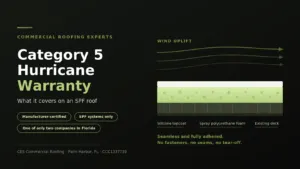
Field evidence and wind uplift testing both favor SPF in hurricane-exposed regions. After Hurricane Andrew hit South Florida with 165+ mph winds, investigators documented that SPF roofs did not peel or lift unless the substrate beneath them failed first. NIST’s reconnaissance work on Hurricanes Katrina and Rita found that SPF roofs “performed extremely well” with no blow-off of foam and no flashing damage, while adjacent built-up roofs with three-tab shingles lost 50% or more of their roof area.
Laboratory testing backs up the field record. Industry documentation compiled by IIBEC reports that SPF on steel and plywood decks resisted wind uplift loads up to 160 to 165 psf, the maximum Underwriters Laboratories could generate with its test equipment, without any delamination. FM Global testing produced an I-990 rating on structural concrete, meaning the assembly resisted more than 990 pounds of uplift pressure per square foot.
This hurricane track record is the reason SPF is the foundation of our Category 5 Hurricane Warranty. CES is one of only two companies in Florida authorized to offer a manufacturer-certified Category 5 warranty on SPF roofing systems, and we install these systems across commercial properties in Tampa, Orlando, and surrounding hurricane-prone markets.
Salt air, humidity, and coastal exposure
Coastal buildings in Florida face accelerated wear on most roofing systems because of salt air and wind-driven moisture. SPF’s seamless, fully-adhered geometry is less affected by salt exposure than seam-based systems like TPO or built-up roofs, because there are no fasteners or seams to corrode. The coating still needs to be monitored on the typical recoat cycle, but the foam underneath is largely insulated from the coastal variables that shorten the life of other systems.
What Actually Shortens an SPF Roof’s Lifespan
The research is clear on this. When SPF roofs fail early, it is almost always an installation or maintenance issue, not a material issue. The five most common causes of shortened SPF lifespan are:
- Improper installation workmanship. The 2-to-72-hour coating application window, substrate moisture limits, ambient temperature and humidity during spray, and the skill of the applicator all produce defects if mishandled. Blistering, pin-holing, and delamination are nearly always installation-driven.
- The wrong coating for the climate. Acrylic coatings in Florida’s wet climate degrade faster than silicone and allow water intrusion to reach the foam. For Florida specifically, silicone is the correct choice.
- Missed recoat cycles. If the top coat degrades past the recoat window, UV begins to break down the foam itself. Caught in time, a recoat is straightforward. Missed for too long, and parts of the foam may need to be repaired or replaced.
- Mechanical damage from foot traffic and rooftop equipment. HVAC service, satellite installations, and untrained trades can gouge the coating and foam. The redeeming characteristic of closed-cell SPF is that moisture stays isolated to the damaged cell cluster, so gouges rarely cause immediate leaks, but they do need to be repaired.
- Missed annual maintenance. For most commercial roofing warranties, including the Category 5 Hurricane Warranty and the Manufacturer Lifetime Renewable Leak-Proof Warranty, annual maintenance is a mandatory requirement written into the warranty terms. Skip it, and the warranty is voided, even if the roof is still performing.
SPF Lifespan vs. Other Commercial Roof Systems in Florida
For context, here is how the typical lifespan of SPF in Florida compares to the other commercial roofing systems we install most often.
| Roofing System | Typical Lifespan in Florida | Primary Wear Factors |
|---|---|---|
| SPF with silicone top coat | 20 to 30+ years, with indefinite life when recoated on schedule | Coating UV degradation, mechanical damage |
| Silicone coating restoration | 10 to 20 years, renewable with recoating | Coating UV degradation, pooling water |
| TPO (Thermoplastic Polyolefin) single-ply membrane | 15 to 25 years, depending on membrane thickness, seam quality, UV exposure, and maintenance | Seam failures, UV-driven shrinkage |
| Modified bitumen | 15 to 20 years, depending on installation quality, climate exposure, foot traffic, and maintenance | Granule loss, seam separation, blistering |
| Metal (standing seam) | Varies significantly, depending on metal type, coating system, installation quality, proximity to saltwater, and maintenance | Fastener corrosion, coating oxidation, salt exposure |
| Commercial shingle | 15 to 30 years, depending on shingle grade, wind exposure, UV exposure, and maintenance | Granule loss, wind uplift, UV degradation |
The most important thing SPF offers in this comparison is a foam layer that does not meaningfully age. Most other commercial systems are on a linear path toward replacement from the day they are installed. An SPF roof, with proper recoating, stays in a cycle of renewal rather than marching toward a tear-off.
The Recoat Cycle: Why SPF Is Effectively a Permanent Roof System
The recoat cycle is the single most important concept to understand about SPF lifespan. Here is how it works in practice:
- Years 0 to 10. New SPF roof performs without intervention. Annual maintenance keeps the system clean, catches any mechanical damage, and preserves the warranty.
- Years 10 to 20. Coating inspection determines whether a recoat is due. On well-maintained systems with silicone coatings in Florida, the window often extends toward the longer end of that range.
- First recoat. A new layer of silicone is applied over the existing coating. The foam underneath is untouched. This resets the UV-protection clock.
- Years 25 to 35. Second recoat typically due. Foam remains in service.
- Ongoing. The cycle continues indefinitely.
A recoat costs a fraction of a full tear-off and replacement, and it qualifies for the same manufacturer warranty terms (10, 15, or 20 years) as a new installation. Under IRS rules, coating restorations can often be treated as repairs rather than capital improvements, meaning the full cost may be deductible in the year it is completed rather than depreciated over many years. Property owners should confirm the specifics with their tax advisor.
When we perform silicone coating restoration on an aging SPF roof, the goal is to extend the roof’s useful life on schedule rather than rescue a failing system.
How to Actually Maximize the Lifespan of Your SPF Roof
If you own an SPF roof in Florida and want to get 30+ years out of it, five things matter far more than anything else:
- Hire a manufacturer-certified installer. A system warranty covers the entire installed system, materials, and labor. A material warranty only covers defects in the product. You cannot get a system warranty unless your contractor is actively certified with the manufacturer. CES holds active certifications with 14+ manufacturers, including GAF, Polyglass, NCFI, Carlisle, Henry, and Sherwin-Williams.
- Specify silicone, not acrylic. For Florida’s climate, silicone is the correct coating chemistry. Acrylic performs well in dry regions but degrades more quickly in Florida’s humidity and ponding conditions.
- Stay on annual maintenance. Power washing, debris cleanup, repair of small issues, and a documented inspection report are not optional. Annual maintenance is a mandatory condition of most SPF warranties and is the single biggest factor in whether a roof hits its lifespan potential.
- Use thermal imaging during inspections. Moisture trapped in a roof is invisible to the naked eye. Thermal imaging identifies wet areas that need attention before they compromise the system. The Florida Building Code requires a full tear-off if more than 25% of a roof is wet, so catching moisture early is the difference between a repair and a replacement.
- Schedule recoats on time, not late. A recoat scheduled in the intended window is routine. A recoat delayed past the window can turn into a much more involved repair.
How CES Approaches SPF Lifespan
At CES, SPF is the system we install the most on hurricane-exposed buildings, and it is the foundation of our Category 5 Hurricane Warranty and our Manufacturer Lifetime Renewable Leak-Proof Warranty. Both warranties are designed around the reality that SPF performs over decades rather than years, but only when the maintenance and recoat schedule are actually followed.
We operate three dedicated SPF rigs, which gives us the capacity to take on multiple foam projects simultaneously across our service area, from Palm Harbor through Tampa Bay down to Sarasota and across to the Orlando commercial market. Our Commercial Roof Concierge program manages the full lifecycle of the roof, including annual maintenance, warranty documentation, and strategic recoat planning, so the roof never falls out of warranty because a scheduling detail was missed.
We stand behind the longevity claim with the Manufacturer Lifetime Renewable Leak-Proof Warranty, which is renewable and covers labor and materials for the life of the roof system.
The Bottom Line
A properly installed and maintained SPF roof in Florida lasts 20 to 30+ years, and there is credible evidence that it can last indefinitely when the recoat cycle is followed. The performance envelope is set at installation, which is why contractor selection matters more on SPF than on almost any other commercial roofing system. The research, the hurricane field record, and the laboratory testing all point in the same direction. The variable is workmanship.
If you own or manage a commercial property in Florida and want an honest evaluation of whether SPF is the right fit for your building, or whether your existing SPF roof is due for a recoat, we offer free drone-assisted roof inspections with thermal imaging deployed when conditions warrant. Call (813) 419-1918 to schedule a free inspection.