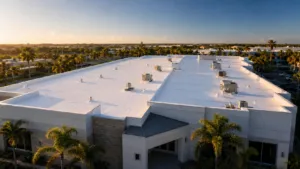


A commercial roof maintenance program is a scheduled, documented relationship with a roofing contractor that keeps your roof working and keeps your manufacturer warranty valid. That second part trips up most owners. For most commercial roofing warranties, annual maintenance is mandatory. It is written into the warranty as a condition of coverage, and skipping it voids the protection you paid for. At CES Commercial Roofing, where we have installed 15 million square feet of commercial roofing across Florida and hold active certifications with 14+ manufacturers, reading and applying those warranty terms is part of the daily job.
So the first thing owners underestimate about a maintenance program is that it is not optional housekeeping. The second is how hard Florida’s climate works against a low-slope roof, and how a real program is built to catch that damage before it reaches the inside of the building. This guide covers what a genuine program includes, why it matters more here than almost anywhere, and how to judge one before you sign.
What a commercial roof maintenance program actually includes
A real program is a recurring service with clearly defined deliverables. A single annual visit on a Florida commercial roof typically covers:
- Power washing to remove biological growth, dirt, and contaminants that break down membranes
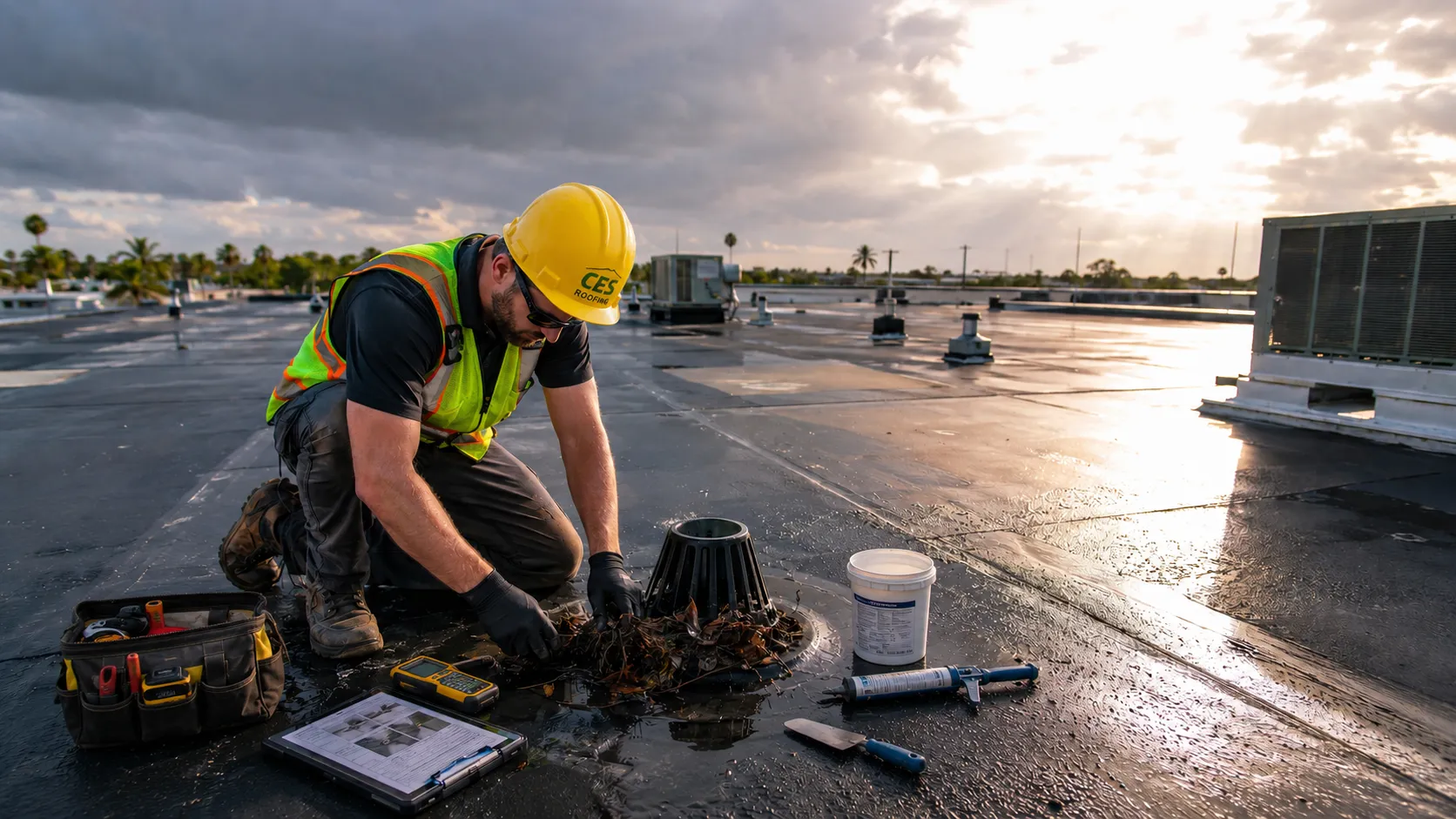
- Debris cleanup, including clearing drains, scuppers, and gutters so water can leave the roof
- Patching and repair of minor problem areas found during the visit
- A full on-site inspection with a written report and dated photographs of the roof’s condition
- A list of any larger repairs the roof needs, handled separately so you can plan and budget
- A maintenance certificate confirming your warranty obligations were met for the year
That certificate is the piece owners overlook and the piece that matters most. It is your proof that you held up your end of the warranty. Without it, a manufacturer can deny a future claim by pointing to a year with no documented maintenance.
Our standard maintenance visit is an on-site physical walkdown. When a roof cannot be safely reached on foot, we use drone access for the inspection. When we suspect moisture beneath the surface, thermal imaging can be brought in through a third-party vendor to confirm it. Drone and thermal scanning are tools we reach for when the situation calls for them. They do not replace a person walking the roof with hands on the flashings, seams, and penetrations.
Why annual maintenance is required to keep your warranty
The biggest misconception we correct is that maintenance is something an owner does to be responsible. For most commercial roofing warranties, it is something you have to do to keep coverage at all. The manufacturers wrote that requirement into the terms themselves.
Here is what three of the largest commercial roofing manufacturers actually require.
| Manufacturer | What the warranty requires | What can void coverage |
| GAF | Documented upkeep of the roof system | “Lack of roof maintenance” is listed as an absolute exclusion. Leaks from ponding water on systems without heat-welded seams are also excluded. |
| Carlisle SynTec | Professional inspections roughly every six months, with records, a visitor log, and photographs of the roof’s condition | Neglected debris, failure to maintain positive drainage, or any repair or modification made without prior written authorization |
| Johns Manville | A documented maintenance program and certified written notice of any leak within 30 days of discovery | Leaks or failures caused by neglect or lack of reasonable care |
You can read this in the manufacturers’ own documents. GAF, for one, names lack of maintenance as a coverage exclusion in its single-ply limited warranty.
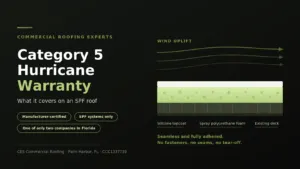
The same rule applies to the warranties we activate on our own installations. Annual maintenance keeps the Category 5 Hurricane Warranty on spray polyurethane foam (SPF) systems active, along with the Manufacturer Lifetime Renewable Leak-Proof Warranty and most system warranties. The Category 5 Hurricane Warranty applies to SPF systems specifically, and CES Commercial Roofing is one of only two companies in Florida authorized to offer it.
It helps to understand the difference between a material warranty and a system warranty. A material warranty covers only defects in the roofing materials. A system warranty covers the whole installed assembly, labor and materials together, and is only available when the roof is installed by a contractor actively certified with the manufacturer. That certification is also what lets a contractor read the maintenance terms correctly and document compliance the way the manufacturer expects.
How Florida’s climate attacks a commercial roof
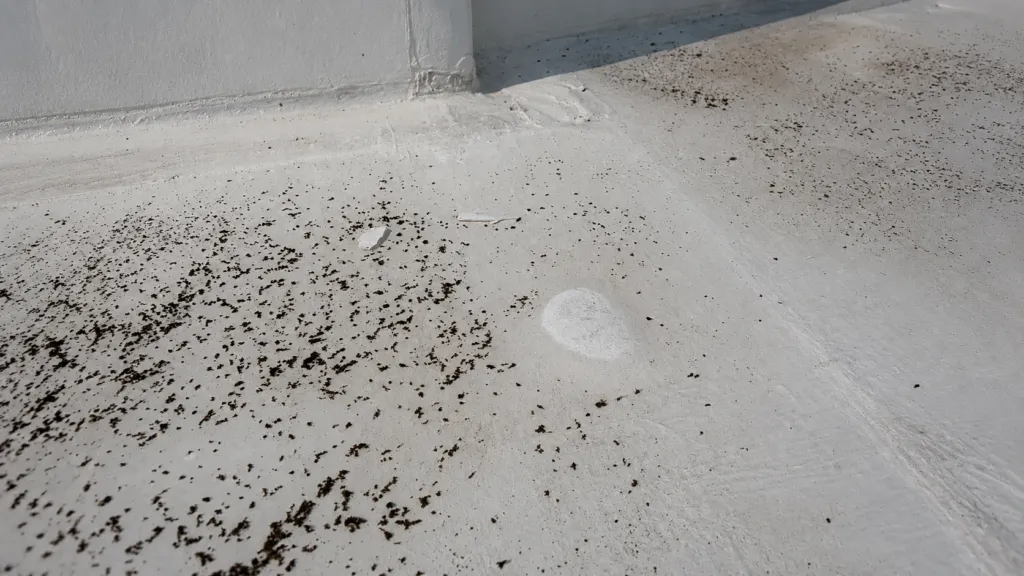
Florida puts a low-slope commercial roof under stress most of the country never sees. A program built for this market is designed to catch the specific failures the climate produces. Three mechanisms do most of the damage.
UV exposure and thermal shock
Constant high-intensity sun drives photo-oxidative degradation in roofing membranes. On single-ply systems like thermoplastic polyolefin (TPO), ultraviolet light breaks down the polymer chains and depletes the stabilizers, which shows up as surface chalking, micro-cracking, and a loss of flexibility. On modified bitumen, the same exposure oxidizes the asphaltic binders and causes the surface cracking known as alligatoring, along with granule loss.
Thermal shock speeds all of it up. A flat roof can sit at a high surface temperature on a summer afternoon, then drop sharply within minutes when an afternoon storm rolls in. Metal flashing, steel decking, and membrane each expand and contract at different rates, so that rapid swing concentrates stress at seams, flashing joints, and adhesive interfaces. That is exactly where splitting and separation begin.
Ponding water
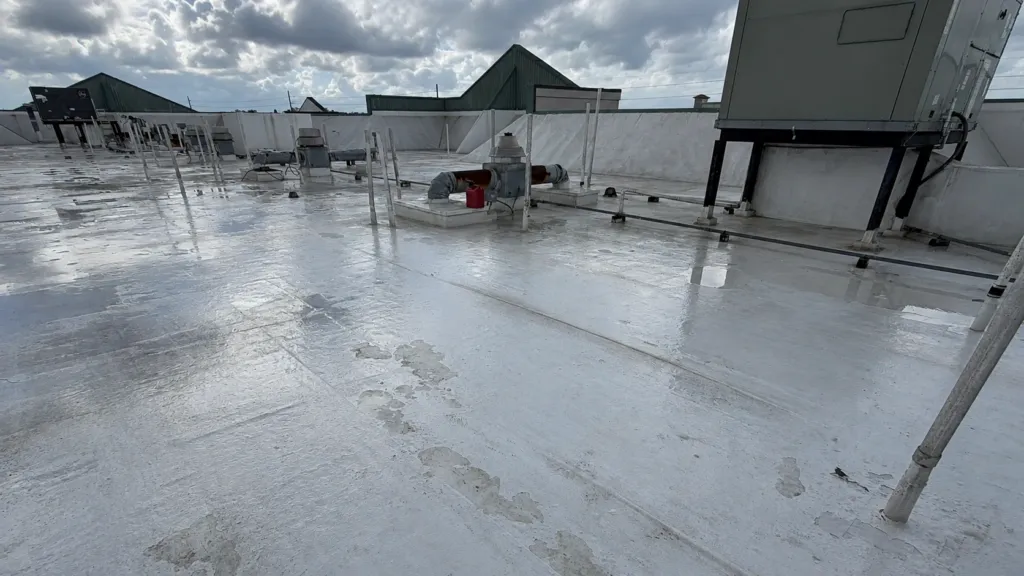
Low-slope roofs are built to drain. Industry authorities define ponding as water that stays on the surface more than 48 hours after rain. When drains clog or the deck deflects, water pools, and a pool of water is heavy. The added load can deflect the deck further, creating a low spot that collects even more water. Over time, standing water breaks down lap sealants and seam adhesives, and once moisture reaches the insulation below, it lowers the roof’s thermal performance and starts corroding the steel deck from underneath. Keeping drains clear is one of the simplest, highest-value things a maintenance visit does.
Wind uplift
In high winds, air separates at the roof’s edges and corners and creates suction directly above the membrane. If edge flashings or seams are already loose from deferred maintenance, wind gets underneath and peels the membrane back, unzipping mechanically attached seams or tearing adhered systems off the substrate. Most wind failures start at the perimeter, which is why a thorough inspection works corner to corner around every edge before walking the field of the roof.
The national standard for catching these problems is twice-a-year inspection. The National Roofing Contractors Association recommends comprehensive inspections at least twice per year, ideally in spring and fall, plus one after any severe weather event. FEMA’s low-slope roof guidance backs the same biannual cadence and adds practical wind-mitigation steps, like securing rooftop HVAC access panels so they do not become flying debris in a storm.
The cost case for proactive maintenance vs. reactive repair
A 15-year study by Firestone Building Products and ProLogis tracked maintenance and repair costs across millions of square feet of active commercial low-slope roofs and found a steady gap between roofs maintained on a schedule and roofs repaired only after a leak showed up.
| Factor | Proactive maintenance | Reactive (run-to-failure) |
| Average annual roofing cost | Lower and predictable | About 44% higher |
| Average service life before replacement | Around 21 years | Around 13 years |
| Cost of a typical repair | Planned rate | Three to five times higher |
| Capital timing | Spread out and budgeted | Large, unplanned tear-off |
Two things drive the reactive penalty. First, emergency repairs carry after-hours labor rates, water extraction, and the cost of fixing damaged interior finishes, inventory, or equipment, none of which a planned visit involves. Second, a neglected roof reaches the end of its life years earlier, which pulls a major capital expense forward. A roof that could have served past the two-decade mark gets torn off and replaced almost a decade sooner.
Roof lifespan is never a single fixed number. How long a commercial roof lasts depends on the material, the quality of the original installation, how much sun and salt air it takes, and whether it is maintained. Maintenance is the one variable an owner controls after the roof goes on, and it has an outsized effect on the rest.
Maintenance and your insurance position in Florida
In Florida’s commercial property insurance market, a documented maintenance history has become one of the most valuable files an owner can keep. Carriers have tightened underwriting and now enforce maintenance and wear-and-tear exclusions hard.
When a carrier reviews a wind or storm claim, the adjuster looks for signs of slow, pre-existing deterioration: cracked sealant, lifting flashing, deteriorated coping seams, unresolved ponding. If those are present, the carrier can argue the damage came from neglect rather than the storm and deny the claim. A continuous record of professional inspections, dated photos of clear drains, and invoices for completed repairs is what counters that argument. It is documented proof of the roof’s condition on the day before the storm.
Florida law has made that documentation more important. Senate Bill 2A, signed in December 2022, prohibited post-loss assignment of benefits for property insurance policies issued on or after January 1, 2023, so owners now manage and document their own claims directly instead of signing the process over to a contractor. Florida’s roof-age rules also give carriers more latitude once a roof passes 15 years of age, including the ability to require a certified inspection before issuing or renewing a policy. A roof with a clean maintenance file walks into that inspection in a much stronger position.
This is one of the clearest reasons the program matters across our Florida service area, from Tampa up the I-4 corridor to Orlando, where commercial owners face the same storm exposure and the same underwriting scrutiny.
How taxes treat maintenance and replacement differently
Routine maintenance and a major roof project are usually treated differently for tax purposes. Costs that keep a building in ordinary operating condition, like clearing debris, sealing seams, and patching localized areas, are often deductible in the year they are incurred under the IRS tangible property regulations, while a full replacement is typically capitalized and depreciated over many years. A scheduled annual maintenance program tends to fit the routine-maintenance category cleanly.
One clarification, since some contractors blur it: Section 179 relates to coating restorations, not routine maintenance. They are separate things. Tax outcomes depend on your specific situation, so confirm any treatment with your tax advisor before relying on it.
How to evaluate a maintenance program before you sign
Most maintenance programs read about the same on a contractor’s website. The differences show up in what the program delivers and what it produces on paper. Before you commit, ask:
- Does each visit produce a written report with dated photos? Without documentation, the program cannot protect your warranty or your insurance position.
- Do you receive a maintenance certificate confirming warranty compliance? This is the deliverable a manufacturer will ask for later.
- Is the contractor actively certified with your roof’s manufacturer? Certification is what lets them read the warranty terms correctly and keep a system warranty intact.
- Is pricing predictable? A flat fee per square foot based on roof size makes annual maintenance easy to budget and easy to compare.
- Is the contractor commercial-only? Commercial low-slope roofs behave differently from residential roofs, and the warranty and insurance stakes are higher.
- How fast do they respond when something goes wrong? Priority response for program clients is the difference between a small repair and an interior flood.
A free, no-obligation roof evaluation is the right place to start. It sets a baseline for the roof’s current condition and tells you whether a program makes sense for the building or whether the roof is already past the point where maintenance is the right move. You can request one through our free commercial roof inspection service.
How the Commercial Roof Concierge model works
A maintenance program does the most good as part of managing the roof across its whole life. That is the idea behind our Commercial Roof Concierge model. CES Commercial Roofing acts as a single point of contact for everything roof-related on a property: annual maintenance scheduling and execution, ongoing condition monitoring, warranty documentation, priority repair response, and planning for eventual restoration or replacement based on what the roof actually needs.
That last point is where maintenance earns its keep over time. Because we are on the roof every year and tracking how it changes, we can tell you when a roof is genuinely nearing the end of its service life and what your options are. Often an aging metal or single-ply roof can be restored with a foam-and-coating or silicone system at roughly one-third the cost of a full replacement, with a fresh warranty attached. Catching that window depends on knowing the roof’s condition, which is exactly what a maintenance program produces. When restoration becomes the smart move, our commercial roof restoration service is the next step, and our commercial roof maintenance and repair team handles everything in between.
For owners managing Florida property from out of state, the single point of contact is the practical payoff. One partner schedules the work, keeps the documentation, watches the roof, and tells you when something needs your attention, so the roof stays off your plate until it genuinely needs you.
Frequently asked questions
Is annual roof maintenance really required to keep a commercial warranty valid?
Yes, for most commercial roofing warranties. Manufacturers like GAF, Carlisle SynTec, and Johns Manville write maintenance and documentation requirements directly into their terms, and lack of maintenance is a listed exclusion. Skip it and you can void coverage you already paid for.
How often should a Florida commercial roof be inspected?
National guidance from the NRCA and FEMA is at least twice a year, ideally spring and fall, plus an inspection after any severe weather event. Florida’s storm season makes the post-event inspection especially important.
How is a commercial roof maintenance program priced?
A common and transparent model is a flat fee per square foot based on the size of the roof, which keeps the cost predictable and easy to build into an annual budget.
What does a maintenance visit include?
A typical visit covers power washing, debris and drain cleanup, patching of minor problem areas, and a full on-site inspection with a written report and photos. Afterward, you receive a maintenance certificate confirming your warranty obligations were met for the year.
Keep your roof, and your warranty, in good standing
A commercial roof maintenance program protects three things at once: the roof itself, the warranty behind it, and the insurance claim you may someday need to file. In Florida, where the climate is hard on roofs and carriers scrutinize every claim, all three matter.
If you want a clear picture of your roof’s condition and whether a maintenance program is the right call for your property, we offer a free, no-obligation roof evaluation. Call CES Commercial Roofing at (813) 419-1918 to schedule yours.