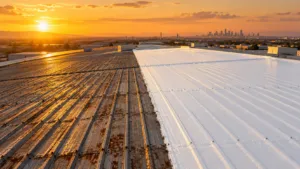


Yes, you can spray foam over a commercial metal roof, and it is an effective way to stop leaks on an aging metal roof without tearing it off. It works when the metal panels and the structure under them are still sound. It also comes with ongoing work: the foam needs regular inspections and a fresh top coat every so often to keep protecting the building.
CES Commercial Roofing started out as a spray foam and coating company. Metal is the roof surface we find best suited to this kind of restoration, and we do a lot of foam work on warehouses and industrial buildings, where metal roofs are common. Across Florida, we have installed more than 15 million square feet of commercial roofing.
What Does Spraying Foam Over a Metal Roof Involve?
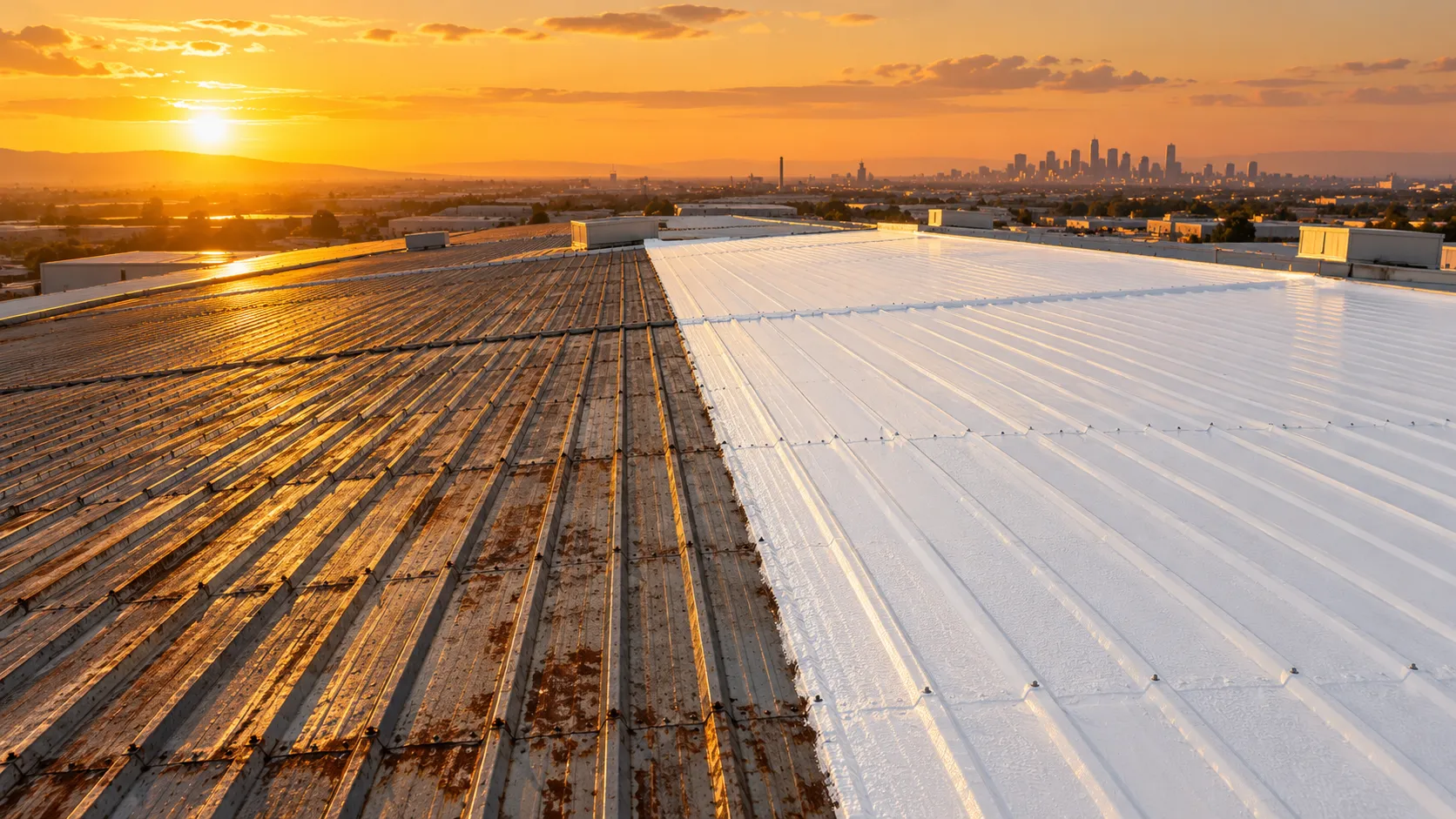
Spray polyurethane foam, or SPF, is a liquid that is sprayed onto the roof and expands into a rigid foam within seconds. On a metal roof, it fills the ribs, covers every fastener and seam, and hardens into one continuous layer with no joints. Our guide to SPF roofing explains how the system works in general. The foam is then covered with a protective coating, because foam breaks down when it is left in sunlight.
A foam-over-metal project follows the same basic order every time:
- Roof evaluation. We check the fasteners, seams, rust, and drainage, and we scan for trapped moisture with thermal imaging when we suspect water under the surface.
- Cleaning. The metal is power washed to remove dirt, oil, and loose rust, because foam only bonds well to a clean, dry surface.
- Rust treatment and primer. Rusted areas are treated and primed so the corrosion stops spreading under the foam.
- Fastener and seam repairs. Loose fasteners are tightened or replaced, missing ones are added, and open laps between panels are fastened together.
- Panel replacement. Any metal that is too corroded to save is cut out and replaced.
- Foam. The foam is sprayed to the thickness the project calls for. Spraying it thicker in low spots also improves drainage.
- Primer and top coat. A protective primer goes over the foam, followed by a white silicone top coat that shields the foam from the sun and reflects heat.
Coated foam adds very little weight to a roof, and we still look at the structure as part of the evaluation. Spray foam is also sold as insulation for the underside of metal buildings, which is a different product use. Everything here is about foam sprayed on top of the roof as the roofing system.
Why Does Fastener and Seam Condition Matter?
The condition of the fasteners and seams decides how well the foam holds on in high wind. Foam bonds very tightly to metal. In a storm, the weak point is usually the connection between the metal panels and the building. When foam goes over an existing roof, its resistance to wind uplift depends on how securely that existing roof is attached. If the screws holding the panels are loose, the foam is only as secure as those screws.
That is why the fastener and seam work comes before any foam goes on. Standard practice for preparing a metal roof for restoration is to check every fastener, tighten the loose ones, and replace stripped or backed-out fasteners with larger ones and new washers. Missing fasteners are replaced. Panel laps with gaps wider than 1/8 inch are fastened together. Leaks on aging metal roofs often start at the fasteners, so this step also removes the most common source of the leaks you have now.
Skipping or rushing this prep is a common reason metal roof restorations fail. Foam sprayed over dirty, oily, or loose rusty metal does not bond well, and a weak bond gives water a way underneath.
How Much Rust Is Too Much for Spray Foam?
Surface rust is normal on an aging metal roof, and it is not a reason to rule out foam. Surface rust is cleaned, treated, and primed. Rust needs moisture to keep spreading, and the foam and coating keep water off the metal.
What rules foam out is rust that has weakened the metal itself. Rust that has eaten holes through the panels, or thinned them to the point that they flex or tear, has to be dealt with before foam goes on. Those panels are cut out and replaced with new metal. Replacing a handful of bad panels is a normal part of the job. If a large part of the roof is in that condition, we will tell you that the roof is a better candidate for reskinning or replacement.
Location affects how fast rust damages a metal roof. On buildings near the coast, like many of the properties we work on around Tampa, salt air, humidity, and wind-driven moisture can speed up corrosion. How long a metal roof actually lasts depends on the metal type, the coating system, the quality of the installation, how close the building is to salt water, and how well the roof has been maintained.
When Is a Metal Roof Too Far Gone for Foam?
A metal roof is too far gone for foam when the metal can no longer serve as a solid base, or when Florida’s building code requires a tear-off. These are the conditions that rule foam out:
- Rust has perforated or weakened a large part of the panels.
- The panels, or the framing they are attached to, are loose or failing, so the roof cannot hold the foam securely.
- The roof system is water soaked or has deteriorated to the point that it is not adequate as a base. Florida’s building code requires removing the existing roof covering in that case.
- The roof already has two or more roof coverings on it, which also requires a tear-off under the code.
Moisture is the condition you can’t always see from the roof. Many metal buildings have insulation under the panels, and water that gets past the metal can soak that insulation without any sign on the surface. We use thermal imaging during the evaluation to find trapped moisture before we recommend foam.
Standing seam roofs need a closer look. Their panels are held down with clips that let the metal slide as it heats and cools, and foam bonded over the top can restrict that movement. We evaluate standing seam roofs one at a time. Through-fastened panels, like R-panel, are a more straightforward fit, because their exposed screws and laps are exactly what the foam is there to seal.
When a roof is past saving, we say so. When a metal roof does need to be replaced, we replace it with a new commercial metal roof.
How Does a Metal Roof Perform Once the Foam Is On?
Once the foam is on, the roof becomes one continuous surface. The fasteners, seams, and laps that used to leak are buried under the foam, so there are no joints left for water to get through. Small punctures from hail or flying debris usually do not cause a leak, and they can often be repaired with a compatible sealant.
The building also stays cooler. A single sheet of metal adds almost no insulation, so a bare metal roof passes the sun’s heat straight into the building. Roofing foam adds about R-5.5 to R-6.5 of insulation for every inch of thickness, and the white silicone top coat reflects much of the sun’s heat before it reaches the foam. For a warehouse or retail building in Florida, that means the space under the roof takes on less heat, and the air conditioning has less work to do.
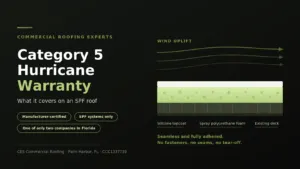
Foam also holds up well in high wind, because it bonds directly to the metal and has no seams for the wind to catch. CES Commercial Roofing is one of only two companies in Florida authorized to offer a manufacturer-certified Category 5 Hurricane Warranty. It applies to SPF systems only, and it is rated for Category 5 wind speeds. The warranty covers the foam staying bonded to the metal. It does not cover the building itself, so it is voided if the metal panels detach from the structure. It is also voided if annual maintenance is not performed.
What Maintenance and Recoating Does a Foam Roof Require?
Foam over metal comes with a maintenance obligation, and you should plan for it before you choose it. Industry guidance calls for inspecting a foam roof twice a year, and again after severe storms. The inspection looks for worn coating, exposed or damaged foam, and damage around rooftop equipment.
The top coat also wears thinner over time. It generally needs to be reapplied every 10 to 20 years, depending on the type of coating and how thick it was applied. If the coating wears through and the foam is left exposed, the sun starts breaking the foam down. Recoating on schedule keeps that from happening.
In Florida, the building code allows a new protective coating over an existing foam roof without a tear-off. That means a foam roof can be renewed each time the coating wears down.
Annual maintenance is also a condition of the warranties. The Category 5 Hurricane Warranty, the Manufacturer Lifetime Renewable Leak-Proof Warranty, and most system warranties are voided if annual maintenance is not done. Our annual maintenance visits include power washing, clearing debris, patching, and a full inspection with photos and a written report. After each visit, you receive a certificate showing that the warranty is still valid.
With that care, a foam roof over metal can last 20 to 30 years or more. The actual number depends on the materials used, the quality of the installation, the local climate, and how consistently the roof is maintained and recoated.
Foam Over Metal vs. Reskinning vs. Full Replacement
Foam over metal is usually the least expensive and least disruptive of the three options. It is also the only one that adds a recoat cycle. Reskinning means replacing the old metal panels with new ones while keeping the building’s existing frame. Full replacement means tearing the roof off down to the structure, repairing what is underneath, and installing a new metal roof.
| Foam over metal | Reskinning | Full replacement | |
|---|---|---|---|
| What happens | Foam and coating sprayed over the repaired existing panels | Old panels removed and new metal panels installed on the existing frame | Roof removed down to the structure, repairs made, new metal roof installed |
| Relative cost | Lowest of the three | Higher, because it adds new panels, trim, and removal of the old metal | Highest, because it adds full tear-off, disposal, and any structural or insulation repairs |
| Tear-off | None | Old panels removed | Full tear-off |
| Business disruption | Work is done from above while the building stays in use; parked cars, walls, and windows are masked against overspray | Sections of the roof are open while panels are swapped | The roof is open the longest, and interior spaces may need protection or rearranging |
| Insulation added | About R-5.5 to R-6.5 per inch of foam | Only if new insulation is installed with the panels | Only if new insulation is included in the project |
| Ongoing obligation | Twice-yearly inspections, annual maintenance, recoat every 10 to 20 years | Routine metal roof maintenance | Routine metal roof maintenance |
The cost difference can be large. On one metal roof project, the foam and coating system cost the owner roughly one-third of what a full reskin would have cost.
Foam also keeps the building running. The work happens on top of the roof, so the business underneath can stay open. Spray foam can’t be applied to a wet surface, so rain affects the schedule, and we plan the work around it. We completed a 45,000-square-foot foam and coated R-panel roof in Orlando during the rainy season.
Reskinning or full replacement is the better choice when the metal itself is failing, when the structure needs repair, or when you would rather not take on a recoat cycle. If you are weighing a new roof, our overview of metal roofing options covers the systems. And if your panels and fasteners are in good shape and you don’t need added insulation, a coating restoration without foam may be all the roof needs.
Get a Straight Answer on Your Metal Roof
If you have an aging metal roof and want to know whether foam is the right fix, we will come out and look at it. Our free roof evaluation covers the fasteners, seams, panels, and drainage, with a thermal scan when we suspect trapped moisture. We will tell you plainly whether your roof is a good candidate for foam, or whether reskinning or replacement makes more sense. Call CES Commercial Roofing at (813) 419-1918 to schedule your free inspection.