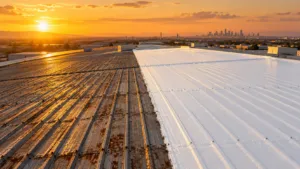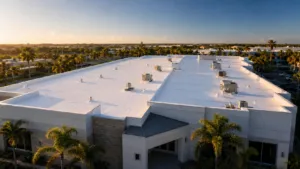


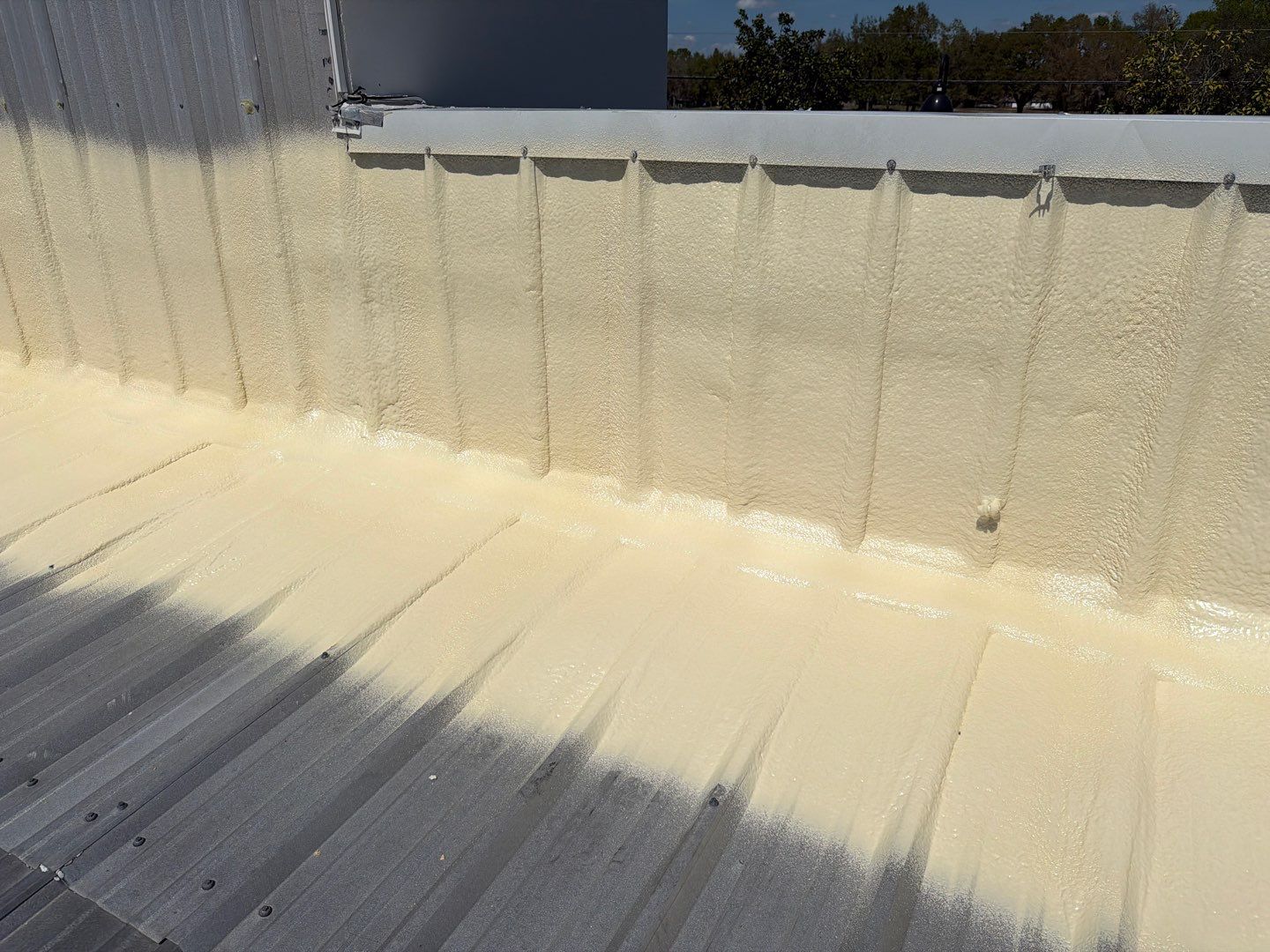
Spray polyurethane foam (SPF) roofing is a fluid-applied commercial roofing system that combines insulation, waterproofing, and wind resistance in a single seamless membrane. Independent testing by the Institute for Business & Home Safety (IBHS) has documented tensile adhesion strength of approximately 900 psf. That is roughly 7 to 15 times greater than conventional mechanically fastened systems. SPF can be applied directly over most existing roof substrates without tear-off, and the foam itself can last indefinitely with periodic recoating every 10 to 15 years.
At CES Commercial Roofing, SPF is our flagship system. We operate three dedicated SPF rigs across Florida and are one of only two companies in the state authorized to offer a manufacturer-certified Category 5 Hurricane Warranty on SPF installations. With over 15 million square feet of commercial roofing installed across Tampa, Orlando, and the rest of Florida, we have seen firsthand how SPF performs in one of the country’s most demanding climates.
This guide covers how SPF roofing works, what it costs, how it compares to other systems, and when it makes sense for a commercial building.
What Is Spray Polyurethane Foam Roofing?
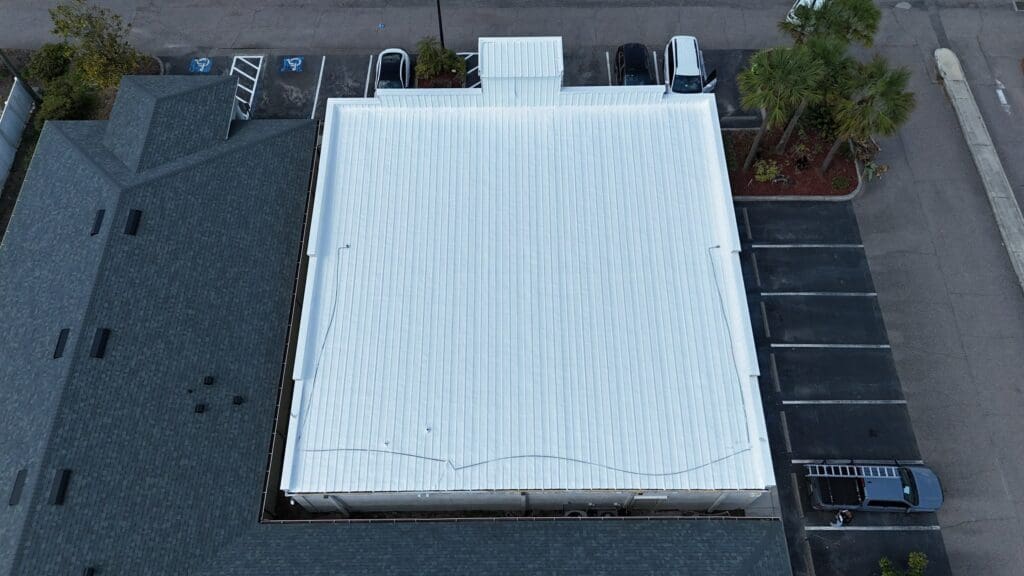
SPF roofing is created by mixing two liquid chemical components at high pressure: an isocyanate (Component A) and a polyol blend (Component B). When sprayed onto a roof substrate, the mixture expands approximately 20 to 30 times its liquid volume and cures within seconds into rigid, closed-cell polyurethane foam.
Roofing-grade closed-cell SPF has a density of 2.5 to 3.0 lb/ft³. Over 90% of cells are closed, trapping an insulating gas within the foam structure and creating a continuous thermal, air, and moisture barrier. This is different from open-cell SPF (0.4 to 0.8 lb/ft³), which absorbs water and is only appropriate for interior wall insulation.
The foam itself is not UV-tolerant. Left exposed to sunlight, unprotected SPF will begin to degrade within weeks. A protective elastomeric coating is applied over the cured foam to provide UV protection and weatherproofing. In Florida’s wet climate, silicone coatings are the preferred choice because of their resistance to ponding water. Acrylic coatings work better in dry climates like Arizona but are not ideal for Florida conditions.
The completed system creates a monolithic, fully adhered, seamless roofing membrane. There are no mechanical fasteners, no seams or laps, and no separate edge terminations. The foam self-flashes around all roof penetrations (HVAC curbs, vents, skylights, pipes, parapet walls), making every transition integral to the surface rather than a potential failure point.
How Is an SPF Roof Installed?
SPF installation follows a standardized sequence established by SPFA (Spray Polyurethane Foam Alliance) guidelines and manufacturer specifications:
- Roof inspection and moisture survey. Infrared thermography identifies wet insulation below the existing surface. Per Florida Building Code Section 706.1.1, if more than 25% of the roof area has moisture saturation, a full tear-off is required. SPF restoration is not an option at that point.
- Substrate preparation. Power washing, debris removal, and repair of damaged areas. The substrate must be clean, dry, and structurally sound.
- Environmental conditions check. Surface temperature must be above 50°F, ambient humidity below 85%, with no rain or dew and wind speed below 15 to 20 mph.
- Foam application. SPF is applied in multiple passes of approximately ½ to 1 inch per pass. Total thickness typically ranges from 1.0 to 2.0 inches for restoration over existing roofs, and 3+ inches for new construction.
- Protective primer. Applied within hours of foam application to shield the foam from UV while work continues.
- Elastomeric topcoat. Silicone coating applied in multiple coats to achieve the specified dry film thickness. Thickness determines warranty term: 20 mils minimum for a 10-year warranty, 30 mils for a 20-year warranty per typical manufacturer specifications.
- Quality control and warranty activation. Final inspection, core sampling for thickness verification, and manufacturer inspection for system warranty issuance.
One of the most significant practical advantages of SPF is that it can be applied directly over most existing roof substrates, including metal, modified bitumen, TPO, EPDM, and built-up roofing. This eliminates tear-off costs of $1.00 to $3.00 per square foot in demolition and disposal. On a 20,000-square-foot building, that is $20,000 to $60,000 in savings before the new system even goes on.
How Does SPF Compare to Other Commercial Roofing Systems?
The table below compares SPF against the most common commercial roofing systems on installed cost, lifespan, and insulation value.
| System | Installed Cost (per sq ft) | Typical Lifespan | Built-In Insulation | Tear-Off Required |
| SPF (spray polyurethane foam) | $5.00 to $13.00 | 20+ years (indefinite with recoat) | Yes (R-5.6 to R-7.0/inch) | No |
| TPO single-ply | $5.00 to $13.00 | 15 to 25 years | No | Yes |
| Modified bitumen (2-ply) | $9.00 to $14.00 | 20 to 25 years | No | Yes |
| Standing seam metal | $10.00 to $20.00+ | 40 to 60 years | No | Yes |
| EPDM (rubber) | $4.50 to $10.00 | 15 to 25 years | No | Yes |
| PVC single-ply | $6.00 to $12.00 | 20 to 30 years | No | Yes |
| Built-up roofing (BUR) | $7.00 to $14.00 | 15 to 20 years | No | Yes |
Note: Florida commercial roofing prices are higher than national averages due to hurricane-code compliance requirements, labor demand, and transportation costs.
SPF’s initial cost range is competitive with TPO, the most widely installed commercial roofing system. Where SPF pulls ahead is in lifecycle economics. Because SPF can be recoated rather than replaced, and because it eliminates tear-off entirely, total cost of ownership over 20 years runs approximately 20 to 30% lower than conventional systems.
How Does SPF Perform in Hurricanes?
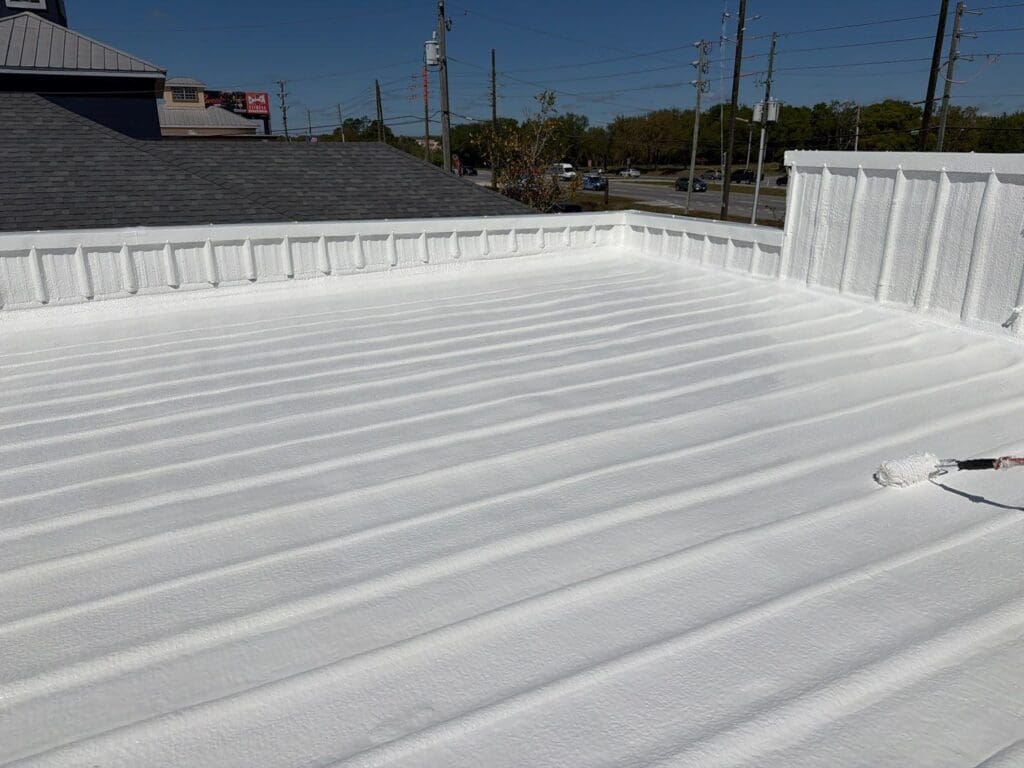
SPF has the highest documented wind uplift resistance of any commercial roofing system. IBHS testing measured tensile adhesion failure at approximately 900 psf, which is 7 to 15 times greater than mechanically fastened TPO or EPDM systems rated at 60 to 120 psf. That gap is not incremental. It is an order-of-magnitude difference.
How Strong Is SPF Against Wind Uplift?
| Roofing System | Typical Wind Uplift Resistance | Common Failure Mode |
| SPF (closed-cell) | ~900 psf (IBHS) | Substrate failure, not foam |
| Mechanically fastened TPO/EPDM | 60 to 120 psf (FM rated) | Perimeter peeling, fastener pull-out |
| Modified bitumen | Varies by attachment | Edge and flashing failure |
| Standing seam metal | High inherent strength | Fastener back-out, panel seams |
| Built-up roofing (BUR) | Moderate | Surface blow-off, flashing failure |
FM Global pull resistance testing on concrete substrates measured over 990 psf of uplift pressure. On metal deck assemblies, the failure mode was fastener back-out from the deck, not foam delamination. The foam outlasted the metal structure it was bonded to. In UL testing, SPF exceeded the capacity of the test equipment (which maxed out at 160 to 165 psf). The equipment failed before the foam did.
The reason for this performance is structural. Conventional roofing systems rely on mechanical fasteners or adhesive spots to hold the membrane to the deck. Wind finds the edges, seams, and fastener points and peels the membrane away. SPF has none of these. It is a continuous, monolithic layer chemically bonded to the substrate across its entire surface area. There are no edges to catch, no seams to separate, and no fasteners to pull out.
How Has SPF Performed in Real Hurricanes?
SPF’s lab results are backed by decades of post-storm documentation:
- Hurricane Andrew (1992, Category 5): Thomas L. Smith, former NRCA research director, inspected 11 SPF roofs in Dade County. Most sustained only minor missile damage while surrounding buildings suffered catastrophic losses. His assessment: “A missile will tear into or gouge out the foam, but the roof will not leak.”
- Hurricane Katrina (2005, Category 3 at landfall): NIST Technical Note 1476 documented that SPF systems, some approximately 20 years old, survived “extremely well.” It was the only roof type in the entire report to receive that characterization.
- Hurricane Dolly (2009, Category 2): On a single building, new metal panels installed in 2008 without SPF blew off, while 1980 metal panels with closed-cell SPF remained fully intact. Same gauge metal, similar fasteners. The only variable was the foam.
- Hurricane Michael (2018, Category 5): RICOWI investigation found 80% of surveyed mechanically attached single-ply roofs sustained perimeter damage and 70% incurred edge metal failures.
IBHS estimates that 70 to 90% of all catastrophe-related insurance claims include damage to the roof. SPF’s monolithic adhesion eliminates the primary failure modes that cause the vast majority of those losses: seam separation, fastener pull-out, and edge peeling.
What R-Value Does Spray Foam Roofing Provide?
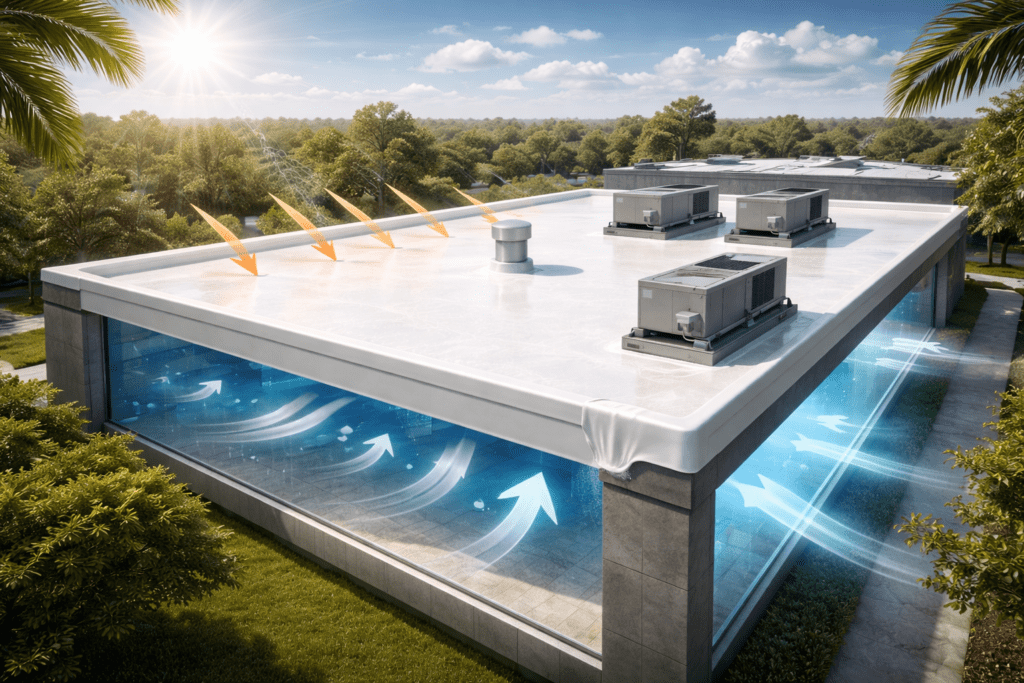
Closed-cell SPF provides R-5.6 to R-7.0 per inch, the highest R-value per inch of any commercially available roofing insulation. It also functions as a continuous air barrier, which matters because Oak Ridge National Laboratory (ORNL) research has documented that thermal bridging in conventional board insulation systems can reduce effective R-value by 10 to 25% compared to labeled values, due to fastener penetrations and gaps between boards.
| Insulation Type | R-Value Per Inch | Air Barrier | Key Limitation |
| Closed-cell SPF | R-5.6 to R-7.0 | Yes | Requires protective coating |
| Polyisocyanurate board | R-5.6 to R-6.5 | No | 10 to 15% thermal drift over time |
| Extruded polystyrene (XPS) | R-5.0 | No | Moderate thermal drift |
| Expanded polystyrene (EPS) | R-3.6 to R-4.2 | No | Lower R-value |
SPF eliminates thermal bridging entirely because it is spray-applied as a continuous layer with no mechanical fasteners. Combined with a white silicone topcoat (Solar Reflectance Index of 95 to 107, well above the ENERGY STAR minimum of 78), the system reduces cooling costs significantly.
The Florida Solar Energy Center (FSEC) at UCF studied nine occupied Florida buildings with reflective roof coatings and found an average A/C energy reduction of 19% (range: 2% to 43%) and an average peak electrical demand drop of 22%. For a typical 20,000-square-foot commercial building in Florida, industry data supports annual energy savings of $4,000 to $7,000 in cooling cost reductions. Simple payback period on energy savings alone: 4 to 9 years.
How Long Does an SPF Roof Last?
The SPF foam itself has an indefinite functional lifespan when properly maintained. The wear component is the protective topcoat, not the foam. Recoating every 10 to 15 years restores full waterproofing performance and restarts the warranty.
The oldest documented SPF roof installation is at Playhouse Square in Cleveland, Ohio, where foam installed in 1972 was still performing as of 2025. That is more than 53 years of continuous service.
Recoating economics are simple: recoat cost is approximately one-third of the original installation cost. Over a 50-year building lifecycle, an SPF roof with two recoats costs significantly less than two or three full conventional roof replacements. And because coatings applied over existing SPF are classified as maintenance under the Florida Building Code, they do not count as a new roofing system. That matters because buildings are typically limited to a maximum of two systems before a full tear-off is required.
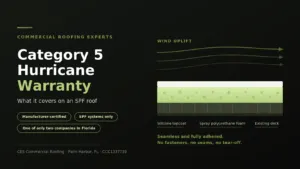
Standard manufacturer warranties are available in 10, 15, and 20-year terms, with warranty duration tied to topcoat dry film thickness. Select manufacturers offer Category 5 Hurricane Warranties covering sustained winds of 157+ mph, issued through authorized applicators. These warranties are transferable to new property owners.
What Maintenance Does an SPF Roof Require?
Annual roof maintenance is a mandatory condition of most SPF warranties. If maintenance is not performed, the warranty is voided. This is not a contractor policy. It is written into the warranty terms by the manufacturers themselves.
At CES Commercial Roofing, our annual maintenance visits include power washing, debris cleanup, patching of any areas that need attention, and a comprehensive inspection with photos documenting the roof’s condition. After each visit, the customer receives a certificate confirming their warranty remains valid.
Moisture resistance is another reason SPF maintenance is relatively straightforward. FEMA classifies closed-cell SPF as a Class 5 flood-damage resistant material (the highest classification), meaning it withstands direct floodwater contact for at least 72 hours without degradation. Per ASTM D2842, closed-cell SPF absorbs less than 2% moisture by volume when fully submerged. If a section of SPF is gouged by debris, water cannot travel through the foam body to other areas. Damage stays completely isolated.
How Much Does SPF Roofing Cost Over 20 Years?
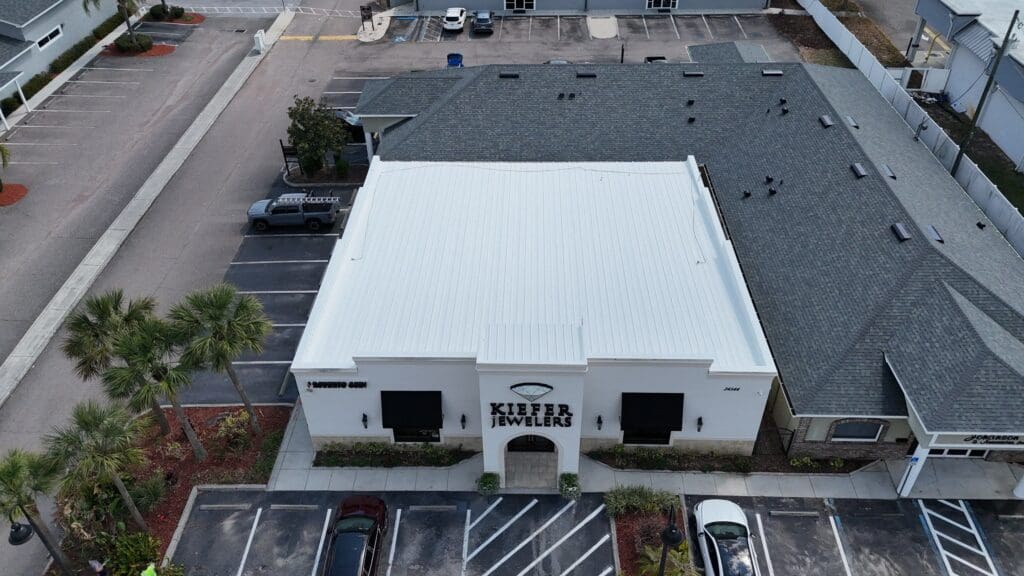
For a 20,000-square-foot commercial building in Florida, an SPF/silicone coating pathway costs an estimated $86,000 to $160,000 over 20 years, compared to $116,000 to $200,000 for a conventional TPO replacement. That is roughly 20 to 30% lower total cost of ownership. Here is how the numbers break down:
SPF/Silicone Coating Pathway:
- Initial installation: $70,000 to $140,000
- Recoat at year 12 to 15: $40,000 to $80,000
- Cumulative maintenance: $56,000 to $80,000
- Energy savings credit: ($80,000) to ($140,000)
- Estimated 20-year total: $86,000 to $160,000
TPO Replacement Pathway:
- Full replacement: $140,000 to $260,000
- Cumulative maintenance: $56,000 to $80,000
- Energy savings credit: ($80,000) to ($140,000)
- Estimated 20-year total: $116,000 to $200,000
A lifecycle study by Carl Cash and Simpson Gumpertz & Heger modeled a 10,000-square-foot commercial roof over 20 years and found that a conventional dark BUR roof ($56,800 upfront) cost $115,220 over 20 years because its 13.9-year average service life forced a mid-cycle renovation. A premium white reflective membrane ($57,800 upfront) totaled only $46,600 over 20 years. The study’s core finding: expected roof life is the dominant factor in lifecycle cost, not initial price. A roof that fails before 20 years can cost 2.5 times more over that period.
We completed an SPF restoration project where the foam and coating system cost $500,000 versus $1.2 million for a full metal reskin. That saved the property owner roughly $700,000 while still providing a full manufacturer warranty.
What Tax Benefits Apply to SPF Roofing?
SPF coating work is 100% tax-deductible in the year it is completed under IRC Section 162, with no dollar limit. Full roof replacements, by contrast, are typically depreciated over 39 years. This distinction can mean the difference between a $21,000 Year-1 tax savings and a $1,346 one on a $100,000 project.
Under the IRS Tangible Property Regulations (Treasury Decision 9636), roof coatings (including silicone over SPF) are classified as repairs when they maintain or restore existing roof performance without materially increasing capacity. The IRS regulations include a directly relevant example: replacing a worn roof membrane with a comparable new one is explicitly not a betterment or restoration. No election is required, and the deduction does not count against the Section 179 annual cap.
Full roof replacements are capital improvements under IRC Section 263(a). However, the Tax Cuts and Jobs Act of 2017 expanded Section 179 to include improvements to nonresidential real property, including roofs, allowing immediate expensing. The One Big Beautiful Bill Act of 2025 doubled the maximum:
| Tax Year | Maximum Section 179 Deduction | Phase-Out Begins |
| 2025 | $2,500,000 | $4,000,000 |
| 2026 | $2,560,000 | $4,090,000 |
Source: IRS Topic 704
Here is what this means in practice for a building owner:
| Scenario | Year-1 Tax Deduction | Year-1 Tax Savings (21% rate) |
| $100K coating (Section 162 repair) | $100,000 | $21,000 |
| $500K replacement (39-year depreciation) | ~$6,410 | $1,346 |
| $500K replacement (Section 179 election) | $500,000 | $105,000 |
The Section 162 repair deduction for coatings is particularly advantageous for building owners with multiple properties, because each project qualifies independently with no aggregate cap. Customers should consult their tax advisor for specific guidance on their situation.
What Are the Limitations of SPF Roofing?
SPF is not the right answer for every building. Here are the genuine limitations:
- UV sensitivity. Unprotected SPF degrades within weeks under direct sunlight. A protective coating is mandatory and adds cost to the system.
- Weather-dependent installation. Application requires dry conditions, surface temperatures above 50°F, and low wind. Florida’s frequent afternoon thunderstorms can limit the daily application window, particularly during rainy season (May through October).
- Limited qualified contractors. SPF requires specialized equipment, training, and certification. The contractor pool is significantly smaller than for TPO or modified bitumen. This makes choosing the right contractor especially important.
- Installation odor. MDI (methylene diphenyl diisocyanate) vapors during spraying require respiratory protection for the crew, and building occupants may need to vacate the immediate area during application.
- Not recyclable. SPF is a thermoset material that cannot be melted or reformed. When it must eventually be removed, it goes to a landfill. By contrast, TPO can be recycled through some manufacturer take-back programs.
- Bird and hail vulnerability. Woodpeckers can peck into thinly coated SPF, and large hail can gouge the surface. However, the closed-cell structure prevents water migration from impact points, so damage stays isolated.
These limitations are real but manageable. The weather dependency means scheduling matters (we recommend the drier months of November through April when possible). The contractor qualification issue reinforces why manufacturer certification matters for any SPF project.
Is SPF Roofing Right for Your Commercial Building?
SPF is strongest in these situations:
- You want to avoid a full tear-off. If your existing roof is structurally sound but aging, SPF can go directly over it, saving $1 to $3 per square foot in demolition costs alone.
- Hurricane resistance is a priority. For commercial buildings in coastal or hurricane-prone areas, SPF’s ~900 psf wind uplift resistance is in a category by itself. No other system comes close.
- You want maximum energy savings. The combination of high R-value insulation, continuous air barrier, and reflective topcoat delivers 30 to 40% cooling cost reductions. In Florida’s cooling-dominated climate, that adds up.
- You have a metal roof. Metal roofs are ideal candidates for SPF restoration. The foam and coating system can restore and protect the existing structure at a fraction of the cost of a full reskin.
- Tax timing matters. If you need to deduct the full project cost in the current tax year, SPF coating work qualifies as a repair under Section 162, giving you 100% same-year deductibility.
SPF may not be the best fit if your building requires work during Florida’s rainy season with no scheduling flexibility, if the existing roof has more than 25% moisture saturation (which triggers a mandatory tear-off under Florida Building Code), or if budget constraints make a lower-cost system like TPO the more practical choice for a full replacement.
Get a Free SPF Roof Evaluation
If you own or manage a commercial building in Florida and want to know whether SPF makes sense for your roof, we can help you find out. CES Commercial Roofing offers free, no-obligation roof evaluations that include on-site inspection, drone assessment, and thermal imaging when conditions warrant it. We will give you a clear picture of your roof’s current condition, your options, and what each one costs.
Call us at (813) 419-1918 to schedule your evaluation.