

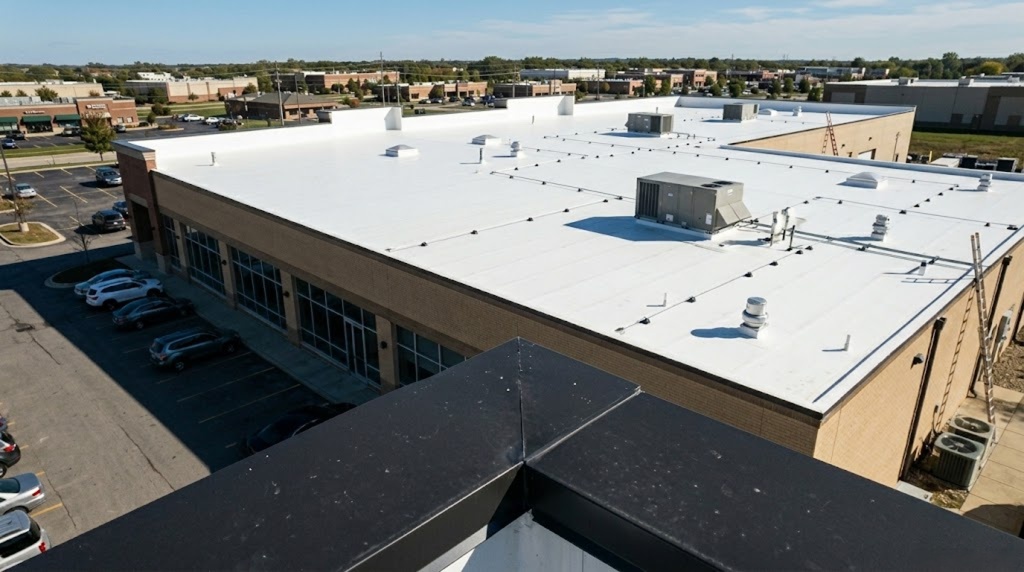
Yes. Commercial roof replacements are tax deductible in 2026, and the deduction limits are the highest they have ever been. The One Big Beautiful Bill Act (OBBBA), signed into law on July 4, 2025, more than doubled the Section 179 expensing limit to $2,500,000 (adjusted for inflation to $2,560,000 for 2026). That means most commercial building owners can deduct the full cost of a roof replacement in a single tax year rather than depreciating it over 39 years.
At CES Commercial Roofing, we have installed over 15 million square feet of commercial roofing across Florida, and Section 179 is one of the most common topics our clients in Tampa, Orlando, Sarasota and throughout the state ask about when planning a roof replacement or restoration. Below, we break down the three deduction methods, the IRS requirements, and a critical energy-efficiency deadline that expires mid-2026. Tax law is complex, so consult a qualified tax advisor to confirm how these deductions apply to your specific situation.
Three Ways to Deduct a Commercial Roof in 2026
Commercial building owners have three primary methods for deducting roof expenses. The best option depends on the project scope, total cost, and your business’s tax situation.
Section 179 immediate expensing is the most powerful option. Under IRC §179(f), the Tax Cuts and Jobs Act of 2017 added roofs to the list of qualifying improvements to nonresidential real property. The IRS confirms this directly: qualified real property includes improvements to roofs, HVAC, fire alarm systems, and security systems on nonresidential buildings. For 2026, you can expense up to $2,560,000 of qualifying property, with the deduction phasing out dollar-for-dollar once total qualifying property placed in service exceeds $4,090,000.
MACRS depreciation over 39 years is the default method when Section 179 is unavailable or when the roof cost exceeds the deduction limit. Under the Modified Accelerated Cost Recovery System, a commercial roof replacement is classified as nonresidential real property and depreciated using the straight-line method over 39 years. A $300,000 roof, for example, would yield approximately $7,692 per year in depreciation deductions.
Repair expense deductions apply when work qualifies as maintenance rather than a capital improvement. Under IRC §162(a), ordinary and necessary business expenses, including roof repairs, are fully deductible in the year incurred with no capitalization requirement or dollar limit.
Here is how the three methods compare:
| Method | 2026 Deduction | Recovery Period | Taxable Income Limit | Roof Type Eligible |
| Section 179 | Up to $2,560,000 in Year 1 | Immediate | Yes, cannot exceed active business income | Capital improvements to nonresidential buildings |
| MACRS Depreciation | ~2.56% of cost per year | 39 years (straight-line) | No | All commercial roof replacements |
| Repair Deduction | 100% in Year 1 | Immediate | No | Repairs only (not replacements) |
For most commercial roof projects, Section 179 is the clear winner. A building owner replacing a $400,000 roof can potentially deduct the entire cost in 2026 instead of spreading $10,256 per year across nearly four decades.
How Section 179 Works for Commercial Roofing
Section 179 was not always available for commercial roofs. Before the TCJA, building owners had no choice but to depreciate a new roof over 39 years. The TCJA changed this by adding four specific improvement categories to IRC §179(f): roofs, HVAC property, fire protection and alarm systems, and security systems. The OBBBA then more than doubled the dollar limits, creating the most generous expensing environment for commercial roofing in tax history.
| Tax Year | Maximum Deduction | Phase-Out Threshold | Legislation |
| 2017 (pre-TCJA) | $510,000 | $2,030,000 | Pre-TCJA baseline |
| 2018 (TCJA enacted) | $1,000,000 | $2,500,000 | Tax Cuts and Jobs Act |
| 2024 | $1,220,000 | $3,050,000 | TCJA + inflation adjustments |
| 2025 (OBBBA enacted) | $2,500,000 | $4,000,000 | One Big Beautiful Bill Act |
| 2026 | $2,560,000 | $4,090,000 | OBBBA + inflation adjustment |
The jump from $1,220,000 in 2024 to $2,560,000 in 2026 means that a much wider range of commercial roof projects can now be fully expensed in Year 1.
Requirements to Qualify
Several conditions must be met for a commercial roof to qualify for Section 179:
- The building must be nonresidential real property. Residential rental properties (those deriving 80% or more of gross rental income from dwelling units) do not qualify.
- The improvement must be placed in service after the building was first placed in service. A roof on a brand-new building being occupied for the first time does not qualify.
- Business use must exceed 50%. If business use drops to 50% or below during the recovery period, a portion of the deduction must be recaptured as ordinary income.
- The deduction cannot exceed taxable income from active trades or businesses. It cannot create or increase a net operating loss. Unused amounts, however, carry forward indefinitely.
- Trusts and estates cannot claim Section 179.
The election is made on IRS Form 4562, which specifically lists “roof” as an example property description.
Does Bonus Depreciation Apply to Commercial Roofs?
This is a common source of confusion. The OBBBA permanently restored 100% bonus depreciation for qualified property acquired and placed in service after January 19, 2025. However, bonus depreciation generally does not apply to commercial roof replacements.
Under IRC §168(k), bonus depreciation applies only to property with a MACRS recovery period of 20 years or less. A commercial roof replacement is classified as 39-year nonresidential real property, which exceeds this threshold. As Grant Thornton noted, Section 179 remains particularly useful for property types not eligible for bonus depreciation, such as certain improvements to nonresidential real property like roofs, HVAC systems, and security systems.
There is one workaround. A cost segregation study performed by a qualified engineer can identify specific roof-related components, such as rooftop HVAC units, specialized drainage systems, or certain electrical work, that may be reclassified into shorter recovery periods (5, 7, or 15 years). Those reclassified components can then qualify for 100% bonus depreciation.
The OBBBA also created a new Section 168(n) allowing 100% expensing of nonresidential real property used in qualified production activities (manufacturing, refining) if construction begins after January 19, 2025 and the property is placed in service before January 1, 2031. If your commercial building is used for manufacturing or similar production, this may provide an additional path.
Roof Repair vs. Roof Replacement: Why the IRS Distinction Matters
Whether your roofing work is classified as a “repair” or a “replacement” determines how you can deduct it. A repair is fully deductible in Year 1 as an ordinary business expense under IRC §162(a). A replacement must be capitalized, though it can still be expensed immediately via Section 179.
The governing framework is Treasury Regulation §1.263(a)-3, which establishes the BAR test: an expenditure must be capitalized if it results in a Betterment, Adaptation to a new use, or Restoration of the unit of property.
For roofing, the restoration test is most often decisive, specifically the “major component or substantial structural part” standard.
The Treasury Regulations provide two illustrative examples that establish the boundary:
- Capitalized (replacement): A building owner replaces an entire roof including decking, insulation, asphalt, and coatings after discovering rot. The IRS says this must be capitalized because the entire roof performs a discrete and critical function and comprises a major component of the building structure.
- Deductible (repair): A building owner replaces only the worn membrane with a comparable membrane. The IRS says this is deductible because the membrane alone is not a significant portion of the roof or a substantial structural part of the building.
While the regulations avoid bright-line thresholds, the regulatory examples suggest that replacing less than approximately 30% of a major component generally avoids capitalization, while replacing two-thirds or more clearly triggers it.
This distinction is something we deal with regularly at CES. A silicone roof coating applied over an existing membrane, for example, may qualify as a repair or maintenance expense depending on the scope of work. A full tear-off and replacement of a TPO (thermoplastic polyolefin) or modified bitumen system will almost certainly be classified as a capital improvement. Both paths lead to deductions, but through different mechanisms.
Safe Harbors for Smaller Projects
Three IRS safe harbors can simplify the repair-vs-improvement analysis:
- De minimis safe harbor (Treas. Reg. §1.263(a)-1(f)): Allows businesses to immediately expense items costing $2,500 or less per invoice item ($5,000 for businesses with applicable financial statements).
- Safe harbor for small taxpayers (§1.263(a)-3(h)): Businesses with average annual gross receipts of $10 million or less can deduct all repair and improvement costs on buildings with an unadjusted basis of $1 million or less, provided annual spending does not exceed the lesser of $10,000 or 2% of the building’s basis.
- Routine maintenance safe harbor (§1.263(a)-3(i)): Covers recurring maintenance activities expected to be performed more than once within 10 years, including periodic inspections, sealant applications, and minor patching.
Regular roof inspections and preventive maintenance work typically fall under these safe harbors, making them immediately deductible without the repair-vs-improvement analysis.
Energy-Efficient Roofing Adds a Second Deduction Before June 2026
Section 179D offers an additional per-square-foot deduction for energy-efficient commercial building improvements, including cool roofs, reflective roofing systems, and insulation upgrades. For 2026, the inflation-adjusted rates range from $0.59 to $1.19 per square foot at the base level and from $2.97 to $5.94 per square foot for projects meeting prevailing wage and apprenticeship (PWA) requirements.
To put that in perspective: a 50,000-square-foot commercial building with a qualifying energy-efficient roof could generate an additional deduction of up to $297,000 at the enhanced rate. This is on top of the Section 179 deduction for the roof itself.
The building must achieve at least 25% savings in total annual energy and power costs compared to the applicable ASHRAE Standard 90.1 reference building. Certification by a licensed professional engineer or architect is required.
The critical deadline: The OBBBA terminated Section 179D for property whose construction begins after June 30, 2026. This makes Q1 and Q2 of 2026 the final window for building owners to initiate energy-efficient roofing projects that qualify.
| Energy Incentive | 2026 Benefit | Deadline | Key Requirement |
| Section 179D | $0.59 to $5.94/sq ft | Construction must begin by June 30, 2026 | 25% or greater energy savings vs. ASHRAE 90.1 |
| Solar ITC (§48E) | Up to 30% credit | Construction must begin by July 4, 2026 | Solar energy generation on commercial building |
| Domestic Content Bonus | +10% ITC adder | Same as §48E | 50% or greater U.S.-sourced manufactured components |
For Florida building owners in particular, reflective roof coatings and cool roof systems are a natural fit. Florida’s intense UV exposure and year-round heat mean energy-efficient coatings often produce measurable energy savings that can meet the ASHRAE threshold, while also extending the roof’s service life. Our clients in Tampa and Orlando frequently ask whether the Section 179 deduction and the 179D energy-efficiency deduction can be claimed in the same year. The answer is yes, they can be combined when both sets of requirements are met.
Frequently Asked Questions
Can I deduct a roof coating instead of a full replacement?
It depends on the scope of work. A coating applied over an existing membrane as part of routine maintenance may be deductible as a repair expense under IRC §162(a). A coating applied as part of a broader roof restoration that improves the roof’s condition may be classified as a capital improvement and deducted under Section 179. Your tax advisor can make the determination based on the specifics of the project.
What form do I use to claim Section 179?
IRS Form 4562 (Depreciation and Amortization). The form specifically lists “roof” as an example of a qualifying property. Attach it to your business tax return for the year the roof was placed in service.
Does the roof have to be installed by December 31 to qualify?
Yes, but the IRS term is “placed in service,” not “installed.” Placed in service means the roof is ready and available for its intended use, not just ordered or paid for. If installation is completed in December 2026, you claim it on your 2026 return.
Can I use Section 179 on a leased building?
In many cases, yes. If you are the tenant and you pay for a qualifying roof improvement on a nonresidential building you lease, the improvement may qualify for Section 179 as long as it meets the other requirements. Consult your tax advisor for guidance specific to your lease structure.
Does this apply to residential rental properties?
No. Section 179 for roofs applies only to nonresidential real property. Residential rental properties (where 80% or more of gross rental income comes from dwelling units) do not qualify. Residential landlords may want to look into MACRS depreciation and cost segregation studies instead.
Can the Section 179 deduction and Section 179D deduction be combined?
Yes. A qualifying roof replacement can be expensed under Section 179, and if the roof also meets the energy-efficiency requirements of Section 179D, you can claim the per-square-foot deduction on top of it. Work with your tax advisor to ensure both sets of requirements are met.
Plan Your Roof Project Around the 2026 Tax Calendar
The combination of expanded Section 179 limits, the permanent restoration of bonus depreciation, and the June 30, 2026, deadline for Section 179D energy incentives makes this a uniquely favorable year for commercial roof investment. But the window for the energy-efficiency deductions is closing.
If you own a commercial building in Florida and are considering a roof replacement, restoration, or energy-efficient upgrade, the first step is a professional roof evaluation to determine the scope of work and which deduction methods apply. CES Commercial Roofing provides free inspections for commercial properties across Tampa Bay, Orlando, and throughout Florida.
CALL (813) 419-1918
This article is for informational purposes only and does not constitute tax advice. Consult a qualified tax professional to determine how these deductions apply to your specific situation.