

Choosing the right commercial roofing contractor in Tampa Bay comes down to six verifiable factors: active Florida licensing, standalone workers’ compensation insurance, manufacturer certifications that match your roofing system, documented commercial experience, code compliance paperwork, and realistic lead times. Contractors who come up short on any of these expose building owners to uninsured workers, voided warranties, failed inspections, and insurance non-renewals. At CES Commercial Roofing, we’ve installed 15 million square feet of commercial roofing across Florida, and the single most reliable predictor of a bad roofing outcome is a property owner who skipped these verification steps before signing.
The 2026 Tampa Bay market is still absorbing the aftermath of Hurricane Helene and Hurricane Milton, so contractor availability, pricing, and quality control are all under pressure at once. The contractors who will still be standing behind your roof in 2031 tend to share a common profile. The ones who disappear after collecting a deposit share a different one. This guide explains how to tell them apart before you sign anything.
Why contractor selection in Tampa Bay is harder in 2026
Florida’s commercial roofing market has changed more in the last three years than in the previous twenty. Three shifts matter for Tampa Bay property owners.
First, the 2024 hurricane season left a multi-year backlog. Hurricane Milton alone drove more than $3 billion in Florida insured losses, and combined with Hurricane Helene, the 2024 storm season pushed total insured losses well past $4 billion, with roofing dominating the claim volume. Reputable contractors in the Tampa area still quote four to eight week lead times on non-emergency work because pulling permits, sourcing materials, and staging licensed crews takes time.
Second, the 8th Edition Florida Building Code took effect December 31, 2023, with changes to Chapter 15 governing roofing assemblies. Any contractor quoting commercial work today needs to know these changes cold. Building officials catch what contractors miss, and a failed final inspection can stall occupancy for weeks.
Third, SB 4-D, effective May 26, 2022, ended the old “25% rule” that forced a full replacement whenever repairs exceeded a quarter of any roof section in a twelve month window. Under Florida Statute 553.844(5), only the repaired portion of a roof built under the 2007 Florida Building Code or later must meet current code. This change favors properties with documented compliance history, and it rewards contractors who pull permits and keep records. It punishes owners who worked with unlicensed operators whose paper trail does not exist.
Verify Florida licensing before you review a single quote
Commercial roofing work in Florida requires a Certified Roofing Contractor license (CCC prefix). It’s issued by the Florida Department of Business and Professional Regulation and can be verified online in under a minute.
We recommend pulling the license number yourself rather than taking a printed copy at face value. Verify three things:
-
- The license is active and in the contractor’s legal business name, not an individual’s personal name from a prior business
-
- The license has no recent disciplinary actions
-
- The contractor holds the right class of license for your project scope
For reference, we hold an active Florida Certified Roofing Contractor license, CCC1337739, which covers the full commercial roofing scope statewide.
One more licensing question separates legitimate contractors from risky ones: who pulls the permit? A licensed contractor pulls permits under their own license, which creates the legal paper trail that SB 4-D and insurance carriers both rely on. Any contractor who asks the property owner to pull the permit is either unlicensed, trying to stay off the state’s radar, or both. Walk away.
Confirm standalone workers’ compensation insurance
This is the single most common insurance gap in Florida commercial roofing, and most property owners never think to check.
Many roofing contractors carry a certificate of insurance sourced through an employee leasing company. The certificate technically shows workers’ compensation coverage. But the policy may only cover a single office employee. The actual crews on your roof are often subcontractors or day labor with no coverage at all.
If an uninsured worker falls off your building, liability can attach to both the contractor and the property owner. We have seen this outcome settle in the high six figures on small projects. A certificate of insurance is meaningless unless the policy actually covers the people on the roof.
Ask for a certificate of insurance that names your business as a certificate holder, and specifically ask whether the policy covers every worker the contractor will bring onto your property, including any subs. We carry a standalone workers’ compensation policy that covers every person working on a commercial roof, which is a deliberate structural choice and a real cost the company absorbs to protect customers from this exposure.
Check manufacturer certifications that match your roofing system
Manufacturer certification is the only way to access a system warranty. Without it, you are limited to a material warranty, and those two coverages are not comparable.
| Coverage | Material Warranty | System Warranty |
|---|---|---|
| What it covers | Product defects only | Materials and installation workmanship |
| Who can provide it | Anyone who buys the product | Manufacturer-certified contractors only |
| Typical term | 10 to 20 years on materials | 10 to 30 years, including NDL options |
| Recourse if the roof leaks | Product replacement only | Full leak repair including labor |
| Transferable on sale | Usually no | Often yes |
When a contractor says “we offer a lifetime warranty,” the first question is always: lifetime on materials, or lifetime on the installed system, and from which manufacturer? If the answer is vague, assume it is a material warranty marketed as something bigger.
We hold active certifications with 14 or more roofing manufacturers, including GAF, Polyglass, Tropical Roofing Products, Henry, Carlisle, NCFI, Sherwin-Williams, Berridge, Elevate, Mule-Hide, Gaco, and Karnak. That certification breadth lets us offer manufacturer-backed system warranties across virtually every major commercial roofing product line, including our SPF and coating systems that carry the Manufacturer Lifetime Renewable Leak-Proof Warranty.
One caveat worth knowing: large institutional projects (schools, municipalities, universities) sometimes specify a particular manufacturer. If you have a specified manufacturer, ask any prospective contractor to show you their active certification letter from that specific manufacturer before issuing a PO.
Require commercial experience, not residential crossover
The biggest quality-control risk in the Florida commercial roofing market today is residential roofers marketing commercial capability. The logic is simple: residential roofers can buy buckets of silicone and roll it onto a flat roof. The result often looks acceptable on day one and fails within a few years.
Commercial roofing is a different discipline. Installation specs, detail work around penetrations and parapets, seam welding, substrate preparation, and manufacturer-required thickness tolerances all affect long-term performance. A residential crossover crew can get the square footage down but skip the steps that make the warranty valid.
Before signing, ask two questions:
-
- What percentage of your work over the last three years has been commercial?
-
- Can you show me three commercial projects you completed at least three years ago that I can drive by?
Drive-by references on three-year-old work reveal more than any brochure. Early failures show up in coating wear, ponding, edge lift, and flashing separation within that window.
We made a structural choice to remain 100% commercial-only, which is why we carry the Commercial Roofing Experts descriptor. No residential work competes for our crews or pulls our focus from the code, warranty, and inspection realities unique to commercial buildings.
Ask how they document Florida code compliance
Every commercial roofing assembly installed in Florida must carry either a Florida Product Approval (FL number) or, in the High-Velocity Hurricane Zone covering Miami-Dade and Broward counties, a Miami-Dade Notice of Acceptance (NOA). Both are searchable at FloridaBuilding.org.
A qualified commercial roofer can tell you, before they quote the project, which specific FL number or NOA applies to the assembly they are proposing. They can also explain whether the product carries HVHZ endorsement, which is relevant if you own properties in multiple Florida markets. HVHZ-endorsed products work statewide. Products with only a state FL number cannot be used in Miami-Dade or Broward.
This matters during the final inspection. If your contractor cannot produce the documentation tying every assembly component to an FL number or NOA, the building official can fail the inspection and delay occupancy. We handle this paperwork as part of every commercial installation we do in Tampa, Orlando, and across our Florida service area.
Look for modern inspection technology and written documentation
Visual rooftop inspections miss the single most important variable in any repair or replacement decision: how much moisture is trapped inside the roofing system. Florida code and manufacturer specifications treat roofs with more than 25% trapped moisture as ineligible for a re-cover, so a full tear-off becomes the required path. This moisture threshold is distinct from the SB 4-D repair-scope rule discussed earlier, and it cannot be determined by eye.
The objective tool for this is thermal imaging, which detects temperature differentials caused by moisture trapped between the membrane and the deck. Drone-assisted photography documents visible condition from angles a walkthrough cannot reach. The combined output is a written inspection report with photos and thermal data that supports a clear recommendation: repair, restore, or replace.
Through our commercial roof inspection work, we use both drones and thermal imaging on every evaluation where hidden moisture is a concern. Any contractor who hands you a recommendation without documented data is guessing, and guesses on commercial roofs run into six figures.
Evaluate responsiveness and communication standards
The number one complaint we hear about other roofing contractors is the same one every property manager has heard: contractors who do not return calls and do not show up when they say they will. That pattern predicts bigger problems. A contractor who cannot respond to a voicemail is not going to respond to an active leak.
Practical benchmarks to ask about:
-
- What is your standard response time on inquiries? (Same business day is the bar.)
-
- What is your standard time to first site visit on a new commercial lead?
-
- Who is the day-to-day point of contact on my project?
-
- How do you communicate progress (written updates, photos, site visit schedule)?
Our own standard is same-day response through a 24-hour answering service, with same-day or next-day site visits on new commercial inquiries. Standards like these are easy to promise and hard to sustain. Ask for recent references who can speak to actual response times, not policies on a sales sheet.
Red flags to walk away from
Certain contractor behaviors should end the conversation immediately. If you see any of these, keep looking:
-
- Immediate availability during a storm backlog. Legitimate Tampa Bay contractors have four to eight week lead times in 2026 on non-emergency work. A contractor offering next-week availability is likely unlicensed, unpermitted, or both.
-
- Full payment required before work begins. Never pay a commercial roofing contractor 100% upfront. Progress-draw schedules tied to milestones are standard and appropriate.
-
- They want you to pull the permit. A licensed contractor pulls permits under their own license. Asking the owner to pull the permit is a sign the contractor is working outside their license class or avoiding regulatory oversight.
-
- No physical office in Florida. Out-of-state storm chasers are a known problem after every named hurricane. Verify a Florida business address and actual Tampa Bay or Florida presence.
-
- Vague insurance answers. “We have insurance” is not an answer. The answer is a certificate of insurance in your name, with workers’ comp that covers every person on the roof.
-
- No manufacturer certification for the product they are quoting. No certification means no system warranty. Any promise otherwise is unenforceable.
-
- “Lifetime warranty” with no manufacturer name attached. Ask for the warranty document in writing, with the manufacturer’s name and the conditions that void coverage.
How to compare commercial roofing quotes
Apples-to-apples quote comparison in commercial roofing is genuinely hard because every meaningful variable (system type, thickness, insulation, warranty term, permit handling, tear-off or overlay) can be changed to produce a lower number. Here is the framework we use when helping property owners evaluate competing quotes:
| Quote Element | What a Weak Quote Shows | What a Strong Quote Shows |
|---|---|---|
| System specification | Generic (“TPO roof”) | Manufacturer, product name, thickness (e.g., 60-mil TPO from a named manufacturer) |
| Insulation | Not listed | R-value, type, and layers specified |
| Warranty | “Lifetime” or no details | Manufacturer name, term (e.g., 20-year NDL), and what voids it |
| Tear-off vs overlay | Unclear | Explicitly stated, with deck condition assumptions |
| Permit handling | Not mentioned | Contractor pulls, permit fee itemized |
| Code compliance | Not mentioned | FL number or NOA cited for every assembly component |
| Payment schedule | Large upfront deposit | Progress draws tied to milestones |
| Licensing and insurance | Copies of outdated certificates | Current COI naming owner as certificate holder; active Florida license verifiable online |
The lowest number almost always wins a bidding process that does not look past the number. Forcing every bidder onto the same spec sheet usually changes the picture.
Questions to ask any commercial roofer before signing
For any Tampa Bay contractor on your shortlist, we recommend asking the following before committing. We’ve published the long version of this list, but these are the essentials:
-
- What are your payment terms, and what milestones trigger each draw?
-
- What percentage of your work is commercial versus residential?
-
- Do you use subcontractors, and are they covered by your workers’ compensation policy?
-
- Which manufacturers are you certified with, and can you provide a system warranty on this specific product?
-
- Based on your inspection, do you recommend repair, restoration, or full replacement, and why?
-
- Who will be on-site supervising the project, and how do you communicate progress?
-
- Do you offer an annual maintenance program, and is it required to keep the warranty valid?
-
- Can I see three commercial projects you completed at least three years ago?
The answers to these questions tell you more than any marketing page.
Our approach at CES Commercial Roofing
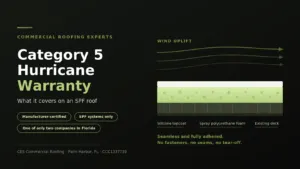
We built our practice around the gaps this guide describes. Every person on our roofs is covered by our standalone workers’ compensation policy. We hold an active Florida Certified Roofing Contractor license, CCC1337739, 14 or more manufacturer certifications, and 46 building permits totaling over $4.5 million in pulled commercial work. BuildZoom places us in the top 5% of 191,428 Florida licensed contractors based on that permit history. We carry an A+ BBB Rating and a 4.9-star Google rating across roughly 70 reviews, and we are one of only two companies in Florida authorized to offer the Category 5 Hurricane Warranty on SPF roofing systems.
If you are evaluating contractors for a commercial roof in Tampa Bay, Orlando, or anywhere in our Florida service area, we are happy to walk your roof, run drone and thermal imaging where useful, and give you an honest recommendation in writing. If the roof can be restored, we will tell you. If it needs to come off, we will tell you that too.
Schedule a free commercial roof evaluation: CALL (813) 419-1918!