

The best metal roofing option for a commercial building comes down to three decisions: the panel system you install, the metal and gauge you choose for your climate, and whether an existing metal roof should be replaced at all or restored with a coating instead. For most Florida commercial buildings, that means choosing between standing seam and R-panel, choosing steel or aluminum sized for coastal exposure, and taking an honest look at whether an aging roof still has sound structure underneath. At CES Roofing, we install and restore commercial metal roofs across Florida, with more than 15 million square feet of commercial roofing installed and a 100% commercial focus. This guide walks through each of those decisions the way we would explain it across the table from a building owner.
Most guides on this topic are written for homeowners choosing a roof color. Commercial buildings are a different problem. The decision involves wind uplift engineering, building code compliance, salt exposure, energy loads, and often a six or seven figure budget. The right answer for a coastal warehouse is rarely the right answer for an inland office park, so it helps to work through the choices one at a time.
Standing Seam vs. R-Panel: Which Commercial Metal Roof System Is Best?
The two systems used on commercial buildings are standing seam and R-panel, and they resist water in fundamentally different ways.
An R-panel is an exposed-fastener system. Screws are driven straight through the face of the panel into the deck or purlins below. R-panels are wide, usually around 36 inches, so a crew can cover a lot of square footage quickly, which keeps material and labor costs down. That makes them a common choice for agricultural buildings, pre-engineered metal buildings, and warehouses where budget and speed matter more than long-term weathertightness. The tradeoff is thermal movement. Metal expands in the sun and contracts at night, and because the panel is pinned in place by thousands of screws, that daily movement slowly enlarges the fastener holes. Roofers call this slotting or wallowing. As the holes widen and the rubber washers degrade under UV, water starts to find its way in. For that reason, R-panels are best kept to shorter roof runs and to unconditioned buildings where a minor leak will not threaten valuable interior assets.
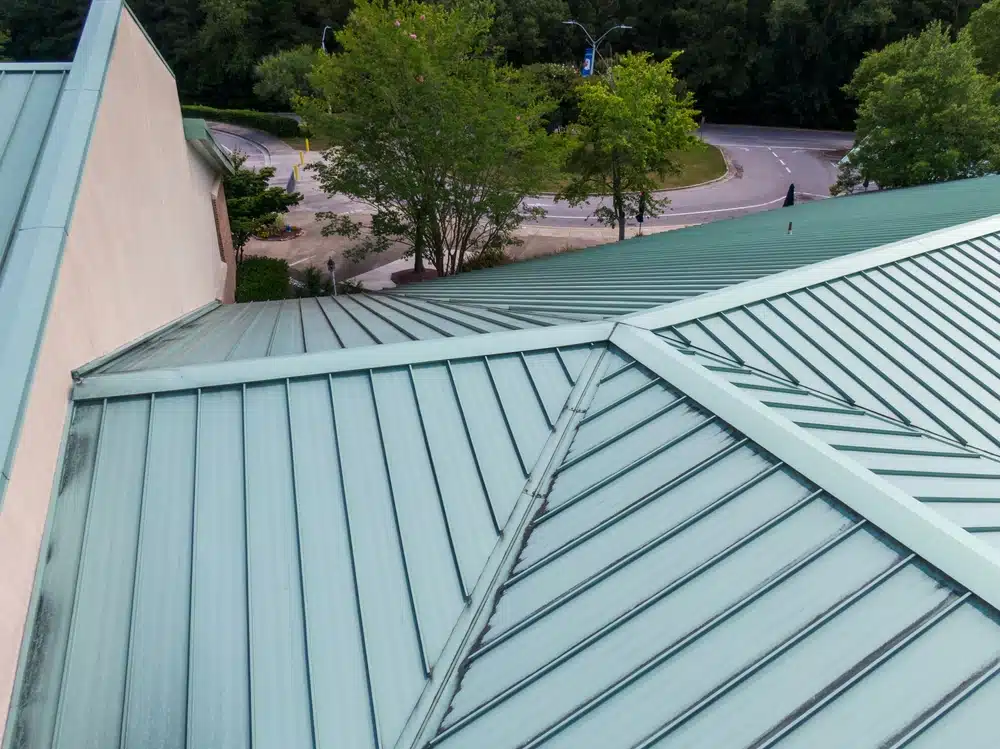
A standing seam roof uses concealed fasteners. Instead of screws through the surface, the panels attach to hidden clips, and the vertical seams sit up above the water line. Because the panels are not pinned down, they float across the clips as the metal expands and contracts, so thermal movement does not tear the roof apart over time. There are no penetrations in the field of the roof, which removes the most common failure point on metal buildings. On low-slope commercial roofs and in high-wind areas, panels are mechanically seamed with a motorized machine that folds the metal and clip together into a rigid, locked connection built to handle severe wind uplift. Properly installed standing seam systems often carry weathertightness warranties of 20 years or more, which exposed-fastener roofs rarely offer.
| Feature | R-Panel (exposed fastener) | Standing Seam (concealed fastener) |
| Fastener location | Through the face of the panel | Hidden clips beneath the panel |
| Thermal movement | Restricted; prone to fastener slotting | Panels float freely on clips |
| Typical panel width | Around 36 inches (fast to install) | Around 16 to 18 inches (more labor) |
| Water intrusion risk | Higher over time as washers and holes wear | Very low; no field penetrations |
| Weathertightness warranty | Rarely available | Commonly 20 years or more |
| Best fit | Warehouses, agricultural and unconditioned buildings, shorter runs | Long-term commercial buildings, low-slope and high-wind applications |
We install both systems, and the right one depends on the building and how long you plan to own it. One thing does not change: when a metal roof needs to be replaced, we replace it with metal every time. You can see how we approach both profiles on our commercial metal roofing page.
What About Hurricanes and Wind?
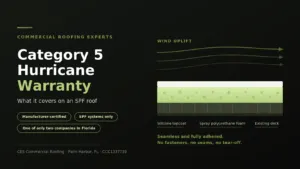
For wind, the fastening method matters as much as the panel. Mechanically seamed standing seam systems are the standard for high-velocity wind zones because the folded seam creates a continuous, rigid connection that resists uplift. Meeting the Florida Building Code and Miami-Dade wind standards also depends on thick-gauge panels and the correct clip fastening schedule. Separately, for spray polyurethane foam (SPF) roofs, we are one of only two companies in Florida certified to offer the manufacturer-backed Category 5 Hurricane Warranty. That warranty applies to SPF systems rather than metal, so if hurricane-rated protection is your priority, it is worth understanding on our Category 5 Hurricane Roof page.
Steel vs. Aluminum: Choosing the Right Metal for Florida’s Climate
Once you have picked a profile, the next choice is the metal itself, and near the coast this is the most consequential decision you will make.
Steel is the most common and cost-effective substrate, and it is very strong. Commercial steel roofing is usually protected with Galvalume, an aluminum-zinc coating that shields the steel and heals minor scratches through a sacrificial process. That works well inland. In coastal air, it does not hold up as well. Chloride from salt spray accelerates the loss of that protective coating, and any raw steel edge that gets cut during installation is vulnerable to a creeping form of rust that works its way under the paint. This is why many manufacturers void their steel roofing warranties when the building sits within roughly 1,500 to 3,000 feet of saltwater.
Aluminum behaves differently. It forms its own tight, inert oxide layer the moment it is exposed to air, and it reseals itself instantly when scratched or cut. That corrosion resistance is a property of the metal, not a coating that wears away, so aluminum is essentially immune to the salt-driven rust that shortens the life of steel near the water. For coastal buildings, barrier islands, and intracoastal properties, aluminum is the standard. The tradeoff is that aluminum is softer than steel, so it has to be specified in a heavier gauge (commonly .040 or .050 inch) to meet Florida wind requirements, and it must be installed with stainless steel or all-aluminum fasteners to avoid corrosion between dissimilar metals.
| Metal | How it resists corrosion | Coastal use | Notes |
| Galvalume steel | Sacrificial aluminum-zinc coating | Best kept inland | Very strong; cut edges are vulnerable to salt-driven rust |
| Aluminum | Self-sealing oxide layer | Standard for coastal buildings | Softer, so needs a heavier gauge and non-corroding fasteners |
If your building is anywhere near saltwater, this decision is worth getting right the first time, because a mismatched metal can fail years earlier than it should.
How Coatings and Finishes Affect Performance and Energy Costs
The finish on a metal roof does more than set its color. In Florida sun, it is the first line of defense against UV, fading, and heat. The premium standard for commercial metal is a PVDF finish, often known by the trade name Kynar. PVDF holds its gloss and color for decades and resists the chalky breakdown that lower-grade paints develop under constant sun.
A light-colored, reflective finish also lowers what the roof costs you to cool. A “cool roof” reflects solar energy and releases absorbed heat rather than driving it into the building. Commercial metal roofs can reach up to 75% solar reflectivity, which keeps the roof surface and the space below it cooler. According to the Cool Roof Rating Council, a cool roof saves roughly 7% to 15% of total cooling costs on average, with the biggest impact on air-conditioning-heavy buildings in hot climates like Florida. In a Florida summer, that adds up to real annual savings and less strain on your HVAC equipment.
How Long Does a Commercial Metal Roof Last?
A properly designed and installed metal roof can last for decades. A long-running service life study by the Metal Construction Association found that standing seam metal roofs, when engineered and installed to best practice, can exceed 60 years of service. You can review the study through the Metal Construction Association.
That kind of longevity is not automatic, and it is not a flat guarantee. Real lifespan depends on several factors:
- The metal and gauge, especially near the coast, where aluminum will outlast steel.
- The coating system and how well it holds up to UV and salt.
- Installation quality, including wind uplift engineering and proper fastening.
- Proximity to saltwater and how much salt air and wind-driven moisture the roof takes.
- Routine maintenance, including keeping drainage clear and sealants intact.
Salt air, humidity, and wind-driven moisture can shorten a coastal roof’s life, but by how much depends on those same factors rather than on any single number. This is why we frame lifespan as a range with conditions rather than a promise. The honest answer for your specific building comes from looking at the roof, the location, and the system in place.
Restore or Replace: Often the Best Metal Roofing Option of All
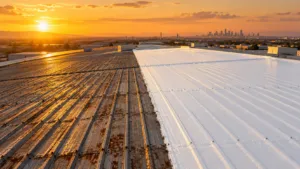
If your metal roof is aging but still structurally sound, replacing it is often the wrong move. A fluid-applied restoration can extend its life for decades at roughly one-third the cost of a full reskin, and it can usually be done while your building keeps operating.
We consider metal one of the best and easiest surfaces to restore, and it is work we do constantly for industrial storage facilities and warehouses. There are two main approaches:
- Silicone coating restoration. After repairing problem areas and sealing every seam, fastener, and penetration, we apply a silicone coating over the existing roof. Silicone stands up well to Florida’s UV and to standing water, which is why we favor it here over acrylic. It creates a seamless, waterproof membrane that flexes with the metal underneath.
- Foam and coating (SPF). For roofs that need added insulation or that have significant fastener movement, we spray closed-cell polyurethane foam over the metal and top it with a reflective coating. The foam encapsulates the roof, adds insulation and rigidity, and eliminates the loose fastener movement that leads to leaks.
A restoration also protects you as well as a new roof does. Because we hold direct manufacturer certifications, a coating or foam-and-coating restoration can carry the same 10, 15, or 20 year No Dollar Limit warranties you would get with a new roof, where the manufacturer covers the full cost of repairing covered leaks for the warranty term. Restoration can also qualify for favorable tax treatment under Section 179 of the tax code, which in many cases lets a business deduct the project in the year it is completed. The specifics depend on your situation, so confirm with your CPA, and you can read more on our post about whether commercial roof replacements are tax deductible.
We have done this on large metal roofs. One project involved an 88,850 square foot metal refurbishment, split into a 35,750 square foot foam section and a 53,100 square foot hybrid section, finished with a high-solids silicone coating. Another was a 45,000 square foot foam-and-coated R-panel roof in Orlando that we completed during Florida’s rainy season.
Restoration has limits, and we will tell you when a roof is past it. A coating cannot save a roof that has lost its structure. If the decking is rusted through, the panels have pulled loose from the purlins, or moisture has saturated the insulation beyond localized repair, a full tear-off and replacement is the only safe and code-compliant path. The way to tell the difference is a professional assessment, which is where drone and thermal imaging inspections come in, since they reveal trapped moisture and hidden damage that a walkover can miss. You can see the full picture of coating and foam work on our commercial roof restoration page.
| Consideration | Restoration (coating or foam) | Full replacement |
| Relative cost | Roughly one-third of a reskin | Full capital cost |
| Building operations | Usually continue during work | Often disrupted by tear-off |
| Best candidate | Structurally sound but aging roof | Structurally failed roof |
| Warranty | 10, 15, or 20 year manufacturer options | 10, 15, or 20 year manufacturer options |
Getting the Right Metal Roofing Recommendation for Your Building
The best metal roofing option is the one matched to your building, your location, and the condition of what is already up there. A few things separate a recommendation you can trust from a sales pitch. Look for a contractor that works only on commercial roofs, holds direct manufacturer certifications (we carry more than 14, including GAF and Carlisle), and uses drone and thermal imaging to verify a roof’s condition before quoting a solution. Those certifications are also what make the strongest manufacturer warranties available in the first place.
Whether you manage a warehouse in Tampa, an industrial facility inland, or a coastal property taking the full brunt of salt air, the starting point is the same. We look at the roof, tell you what we actually find, and lay out your options, including whether restoring it makes more sense than replacing it. You can also compare metal against our other systems on our commercial roof installation page.
If you are weighing metal roofing options for a commercial building, or trying to decide whether your current metal roof needs to come off, let us take a look first. Call us at (813) 419-1918 to schedule a free roof evaluation for your commercial property anywhere we serve across Florida. We will give you a straight answer.