

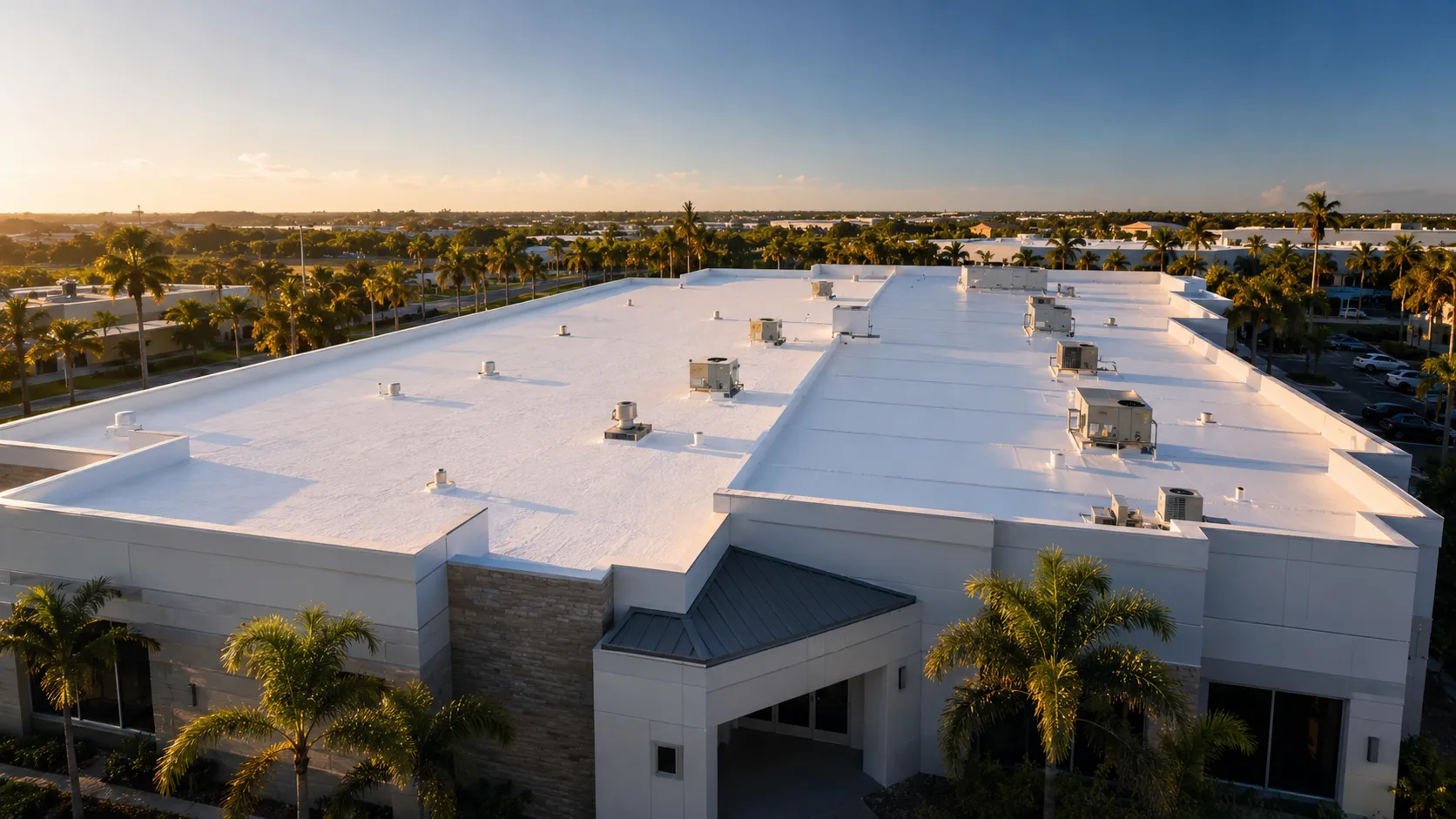
If you are weighing a spray foam roof against a TPO membrane for an existing commercial building in Florida, the honest answer is that neither system wins every time. The right choice is set by the building itself: the condition of the existing roof and deck, the roof’s shape and drainage, how much insulation and hurricane performance matter for that property, and how much ongoing maintenance you are prepared to carry. This guide walks through the factors that actually move that decision, then shows how they line up on a warehouse versus a low-slope retail or office roof.
We install and maintain both systems at CES Commercial Roofing, with over 15 million square feet of commercial roofing across Florida, from Tampa to Orlando and the surrounding markets. Because we are not a foam-only shop and not a membrane-only shop, we have no reason to point every roof toward one product. We evaluate each building on its own terms, and that is the approach this comparison takes.
A quick orientation to each system
If you have already gathered proposals, you know the basics. For anyone landing here cold, here is the short version.
Spray polyurethane foam (SPF) is spray-applied and fully adhered. It cures into a seamless surface that self-flashes around penetrations, and it carries a protective coating on top. Our SPF roofing guide covers how the system is built. TPO is a factory-made single-ply membrane, rolled out across the roof and joined with heat-welded seams. Our TPO roofing page covers that system in detail.
The depth in this article is in the comparison, not the definitions. From here on we are looking at how the two systems differ on the decisions a building owner actually has to make.
Spray foam vs TPO roofing at a glance
The table below sets the two systems side by side across the factors that drive the decision. Every line is conditional on the specific building, and none of it is a substitute for an evaluation of your roof.
| Decision factor | Spray foam (SPF) | TPO membrane |
| How it goes on | Spray-applied and fully adhered, seamless, self-flashes around penetrations, and can be shaped to build slope for drainage. Requires a protective coating over the foam. | Factory-made single-ply sheet, rolled out and heat-welded at the seams. Can be mechanically attached or fully adhered. |
| Existing roof and substrate | Needs a clean, dry, sound substrate to bond to. A water-soaked or failed deck removes the no-tear-off option. | Can go on a new deck, or recover a sound existing roof with a fleece-back system. A water-soaked or deteriorated base removes the recover option here too. |
| Insulation and energy | Adds R-value in the roof covering itself, and a reflective coating gives a cool-roof surface. Most valuable on an under-insulated roof. | A white membrane carries high solar reflectance for a cool-roof surface. Useful R-value comes from the insulation beneath the sheet. Most valuable when insulation is already adequate. |
| Ongoing maintenance | Regular inspection plus periodic recoating as a planned lifecycle event. On our SPF systems, annual maintenance is mandatory to keep the Category 5 Hurricane Warranty valid. | Regular inspection and repair focused on seams, penetrations, and drainage, at least twice a year and after major storms. No scheduled whole-roof recoat. |
| Warranty options | Can carry manufacturer system and No Dollar Limit coverage, and qualifies for the manufacturer-certified Category 5 Hurricane Warranty when installed by an authorized contractor. | Mature manufacturer No Dollar Limit programs, available up to long terms on qualifying systems installed by a certified contractor. |
| Best-fit building | Older or irregular roofs with many penetrations, added-insulation needs, or drainage that has to be reshaped, when the substrate is dry and sound. | Large, relatively simple low-slope fields where the deck is sound and the owner wants a factory sheet with a long, clearly defined single-ply guarantee. |
Start with the existing roof and substrate
On an existing building, the condition of the roof under the new system decides more than material preference does. It is the first gate both systems have to pass, and it is where a foam or coating restoration and a membrane replacement genuinely diverge.
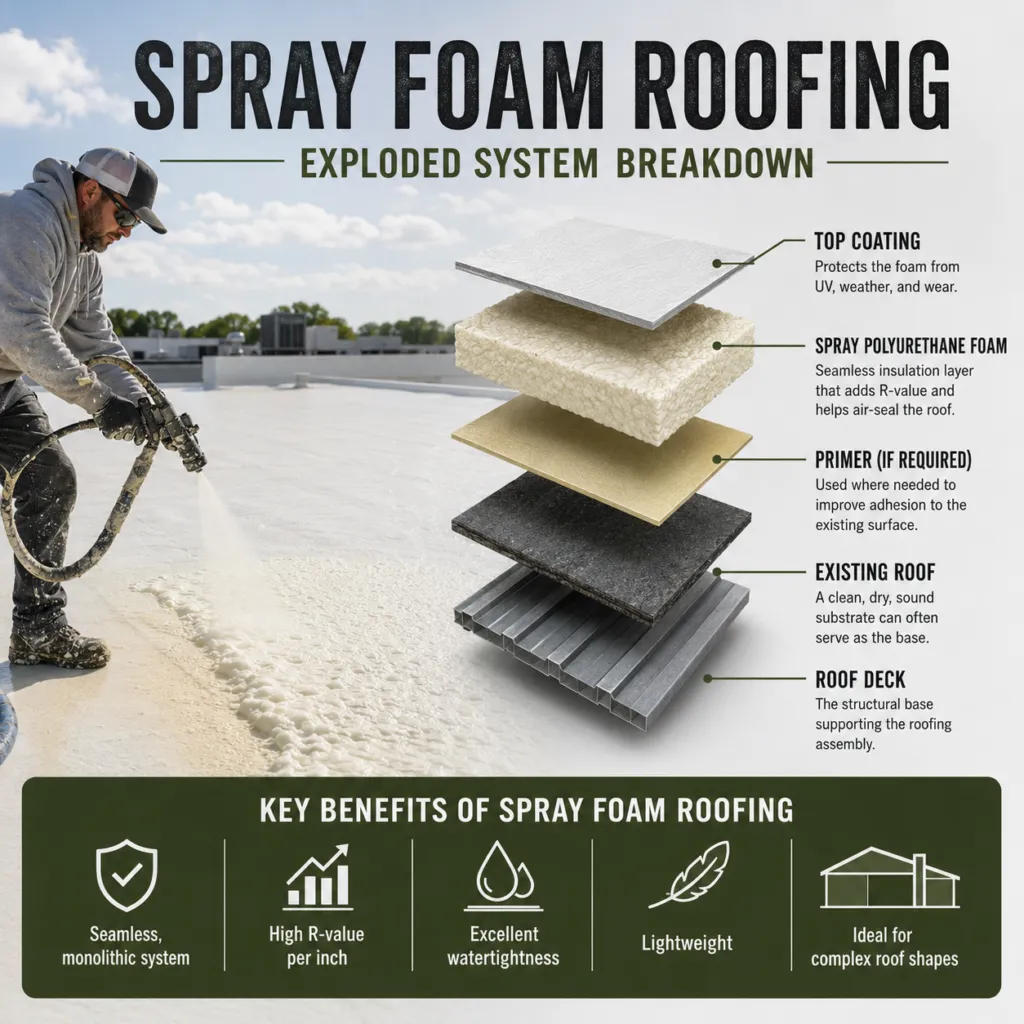
Spray foam has to bond to a clean, dry, sound surface. The Spray Polyurethane Foam Alliance is clear that wet or contaminated substrates cause adhesion problems, so foam sprayed over a saturated deck will not bond and will fail. Florida’s building code reinforces this from the other direction. A new roof covering cannot simply be installed over an existing roof that is water-soaked or deteriorated to the point that it is not a sound base for additional roofing. That restriction applies to a TPO recover just as much as a foam application. So the common shorthand that “foam can always go over an old roof” only holds once the existing assembly has been shown to be dry and serviceable.
You may have heard a version of this stated as a fixed threshold, such as a full tear-off being required once a set percentage of the roof is wet. The current code is more specific than that, and it is worth checking the actual language and your local building official’s reading rather than assuming a single number decides it. If the deck or insulation is saturated or the assembly is failing, a no-tear-off path is off the table for either system, and moisture has to be removed before anything new goes down.
This is where an accurate look at the roof matters more than a sales pitch. Our free, no-obligation roof evaluation is drone-assisted, and when we suspect moisture under the surface we bring in thermal imaging to map it. That tells us, and you, whether the roof can take a restoration or whether the wet material has spread far enough that a full replacement is the responsible call. When a roof is a genuine candidate for a foam or coating restoration over the existing surface, that path can run roughly one-third the cost of a full replacement. When it is not, we will tell you that too.
Insulation and energy performance
The energy comparison depends on where your roof is starting from, so this is one place where the same two products can point in different directions.
Spray foam adds thermal resistance in the roof covering itself. The Spray Polyurethane Foam Alliance puts closed-cell foam in a range of about R-5.8 to R-6.9 per inch, which is meaningful insulation built directly into the roof surface. A reflective coating over the foam also gives you a cool-roof surface on top of that added R-value.
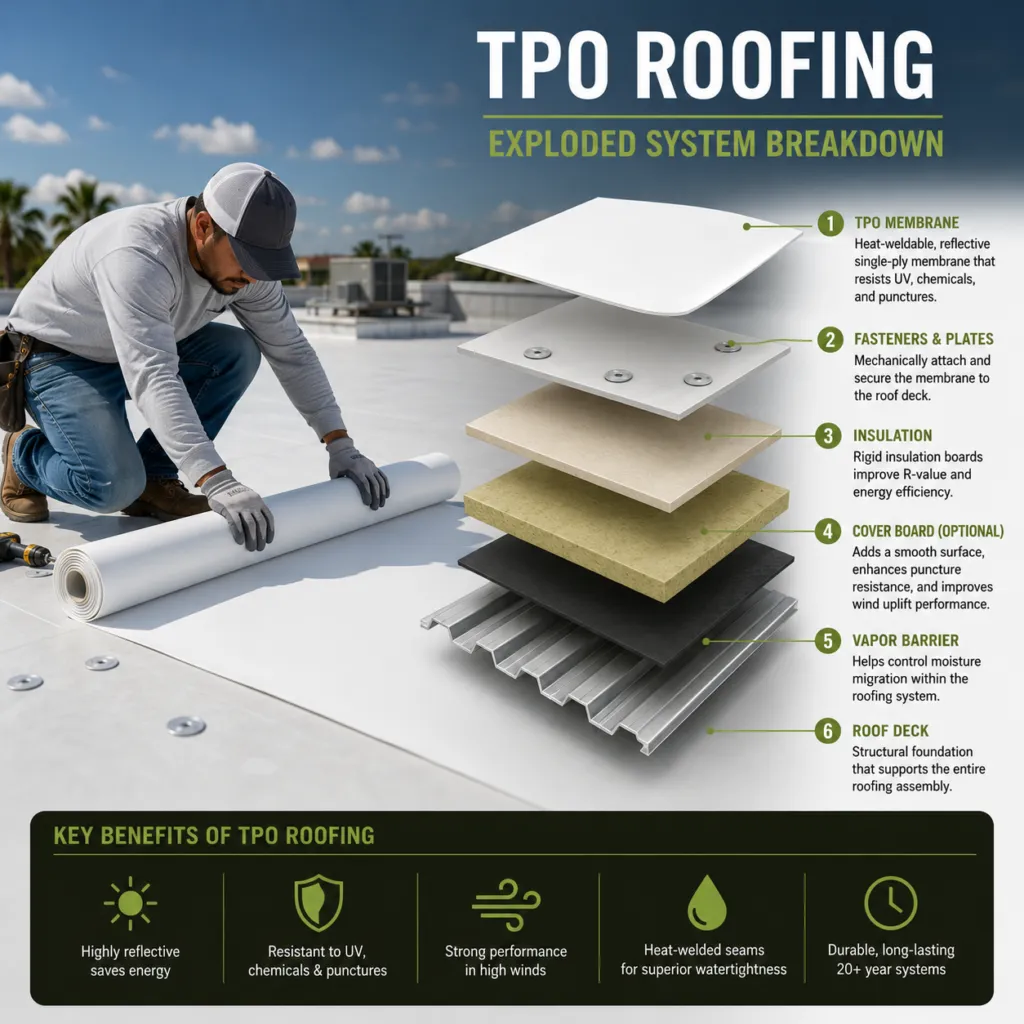
A TPO membrane works differently. The sheet is only tens of mils thick, so the useful insulation in a TPO assembly comes from the insulation package under the membrane, not the membrane itself. What a white TPO membrane brings is reflectance. A high-performance white TPO membrane can reach around 0.83 initial solar reflectance, which drops somewhat as the surface ages. The U.S. Department of Energy explains that a roof’s “coolness” is governed by the surface’s solar reflectance and thermal emittance, and a reflective foam coating can deliver the same cool-roof benefit.
Put simply, R-value and reflectance address different things. On a roof that is already well insulated, a reflective white membrane may capture most of the summertime benefit you are after. On a roof that is under-insulated, the added R-value foam builds into the covering can be the deciding advantage. Neither system automatically wins the energy question, and any comparison that hands the win to one of them without looking at your existing insulation is skipping the part that matters.
The maintenance obligation each system creates
Both systems need maintenance. The difference is the shape of the obligation, and that difference should factor into the decision because it is a commitment you are signing up for over the life of the roof.
A spray foam roof carries a real recoat obligation. The foam depends on its protective coating to shield it from ultraviolet exposure and surface wear, and that coating is renewed periodically as a planned capital-maintenance event rather than an optional upgrade. The Spray Polyurethane Foam Alliance describes a recoat window that varies with climate, coating chemistry, and coating thickness, and calls for regular inspection to determine when recoating is actually needed. Foam roofs should be inspected at least annually, and industry guidance recommends more frequent checks in severe climates and after major storms.
TPO follows an inspect-and-repair model instead of periodic whole-roof recoating. Manufacturer maintenance guidance asks owners to inspect the roof at least twice a year, and after heavy rain, high wind, or hail, with attention to seams, penetrations, drainage, and puncture damage from rooftop traffic. That is a lower maintenance burden than a scheduled recoat, but it still requires disciplined upkeep. Neglected seams or clogged drains will shorten the life of a membrane the same way a worn coating will shorten the life of foam.
On our SPF systems, the Category 5 Hurricane Warranty is voided without annual maintenance. If keeping that coverage active matters to you, that annual visit is mandatory. We handle that through our ongoing maintenance and repair program, and after each annual visit you receive a certificate confirming your warranty obligations have been met.
Warranty differences
“Warranty” is not a single number, and comparing two proposals by headline years alone can hide a real difference in what you are actually covered for. Both foam and TPO can carry strong manufacturer coverage, so the useful comparison is the fine print, not the technology.
Ask the same questions of both quotes. Is it a material warranty or a system warranty that covers labor and materials together? Is it No Dollar Limit? What is the term, and are there riders or exclusions for wind, hail, or ponding water? Is it transferable to a new owner? Does the manufacturer require inspections, and does the coverage require a certified installer? Contemporary TPO systems from certified contractors can carry No Dollar Limit coverage up to long terms on qualifying assemblies, and a qualifying foam system can carry system and No Dollar Limit coverage as well. Two twenty-year proposals can still be very different investments once you read what each one actually covers.
System warranties, on either system, are only available when the roof is installed by a contractor who holds active certification with the manufacturer of the products being used. A contractor who is not certified cannot issue a manufacturer system warranty, whatever they promise verbally. We hold active certifications with 14+ manufacturers, including GAF, with System Plus warranty authority, and Polyglass, which is what unlocks manufacturer system coverage on either a foam or a TPO system.
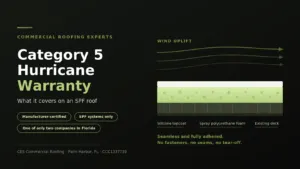
The Category 5 Hurricane Warranty is a manufacturer-certified warranty available only on SPF systems, and CES Commercial Roofing is one of only two companies in Florida authorized to offer it. It covers the foam system remaining intact under Category 5 hurricane wind conditions, and it is transferable to a new property owner, which carries real value in a sale. Two conditions define it. It requires annual maintenance to stay valid, and it warrants the foam system itself, not the underlying building structure. If the building’s substrate detaches, the foam stays bonded to that substrate and the coverage does not extend to the structure it was attached to.
How each system performs in a Florida hurricane
Hurricane performance is a real factor for a Florida commercial roof, and it is one where the honest answer requires looking at the assembly, not just the material name.
FEMA’s low-slope roof guidance reports that post-storm research has found sprayed polyurethane foam and liquid-applied roofs to be very reliable high-wind performers. That is a point in foam’s favor in a hurricane zone. In the same guidance, FEMA cautions specifically against mechanically attached and air-pressure-equalized single-ply membrane systems, which can degrade after debris impact, and does not recommend that attachment type in hurricane-prone regions.
FEMA’s caution is about an attachment method, not about TPO as a material. A properly engineered, fully adhered TPO assembly is a different thing from a mechanically attached one, and current TPO products carry Miami-Dade and State of Florida approvals on qualifying assemblies. So for a Florida building, the questions that matter are the attachment method, the perimeter and edge design, the deck condition, and the exact tested assembly, at least as much as foam versus membrane. A blanket claim that all TPO fails in hurricanes would overstate the evidence, and a claim that attachment method does not matter would ignore it.
Warehouse versus low-slope retail or office
The clearest way to see the “it depends” answer is to watch how the same factors resolve on two different buildings.
On a large warehouse or industrial roof, several factors often line up on the foam side at once. These roofs are frequently older metal or built-up assemblies with numerous vents, curbs, and penetrations. They may be under-insulated, and they sometimes need drainage reshaped to clear ponding. Spray foam self-flashes around all those penetrations, adds R-value directly into the covering, and can be built up in thickness to create slope, all without a grid of membrane seams. Provided the substrate is dry and sound, those advantages can stack up on exactly this kind of roof. A large, relatively simple warehouse field with a sound deck and adequate insulation, on the other hand, can be a clean fit for a TPO recover or replacement where the owner wants a factory sheet and a long single-ply guarantee.
On a smaller low-slope retail or office roof, the balance often shifts. These buildings are usually occupied during the workday, sometimes with sensitive air intakes or parked vehicles right next to the roof. Foam application involves spray, masking, overspray control, and manufacturer reoccupancy requirements that are more demanding around occupied and sensitive spaces. If the deck is sound and the insulation is already adequate, a reflective TPO membrane with a well-defined manufacturer guarantee can be the more natural fit. Retail does not automatically mean membrane, and a warehouse does not automatically mean foam. The building’s real conditions decide it.
How to decide between spray foam and TPO
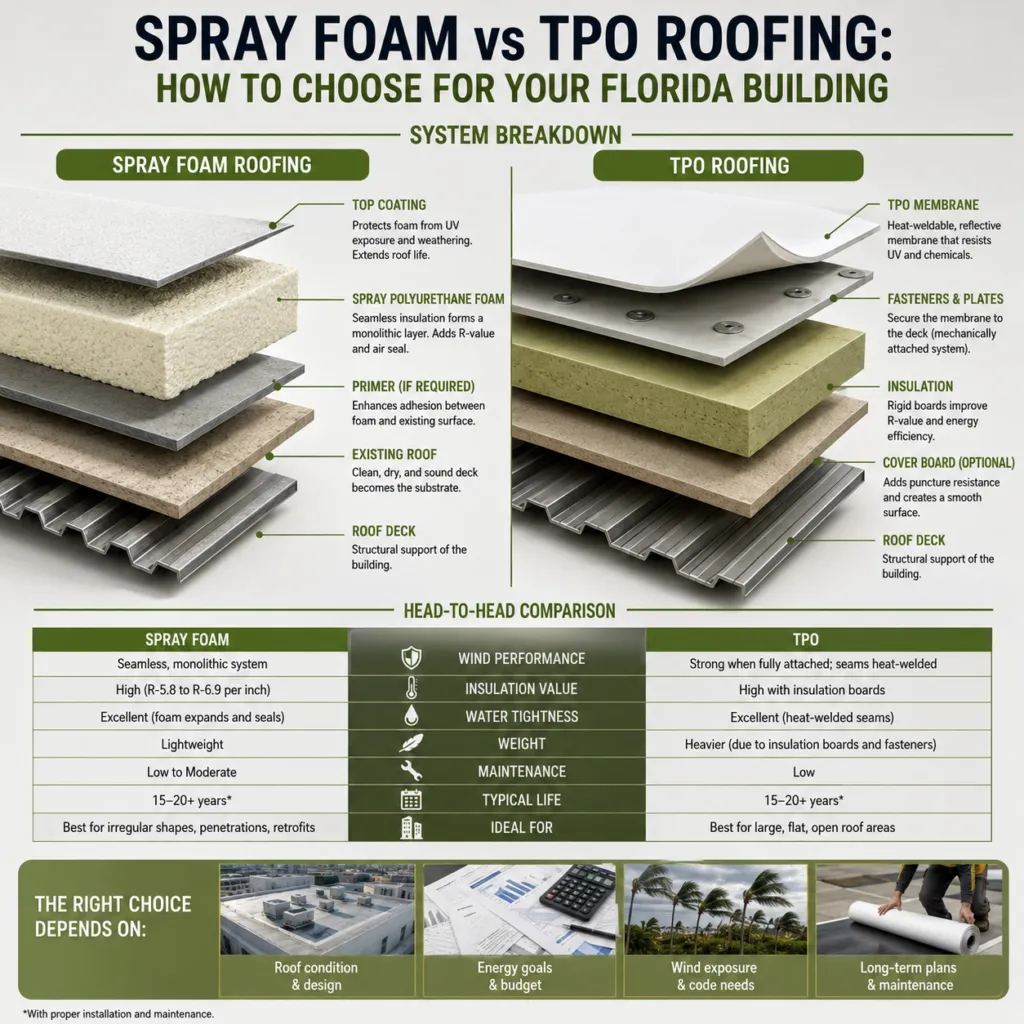
The decision comes from an accurate picture of your specific roof: whether the deck and insulation are dry and sound, how the roof is shaped and drained, what your insulation and hurricane priorities are, and which maintenance obligation fits how you plan to hold and manage the building. A table cannot answer that, and a contractor’s product preference should not.
That picture comes from a real evaluation of the specific roof, not a rule of thumb applied from a distance. We would rather recommend the system that genuinely fits the building, whether that is restore, repair, or replace, than win a job on the wrong one. We serve commercial properties on both systems across Florida.
Frequently asked questions
Which is better for a commercial roof, SPF or TPO?
Neither is better in every case. Foam tends to fit older or irregular roofs that need added insulation, drainage reshaping, or self-flashing around many penetrations, while TPO tends to fit large, simple low-slope fields with a sound deck and adequate insulation. The building decides.
Foam roof or TPO on an existing building?
It depends first on whether the existing roof is dry and sound. A saturated or failed deck rules out a no-tear-off application of either system. If the assembly is serviceable, the choice turns on insulation needs, roof geometry, drainage, and the maintenance and warranty terms you prefer.
Which handles Florida hurricanes better, spray foam or TPO?
FEMA has found spray foam and liquid-applied roofs to be very reliable high-wind performers, and its caution is aimed specifically at mechanically attached single-ply systems, not fully adhered TPO. For a Florida building, the attachment method and edge design matter as much as the material, so hurricane performance should be judged at the assembly level.
Can spray foam go over an existing TPO roof?
Sometimes, if the existing membrane and the deck below it are dry, sound, and compatible with the foam and its adhesion requirements. A wet or failing assembly has to be addressed first. The only way to know is an evaluation that checks for hidden moisture, which is where thermal imaging comes in.
Get a straight answer for your building
If you are choosing between spray foam and TPO for a commercial roof in Florida, the fastest way to a real answer is to have us look at the roof. Call CES Commercial Roofing at (813) 419-1918 to schedule a free, no-obligation evaluation. We will map the roof’s condition, walk you through the options that actually fit it, and give you an honest recommendation, whichever system that turns out to be.