

A quality metal roof installed in Florida can last 40 to 70 years for inland properties when properly installed and maintained. Premium metals like copper and zinc can exceed a century under the right conditions. Coastal installations have a wider range. Salt air, humidity, and wind-driven moisture can shorten metal roof lifespan significantly, but actual longevity depends on the metal type, coating system, installation quality, proximity to saltwater, and maintenance practices.
At CES Commercial Roofing, we’ve installed over 15 million square feet of commercial roofing across Florida, including both standing seam and R-panel metal systems. The gap between a 20-year roof and a 70-year roof comes down to the decisions made at specification and how well the roof is maintained afterward. This guide covers each variable so you can make an informed decision for your commercial property.
Why is Florida so hard on metal roofs?
Florida’s climate creates one of the most demanding roofing environments in the continental United States. Five factors work together to accelerate wear on metal roofing systems.
Humidity and corrosion. Florida’s average annual humidity sits around 74.5%. This promotes condensation on metal surfaces and accelerates corrosion wherever protective coatings are compromised. Trapped moisture between panels and decking can cause underlayment degradation and structural rot if ventilation is inadequate. According to the National Roofing Contractors Association (NRCA), proper attic ventilation alone can extend roof life by up to 25%.
Salt air exposure. This is the single most consequential variable for Florida metal roofs. FEMA’s NFIP Technical Bulletin 8 establishes a 3,000-foot threshold from saltwater shorelines, within which structures face significantly accelerated corrosion. Properties near the coast can experience roughly 40% faster roofing material degradation compared to inland properties.
UV radiation. Florida receives among the highest UV radiation levels in the continental U.S. Standard polyester coatings degrade quickly, chalking and eroding within a few years and requiring repainting every 5 to 7 years. PVDF (Kynar 500) coatings perform far better. Panels coated with Kynar 500 have been tested on a South Florida exposure fence since the 1960s and show negligible color change after more than 50 years, according to Arkema’s weatherability testing data.
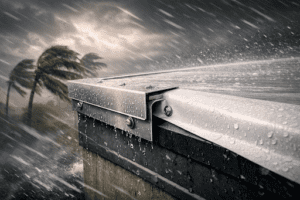
Hurricanes and high winds. Properly installed standing seam metal roofs can resist winds of 130 to 150+ mph, exceeding Category 3 hurricane demands. FEMA documented a structural standing seam system that survived Hurricane Andrew in 1992 at estimated 170 mph peak gusts. More recently, FEMA’s 2025 case study of Hunters Point found that steel roofs in a coastal community in Cortez, FL survived Hurricanes Helene and Milton with minimal to no damage.
Thermal cycling. Metal roof surface temperatures in Florida can exceed ambient air temperature by 100°F+ in direct summer sunlight. This creates potential temperature swings exceeding 200°F across seasons. The repeated expansion and contraction loosens fasteners, elongates screw holes, and degrades sealants. Standing seam systems with floating clips accommodate this movement. Through-fastened panels are more susceptible to thermal stress damage.
Which metal type lasts longest in Florida?
Aluminum lasts longest in coastal environments, with an expected range of 50 to 70 years when properly installed with quality coatings and regular maintenance. For inland properties, Galvalume steel is the industry standard at 40 to 60+ years under similar conditions. The choice of base metal sets the upper limit on how long any metal roof can perform. Coatings, profile, and maintenance determine where within that range actual performance falls.
Aluminum is the top performer for coastal Florida, with an expected lifespan of 50 to 70 years depending on coating quality and maintenance frequency. It forms a natural oxide layer that resists salt corrosion without relying on sacrificial coatings. Industry sources consistently identify it as the most recommended metal for properties within 1,500 feet of the coast. The trade-off is higher cost and greater susceptibility to denting.
Galvalume steel (55% aluminum, 43.4% zinc, 1.6% silicon over steel) is the current industry standard for inland installations, delivering 40 to 60+ years with quality installation and consistent upkeep. It offers 2 to 4 times greater corrosion resistance than traditional galvanized steel, according to Sheffield Metals. Most manufacturers exclude properties within 1,500 feet of breaking surf from substrate and paint warranties. McElroy Metal’s Galvalume substrate warranty through US Steel now covers 45 to 50 years of non-prorated protection against perforation.
Galvanized steel has largely fallen out of favor for Florida applications. Galvanized roofs typically last approximately 15 to 20 years before visible rust begins, especially in moisture-exposed areas. Over 90% of the industry has shifted from galvanized to Galvalume.
Copper and zinc represent the premium tier. Both can reach 60 to 100+ years in Florida conditions thanks to self-healing patinas that protect against corrosion. European zinc roofs installed over 100 years ago remain functional. These metals are cost-prohibitive for most commercial applications but deliver unmatched longevity when budget allows.
All lifespan estimates assume proper installation, appropriate material selection for the environment, and regular maintenance. Actual performance varies based on coating system, proximity to saltwater, climate exposure, and maintenance frequency.
| Metal type | National lifespan | Florida estimate (inland) | Florida estimate (coastal) | Key Florida consideration |
| Aluminum | 40 to 60 years | 50 to 70 years | 40 to 60 years | Best corrosion resistance; preferred within 1,500 ft of coast |
| Galvalume steel | 40 to 60+ years | 40 to 60 years | 25 to 40 years | Warranty void within 1,500 ft of surf; 2 to 4x more durable than galvanized |
| Galvanized steel | 20 to 30 years | 15 to 25 years | Not recommended | Largely obsolete; rapid rust in Florida humidity |
| Copper | 70 to 100+ years | 60 to 100+ years | 60 to 100+ years | Self-healing patina; highest cost |
| Zinc | 80 to 100+ years | 60 to 100+ years | 60 to 100+ years | Self-healing patina; proven 100+ year European track record |
How do standing seam and exposed fastener roofs compare?
With proper installation and maintenance, standing seam systems can last 40 to 70+ years in Florida. Exposed fastener systems typically reach 20 to 35 years before fastener degradation forces major repairs or replacement. The difference is in how each profile handles thermal movement, fastener exposure, and wind uplift.
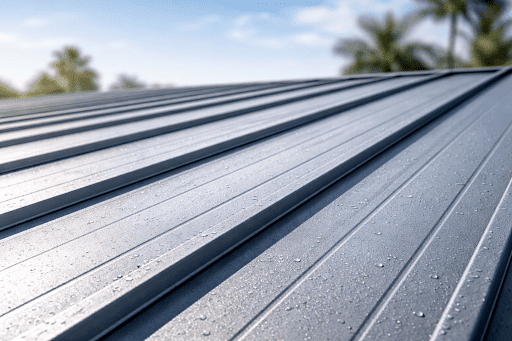
Standing seam (concealed fastener) systems deliver the longest service life, reaching 40 to 70+ years when properly maintained. Fasteners are hidden from UV, moisture, and wind. Expansion clips accommodate thermal movement. Weathertight warranties from reputable manufacturers range from 20 to 35 years. Standing seam is the recommended profile for Florida’s High Velocity Hurricane Zone (HVHZ), with wind ratings typically reaching 140 to 165 mph.
R-panel and exposed fastener systems typically last 20 to 35 years in Florida before fastener-related issues require attention. The limiting factor is the fasteners, not the panels. Neoprene washers begin degrading at the 20 to 25 year mark. A typical roof may have 2,000+ exposed fasteners, each a potential leak point. These systems also cannot accommodate thermal expansion as effectively as standing seam, which increases stress on connections over time.
Stone-coated steel can provide 40 to 60+ years of service with its multi-layer protection (Galvalume core, acrylic adhesive, stone granules, clear glaze). DECRA, the pioneer of stone-coated steel since 1957, rates these systems at 40 to 70 years under proper conditions. They meet HVHZ requirements and achieve Class 4 hail impact ratings.
Lifespan ranges depend on installation quality, coating system, environmental exposure, and maintenance. Coastal properties and high-traffic roofs may fall toward the lower end of these ranges.
| Profile type | Florida lifespan range | Wind rating | Thermal movement | Best fit |
| Standing seam (concealed fastener) | 40 to 70+ years | 140 to 165 mph | Floating clips accommodate movement | Long-term commercial; coastal and HVHZ |
| R-panel (exposed fastener) | 20 to 35 years | Varies by attachment | Limited; fastener holes elongate | Budget-conscious inland projects |
| Stone-coated steel | 40 to 60+ years | Meets HVHZ (Class 4 hail) | Interlocking panels manage movement | Steep-slope commercial where aesthetics matter |
We install both standing seam and R-panel systems across Tampa, Orlando, and throughout our Florida service area. For commercial properties where long-term performance is the priority, standing seam is almost always the better investment. For budget-conscious projects on inland properties, R-panel can still deliver solid performance with proper fastener maintenance.
Which coating system performs best in Florida?
PVDF (Kynar 500) outperforms every alternative by a wide margin, with documented performance exceeding 50 years in South Florida exposure testing. SMP coatings follow at 25 to 35 years under typical conditions. Standard polyester manages just 5 to 15 years in Florida’s UV environment.
PVDF (Kynar 500/Hylar 5000) is the premium standard. The carbon-fluorine bonds in PVDF are among the strongest in polymer chemistry. The coating has documented real-world performance exceeding 50 years in coastal and industrial settings. Sheffield Metals warranties PVDF for 40 years on film adhesion and 30 years on chalking and fading. The Florida Roofing and Sheet Metal Contractors Association (FRSA) chose Kynar 500 for their own headquarters building.
SMP (silicone modified polyester) provides adequate performance at significantly lower cost than PVDF, with a 25 to 35 year effective life in Florida depending on UV exposure and maintenance. It fades faster, though. McElroy Metal documented a case where SMP showed significant fading and chalking after just 8 years while the adjacent Kynar section retained its color.
Standard polyester typically lasts only 5 to 15 years in Florida’s UV environment and is not recommended for long-term applications.
Field-applied acrylic coatings offer 5 to 15 years per application and can extend an existing metal roof’s life by 10 to 20 years per recoating cycle, depending on mil thickness and application quality. A commercial roof coating restoration can restore an aging metal roof at roughly one-third the price of a full replacement, with manufacturer warranties of 10, 15, or 20 years.
| Coating type | Florida effective life | Warranty coverage | Best use case |
| PVDF (Kynar 500) | 40 to 50+ years | 40-year film adhesion; 30-year chalk/fade | Premium commercial; coastal |
| SMP (silicone modified polyester) | 25 to 35 years | 40-year film adhesion; 30-year chalk/fade (lower thresholds) | Budget-conscious inland installations |
| Polyester | 5 to 15 years | Limited | Temporary or budget applications only |
| Acrylic (field-applied) | 5 to 15 years per coat | 10 to 18 years depending on mil thickness | Restoration of existing metal roofs |
How does metal compare to other commercial roofing systems in Florida?
Metal outlasts every major alternative in Florida. A Kynar-coated standing seam roof can deliver 40 to 70 years with proper maintenance, while TPO typically achieves 20 to 25 years, modified bitumen 15 to 20 years, and architectural shingles only 15 to 20 years under Florida conditions. Asphalt-based products degrade significantly faster here than in northern states.
The MCA’s field study of Galvalume standing seam roofs found an expected service life in excess of 60 years when built using best practices. A historical study by Schneider and Keenan examining over 25,000 commercial roof systems found an average BUR (built-up roofing) service life of only 13.6 years.
Metal roofing also has the lowest annual cost of ownership among common commercial roofing systems when measured over a 50-year lifecycle. A Kynar-coated standing seam roof requires no replacement within a 50-year window if properly maintained. TPO typically requires 2 to 3 replacements, and modified bitumen requires 3 or more replacements in the same timeframe. While metal costs more upfront, the total cost of ownership over decades is significantly lower because you avoid the repeated expense of tear-off and reinstallation.
All lifespan figures are industry estimates that assume proper installation and maintenance. Actual results depend on materials, workmanship, climate exposure, and upkeep.
| Roofing system | Florida lifespan range | Replacements in 50 years | Relative installed cost |
| Metal standing seam (Kynar) | 40 to 70 years | 1 | Highest upfront; lowest lifecycle cost |
| SPF (with recoats) | 30 to 50+ years | 1 (+2 to 3 recoats) | Moderate upfront; competitive lifecycle cost |
| PVC membrane | 20 to 30 years | 2 | Moderate to high |
| TPO (80-mil) | 20 to 25 years | 2 to 3 | Moderate |
| Modified bitumen | 15 to 20 years | 3 | Moderate |
| BUR | 15 to 20 years | 3 | Low to moderate |
| Architectural shingles | 15 to 20 years | 3 | Lowest upfront; highest lifecycle cost |
SPF (spray polyurethane foam) roofing can theoretically last indefinitely with recoating every 10 to 15 years, making it highly competitive on a lifecycle cost basis. For commercial properties seeking the longest possible hurricane protection, our Category 5 Hurricane Roof Warranty for SPF systems provides manufacturer-certified wind protection that even metal cannot match at the same price point.
For commercial property owners weighing TPO roofing against metal, the decision often comes down to budget versus timeline. TPO costs less upfront and typically delivers service for 20 to 25 years. Metal costs more upfront but can deliver 40 to 70 years with proper maintenance, making it the more cost-effective choice over a 50-year window.
What does the Florida building code require for metal roofs?
All metal panel roof systems in Florida must be tested per UL 580, ASTM E1592, or TAS 125. All roofing materials must carry a Florida Product Approval Number. In the High Velocity Hurricane Zone (HVHZ), covering Miami-Dade and Broward counties, materials must also earn a Miami-Dade Notice of Acceptance (NOA). The NOA process involves TAS 203 testing: 9,000 cycles of alternating positive and negative pressure with simultaneous wind-driven rain simulation. This is the most stringent building product certification in the United States.
The code mandates corrosion-resistant fasteners statewide, with enhanced requirements near the coast. FEMA recommends stainless steel (ASTM A316) fasteners within 3,000 feet of saltwater. Sealed roof decks (secondary water resistance) are mandatory, creating a backup barrier if the primary covering is lost during storms. These requirements, codified in the Florida Building Code 8th Edition (2023), ensure that every metal roof installation in Florida starts with a higher baseline of durability than in less regulated states.
How do metal roofs affect insurance premiums in Florida?
Florida law (Section 627.0629) requires insurers to offer wind mitigation premium discounts. Metal roofs qualify for maximum roof covering credits. The IBHS FORTIFIED study on Hurricane Sally found that if all homes in the storm’s path had been built to FORTIFIED Gold standards, insurers would have saved $116.1 million in losses. The FORTIFIED system also reduced deductibles paid by policyholders by more than 60%. Insurance premium reductions of 5 to 35% are available through Florida’s wind mitigation inspection program.
How does maintenance affect metal roof lifespan in Florida?
Maintenance is what separates a 20-year roof from a 60-year roof. Metal roofs that receive regular attention routinely outlast their warranties by 15 to 25 years, according to a study by the Roofing Industry Alliance for Progress. Neglected roofs in Florida can fail in under 20 years regardless of material quality.
Florida-specific maintenance priorities include:
- Salt removal for coastal properties: Freshwater rinses twice yearly within 1,500 feet of the ocean, yearly from 1,500 feet to one mile, and every two years beyond one mile
- Biannual professional inspections: Spring (pre-hurricane season) and fall (post-hurricane season), with additional inspections after major storm events
- Fastener monitoring: Thermal cycling and wind vibration naturally loosen fasteners. Annual tightening checks prevent cascading leak damage
- Sealant replacement: Sealants are often the first component to fail on metal roofs. Reapply sealants or protective coatings every 5 to 10 years
- Coating reapplication: PVDF-coated roofs may not need recoating for 30 to 40 years. SMP-coated roofs may need attention at 25 to 30 years. Mill-finish or bare metal roofs require coating at around 20 years
The MCA’s service life study found that butyl sealant showed no significant deterioration in cohesive tensile strength after 35 years, with sealant service life conservatively projected at 60 years for properly installed systems. Florida’s combined UV, heat, and humidity can accelerate degradation of sealants and rubber washers on exposed-fastener systems, though.
For more details on keeping your metal roof in peak condition, see our metal roof maintenance guide.
What is the lifecycle cost of a metal roof in Florida?
Metal roofing delivers the lowest annual cost of ownership among common commercial roofing systems when measured over a 50-year lifecycle. A Kynar-coated standing seam roof can serve for 50+ years with maintenance alone, while most membrane and asphalt-based systems require multiple full replacements in the same period.
Each replacement cycle adds not just the cost of new materials and labor, but also tear-off, disposal, and business disruption. A system that lasts 40 to 70 years avoids 2 to 3 of those replacement cycles entirely, which is why metal’s higher upfront investment typically pays for itself well before the roof reaches end of life.
Metal roofing also delivers additional financial returns beyond the installation itself. The Florida Solar Energy Center (FSEC) at UCF found that reflective roof coatings reduced air conditioning energy use by an average of 19% across nine Florida homes. White galvanized metal saved the most energy of all materials tested.
For commercial property owners with existing metal roofs that are aging but structurally sound, a coating restoration is often the most financially efficient path. A silicone coating restoration costs roughly one-third of a full replacement and qualifies as a repair under Section 179 of the IRS tax code, meaning the entire cost can potentially be written off in the tax year it’s completed. Customers should consult their tax advisor for specific guidance.
What is the optimal metal roof specification for Florida?
The optimal Florida specification, based on manufacturer consensus and field data, is a Galvalume substrate with Kynar 500 PVDF coating in a standing seam profile. For properties within 1,500 feet of the coastline, substitute aluminum for Galvalume.
This combination addresses every major Florida-specific challenge. The Galvalume or aluminum substrate provides the corrosion foundation. The PVDF coating handles UV and weathering for 40+ years under documented South Florida exposure conditions. The standing seam profile eliminates the exposed-fastener failure mode while accommodating thermal movement.
| Component | Recommended specification | Why it matters in Florida |
| Substrate (inland) | Galvalume (AZ55) | 60+ year panel life per MCA study; 45 to 50 year substrate warranty |
| Substrate (coastal, within 1,500 ft) | Aluminum | Natural oxide layer resists salt; no warranty exclusion zone |
| Coating | PVDF (Kynar 500) | 50+ years documented in South Florida exposure testing |
| Profile | Standing seam (concealed fastener) | Eliminates exposed-fastener failure; floating clips handle thermal cycling |
| Fasteners | Stainless steel (ASTM A316) near coast | Required by FEMA within 3,000 ft of saltwater |
Whether your commercial property needs a new metal roof installation or a coating restoration to extend the life of an existing system, the right specification and regular maintenance are what separate a 20-year roof from one that lasts well past 60.
Get a free metal roof evaluation
If you’re evaluating the condition of your commercial metal roof or comparing your options for a new installation, we offer free, no-obligation roof evaluations that include on-site inspection, drone-assisted assessment, and thermal imaging when moisture issues are suspected.
[CALL (813) 419-1918] [Link is – tel:8134191918]
Request your free evaluation to get started.