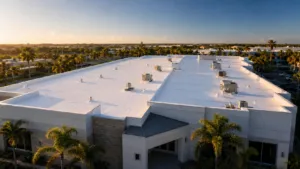


Spray polyurethane foam (SPF) roofing is the best-performing commercial roofing system in hurricane- and high-wind-prone areas. That conclusion comes from NIST, FEMA, and decades of post-storm investigations. During Hurricane Katrina, NIST’s Technical Note 1476 found that SPF was the only roofing system described as performing “extremely well,” with no blow-off damage across the examined installations. Standing seam metal ranks second, with FEMA documenting intact performance at estimated wind speeds of 170 mph during Hurricane Andrew.
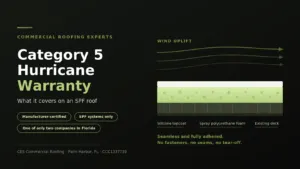
At CES Commercial Roofing, we’ve installed over 15 million square feet of commercial roofing across Florida, and SPF is our flagship system for a reason. We are one of only two companies in Florida authorized to offer a manufacturer-certified Category 5 Hurricane Warranty for SPF roofing systems. This article breaks down exactly how each major commercial roofing system performs in high winds, what lab data and real-world hurricane investigations actually show, and which design decisions matter most for protecting your building.
How Do the Major Commercial Roofing Systems Compare in Hurricanes?
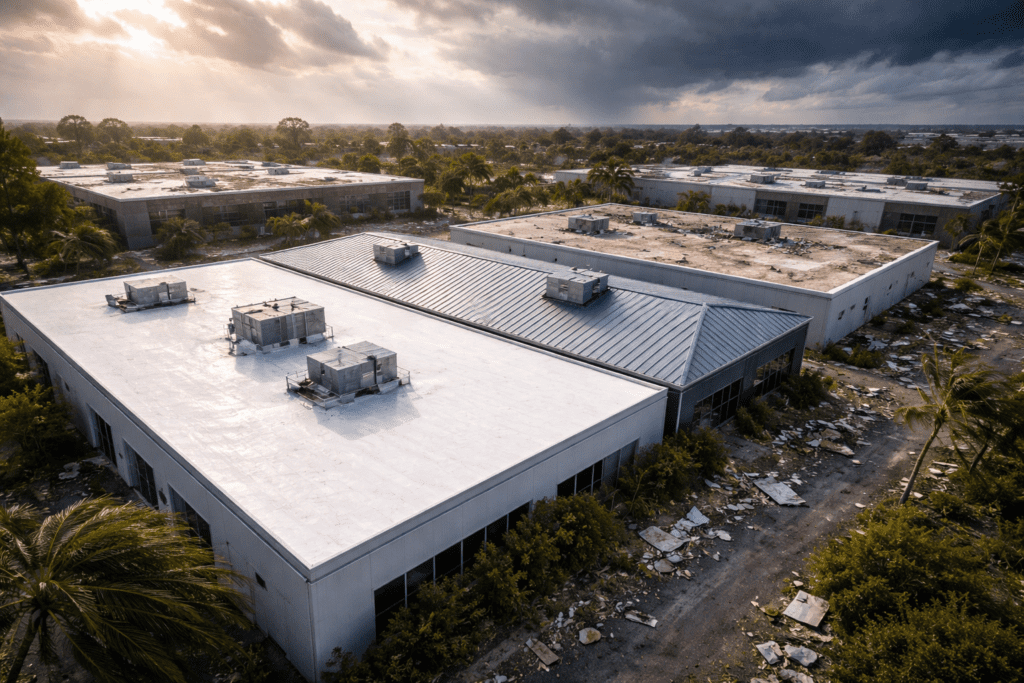
SPF delivers the highest measured wind resistance of any commercial system, followed by standing seam metal and fully adhered single-ply membranes (TPO and PVC). The differences come down to three factors: attachment method, seam integrity, and the system’s response to uplift forces.
The table below summarizes the key wind-performance metrics for every major commercial roofing type, based on laboratory testing, FM Global approvals, and documented post-hurricane field investigations.
| Roofing System | Documented Wind Performance | FM Ratings Available | Typical Lifespan | Installed Cost (per sq ft) |
| SPF (Spray Polyurethane Foam) | Exceeded UL test equipment at 160-165 psf; FM tested to 990 psf over concrete, 220+ psf over metal deck | 1-60 through 1-120+ | 25-50+ years (with recoating) | $5-$13 |
| Standing Seam Metal | Survived 170 mph gusts (Hurricane Andrew); engineered systems rated 140-180 mph | 1-60 through 1-180 | 40-70 years | $8-$22 |
| PVC Membrane | Rated 90-150+ mph (fully adhered); heat-welded seams stronger than membrane | 1-60 through 1-150+ | 20-30+ years | $8-$15 |
| TPO Membrane | Rated 110-130 mph (fully adhered); vulnerable to flutter when mechanically attached | 1-60 through 1-120+ | 15-25 years | $7-$15 |
| Modified Bitumen | Rated 90-150 mph depending on method; multi-ply redundancy | FM Class 1 available | 15-30 years | $4-$8 |
| EPDM | Moderate; adhesive seams weaker than heat-welded alternatives; FM tested to 165 psf | 1-60 through 1-165+ | 20-30 years | $4-$16 |
| Built-Up Roofing (BUR) | Moderate; gravel displacement is a significant hazard in high wind | FM Class 1 available | 20-40 years | $4-$12 |
One important note on these ratings: FM classifications express uplift resistance in pounds per square foot (psf), not wind speed in mph. An FM 1-90 rating means the assembly resists 90 psf of uplift pressure. The actual wind speed required to produce 90 psf depends on building height, exposure category, and roof zone. FM applies a 2:1 safety factor, so an FM 1-90 system has an allowable design load of 45 psf.
Why Does SPF Outperform Every Other System in High Winds?
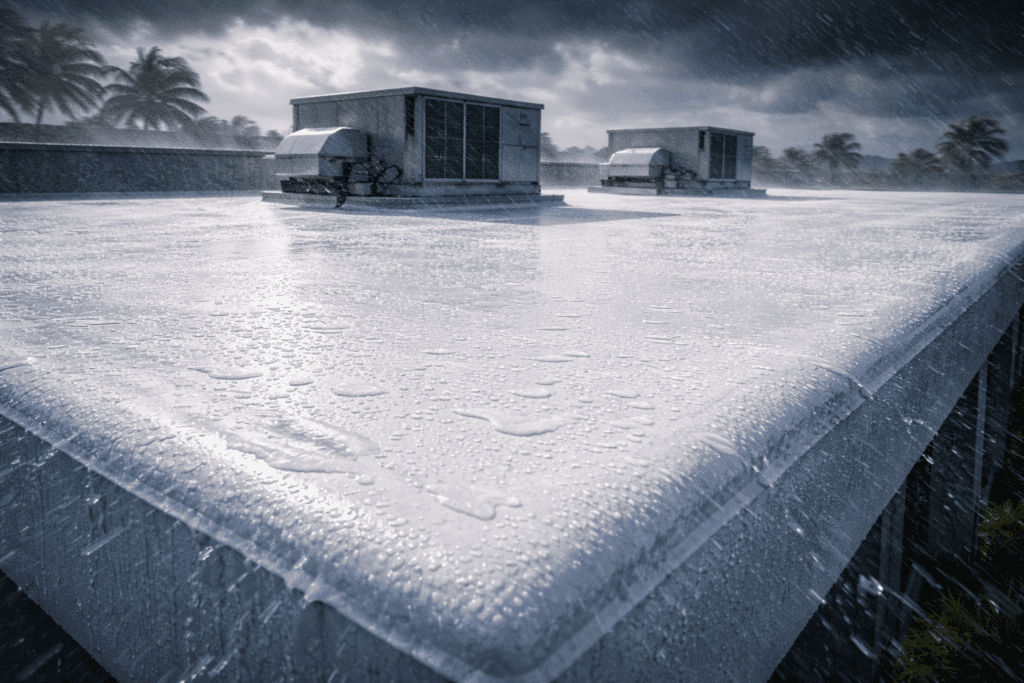
SPF’s wind resistance comes from a simple engineering principle. It is a monolithic, fully adhered system with no seams, joints, or mechanical fasteners for wind to exploit. Applied as a liquid that expands into rigid closed-cell foam bonded directly to the substrate, SPF eliminates the three most common failure modes in hurricanes: edge peel-back, fastener pull-through, and seam separation.
What does the lab data show?
The laboratory data is striking. In 1993, Underwriters Laboratories conducted wind uplift testing on SPF assemblies and found that uplift load resistance exceeded the capacity of the test equipment (160-165 psf) without any sign of damage to the foam. The foam refused to fail before the equipment reached its maximum.
FM Global testing produced even more dramatic results. Closed-cell SPF adhesion to concrete measured at over 990 psf of uplift pressure. Over metal deck assemblies, resistance exceeded 220 psf. In FM’s testing, the mode of failure was fastener back-out from the deck, not the foam adhesion itself.
University of Florida research under Dr. David O. Prevatt confirmed these findings in real-world conditions. Testing per ASTM E330-02, Prevatt found that a continuous 3-inch blanket of closed-cell SPF increased roof panel wind uplift capacity by 2.6 to 3.2 times that of panels with conventional mechanical fasteners. Baseline panels without SPF failed at an average of 75 psf. Panels with 3-inch SPF withstood an average of 250 psf, with individual panels reaching 283 psf. That is roughly equivalent to Category 4 hurricane wind speeds.
How has SPF performed in actual hurricanes?
Post-hurricane field investigations tell the same story. RICOWI’s Hurricane Katrina investigation documented more than 2 million square feet of SPF on metal roof decks that survived the storm with minimal damage, while adjacent buildings suffered serious damage. The Spray Polyurethane Foam Alliance cites these findings as evidence of SPF’s performance in severe weather across multiple hurricane events.
One case study is particularly telling. At the Pascagoula Shrimp and Ice Company, internal pressurization destroyed the building’s tongue-and-groove roof deck, ripping off both a ballasted EPDM membrane and a fully adhered modified bitumen section. Yet three sections insulated with SPF sustained no significant damage. The building’s owner reported that those SPF sections had survived Katrina, plus four other hurricanes over 30 years.
FEMA’s own publications reinforce these findings. FEMA P-2181 states that storm-damage research has shown that SPF and liquid-applied roof systems are among the better-performing systems. FEMA classifies closed-cell SPF as Class 5, the highest classification for flood-resistant products.
What should building owners know about SPF limitations?
SPF’s wind uplift performance is only as strong as the substrate it bonds to. The foam-to-substrate bond is exceptional, but the underlying deck must be properly secured to the building structure. SPF is also vulnerable to cosmetic damage from windborne debris, though RICOWI notes that debris impacts on SPF do not create an immediate leak risk, provided the penetration does not extend through the foam. Regular maintenance and periodic recoating (every 8-15 years) to protect against UV degradation remain essential.
We operate three dedicated SPF rigs at CES and have built our business model around this system’s hurricane resilience. Our Category 5 Hurricane Warranty is manufacturer-certified, transferable to new property owners, and backed by manufacturer-approved system documentation. We hold certifications from GAF, Carlisle, Polyglass, NCFI, Sherwin-Williams, and Henry, and we serve commercial properties across Florida from Tampa to Orlando and beyond.
How Does Standing Seam Metal Perform in Hurricane Conditions?
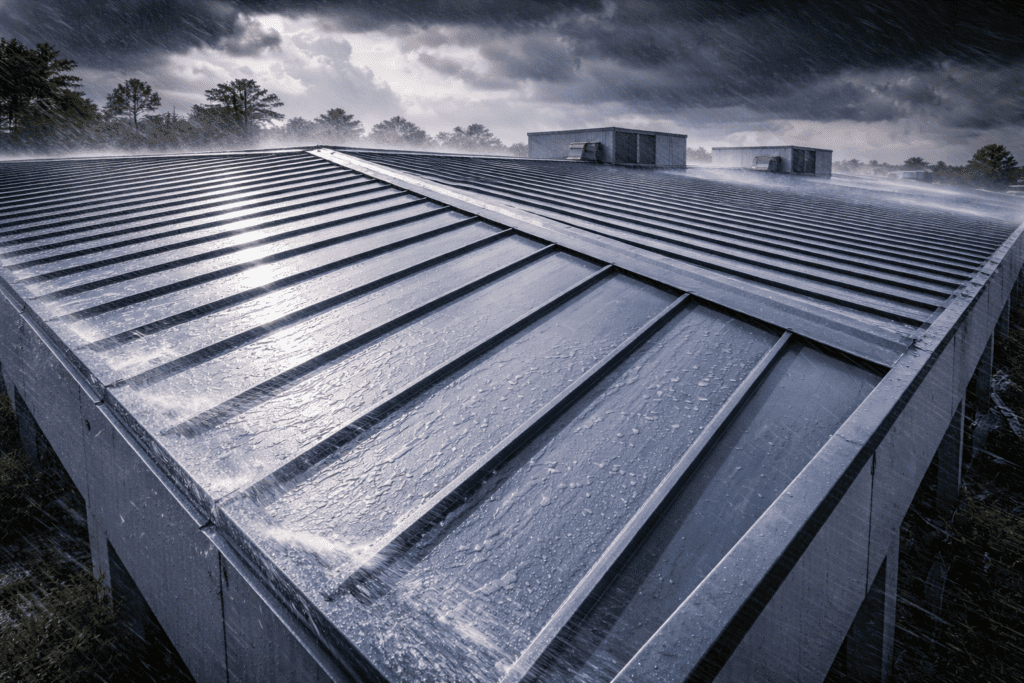
Standing seam metal roofing is the second-best-performing commercial system in documented hurricane events. FEMA’s post-Hurricane Andrew recovery advisory documented that properly designed structural standing seam systems survived in Florida, where estimated wind speeds reached 170 mph. After Hurricane Ian in 2022, FEMA’s Mitigation Assessment Team report found that only 21% of metal-panel roofs sustained visible damage, compared to 90% of asphalt-shingle roofs older than 7 years.
Standing seam systems interlock mechanically through raised seams, with concealed clips attaching panels to purlins. The critical design variables are panel profile and gauge, clip design and gauge, clip spacing, and purlin spacing. A 22-gauge clip provides meaningfully higher uplift performance than a 26-gauge clip. Decreasing clip spacing increases wind resistance proportionally. FM 4471 ratings for metal panels range from 1-60 through 1-180.
How does R-panel compare to standing seam?
R-panel (through-fastened) metal roofing is significantly less wind-resistant than standing seam. Through-fastened systems rely on exposed screws that penetrate the panel surface, creating potential failure points as thermal cycling causes fastener holes to elongate over time. FEMA advisories specifically note that architectural metal panels with concealed clips can unlatch from their clips under extreme uplift, a failure mode that structural standing-seam systems resist more effectively.
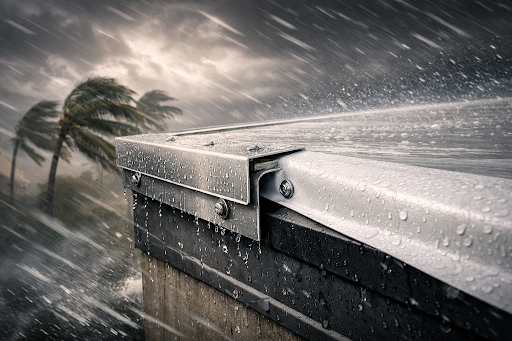
Metal roofing’s primary vulnerability in hurricanes is the same as every other system: edge and flashing failures. NIST’s Katrina investigation found that standing seam roofs survived major hurricanes but lost hip and edge flashings. The panels themselves remained intact while the details at transitions failed.
Can TPO and PVC Membranes Handle High Wind Areas?
Fully adhered TPO and PVC with heat-welded seams can perform well in high-wind areas, but mechanically attached single-ply and adhesive-seamed EPDM are significantly more vulnerable. These membranes account for roughly 36% of commercial roofing revenue, and their wind performance varies dramatically based on two factors: seam technology and attachment method.
Heat-welded seams, used in both TPO and PVC, create bonds typically stronger than the membrane itself. That makes them the superior choice among single-ply options for high-wind applications. EPDM relies on adhesive-bonded seams (contact cement or tape) that can degrade over time. As seam adhesion weakens, edges curl up, providing wind entry points that can lead to progressive membrane loss during storms.
Why does the attachment method matter so much?
Fully adhered systems distribute wind loads continuously across the entire roof surface and achieve higher FM wind uplift ratings than mechanically attached alternatives.
Mechanically attached membranes are fastened only at seams with screws and plates, leaving the membrane loose between attachment rows. Under wind pressure, these systems “flutter” or balloon. This oscillating motion creates progressive fatigue at fastener points and accelerates wear. The flutter effect is particularly dangerous on tall buildings and in coastal locations.
FM Global field investigations after Hurricanes Katrina, Charley, and Ivan revealed that adhered membranes can be susceptible to progressive peel failure starting at building perimeters. Once wind lifts an edge of an adhered membrane, the peeling can propagate across the roof. This is why FM Global’s Data Sheet 1-29 now requires significantly enhanced attachment in perimeter and corner zones. Many designers now use hybrid approaches: adhered membranes in the field with intermittent rows of mechanical fasteners as “peel stops” near perimeters and corners.
What Wind Resistance Standards Should Building Owners Understand?
FM Global ratings, UL 580 classifications, and ASCE 7 wind load calculations are the three key standards that determine whether a commercial roof meets code for its location. Understanding the basics is essential for specifying a roof that will survive a design-level wind event.
How does the FM Global rating system work?
FM Global’s classification system is the industry benchmark for wind uplift ratings. FM ratings range from 1-60 (minimum approval) through 1-990, expressed in 15-psf increments. The “1” prefix denotes Class 1 fire resistance. The number indicates uplift pressure capacity in psf. Testing per FM 4474 pressurizes assemblies starting at 30 psf, increasing in 15-psf increments, with each level held for one minute until failure.
FM requires a 2:1 safety factor. A building that is expected to experience 45 psf of actual uplift requires an FM 1-90 system.
Why do corners and edges require higher ratings?
ASCE 7 (the standard that governs wind load calculations) defines three critical roof zones with very different pressure requirements:
| Roof Zone | Location | Approximate Pressure Multiplier |
| Zone 1 (Field) | Interior of the roof | 1.0x (baseline) |
| Zone 2 (Perimeter) | Edge areas | ~1.8x field pressures |
| Zone 3 (Corner) | Corner areas | ~2.8x field pressures |
These multipliers explain why edge and corner failures dominate post-hurricane damage reports. A roof engineered to handle field pressures may have a completely inadequate attachment at its most vulnerable zones. For a building requiring FM 1-90 in the field, prescriptive FM requirements typically call for FM 1-150 at the perimeter and FM 1-225 at corners.
Why Do Most Commercial Roof Failures Start at the Edge?
FM Global reports that roughly 80% of all roof failures originate at the roof edge. This is the single most important wind-resistance detail for any commercial building, regardless of the membrane or system installed.
FM Global’s Data Sheet 1-49 states that the majority of roof covering failures resulting from windstorms involve improperly designed or constructed perimeter flashings. Their analysis of 145 built-up roofing losses found that 59% originated from perimeter failure. The ANSI/SPRI ES-1 standard, referenced in IBC Section 1504.5, requires testing of all metal edge systems (fascia, gravel stops, and copings) for wind resistance. Edge systems in corner regions must meet corner design loads with a 2:1 safety factor.
Despite this standard being code-required since 2003, edge failures remain the dominant damage pattern. IBHS found 71% of damaged roofs after Hurricane Ian showed visible flashing or coping damage.
Interior pressurization is the other critical factor. When a building loses a window or overhead door during a storm, the ASCE 7 internal pressure coefficient jumps from +/-0.18 to +/-0.55. That is roughly a 3x increase in internal pressure pushing upward on the roof from inside, intensifying uplift forces. Impact-resistant glazing and wind-rated doors are not optional upgrades in high-wind zones. They are essential roof-protection measures.
For more on how roof shape affects hurricane performance, hip roofs consistently outperform gable roofs in IBHS research. In Florida, hip roofs qualify for 10-30% insurance premium discounts on the wind portion of coverage.
How Does Florida’s Building Code Affect Commercial Roof Selection?
Florida enforces the strictest wind requirements of any state, a direct result of Hurricane Andrew’s catastrophic 1992 impact on South Florida. The High-Velocity Hurricane Zone (HVHZ), covering Miami-Dade and Broward counties, requires design wind speeds of 170-200+ mph for Risk Category II structures.
What is Miami-Dade’s TAS 203 test?
Within the HVHZ, all roofing products must obtain either a Florida Product Approval or a Miami-Dade Notice of Acceptance (NOA). Miami-Dade’s NOA process is widely considered the most rigorous product testing protocol in the United States.
The signature test, TAS 203, subjects products to 9,000 cycles of alternating positive and negative pressure, simulating the fluctuating wind loads of a sustained Category 4-5 hurricane. Pressures reach 1.5 times the design pressure, and the cycling is conducted simultaneously with wind-driven rain simulation. Products that pass static ASTM testing routinely fail TAS 203’s cyclic protocol because the repeated pressure reversals reveal fatigue failures and seal degradation that static testing cannot detect.
What about the rest of Florida?
Outside the HVHZ, Florida’s wind requirements still exceed most states. Coastal Panhandle areas face design wind speeds of 140+ mph. Palm Beach County coastal zones reach approximately 146 mph. The Florida Building Code mandates windborne debris protection for all exterior openings in the HVHZ and extends that requirement to other areas where basic wind speed exceeds 120 mph.
For commercial building owners in the Tampa Bay and Orlando markets, these code requirements directly influence which roofing systems and attachment methods are appropriate. Understanding the design wind speed for your specific location is the first step in any roofing decision.
What Is the Long-Term Financial Case for Wind-Resistant Roofing?
Wind-resistant roofing returns $10 for every $1 invested in avoided disaster recovery costs, according to the National Institute of Building Sciences (NIBS). That figure comes from the most comprehensive cost-benefit analysis of hazard mitigation available. Adopting the latest building codes adds only about 1% to construction costs compared to 1990 standards, yet saves $11 for every $1 invested across all natural hazards.
IBHS reports that 70% to 90% of all catastrophe-related insurance claims include damage to the roof, making it the single most consequential building component for loss prevention. The Congressional Budget Office estimates expected annual U.S. economic losses from hurricane damage at $54 billion, with $9 billion falling on the commercial sector. Only about 40% of that commercial exposure is covered by insurance.
How do insurance incentives factor in?
Insurance incentives for wind-resistant construction are substantial and growing. The IBHS FORTIFIED Commercial program, which requires verified wind-resistant construction details, delivers documented savings. In Alabama, FORTIFIED-designated buildings receive 35-60% discounts on the hurricane portion of premiums. Mississippi offers up to 55% off. Louisiana provides savings of 20-52%.
During Hurricane Sally in 2020, buildings with FORTIFIED roofs in Baldwin County, Alabama experienced 63% less roof damage than buildings with standard roofs, validating that the premium discounts reflect genuine risk reduction.
Why does SPF win on lifecycle cost?
SPF offers a particular cost advantage over the long term because of how the system renews. Unlike TPO, PVC, or metal roofing, SPF does not require a full tear-off and replacement at end of life. Instead, the existing foam is recoated at 33-50% of the original installation cost, and the warranty resets.
| Factor | SPF | TPO | Standing Seam Metal |
| Renewal Method | Recoat at 33-50% of original cost | Full tear-off and replacement | Full tear-off and replacement |
| Lifespan Potential | 25-50+ years (with recoating) | 15-25 years | 40-70 years |
| Hurricane Warranty Available | Category 5 (manufacturer-certified) | Standard system warranty | Standard system warranty |
The earliest SPF roofs installed in the 1970s are still performing. Combined with superior energy efficiency from high R-value insulation and the lowest hurricane damage risk of any commercial system, SPF’s total cost of ownership in high-wind regions is exceptionally competitive. An SPF coating restoration can also qualify as a repair under Section 179, allowing the entire cost to be written off in the tax year completed.
What Should Building Owners Do Before the Next Storm?
Three design factors matter as much as material selection, regardless of what system is on your building right now:
- Edge securement engineered to ANSI/SPRI ES-1 with corner-zone enhancements
- Protection of building openings (impact-rated windows and wind-rated overhead doors) to prevent interior pressurization
- Regular maintenance and inspections that address fastener corrosion, flashing integrity, and drainage before storm season
Pre-hurricane season inspections should prioritize perimeter edge metal and coping, flashing at penetrations, backed-out or corroded fasteners (especially within 15 miles of saltwater, where stainless steel Type 316 is recommended), rooftop equipment anchorage, and drainage to prevent ponding.
The NIBS finding that wind-resistant roofing returns $10 for every $1 invested makes the business case as clear as the engineering case: in high-wind areas, the most expensive roof is the one that fails.
Get a Free Wind Resistance Evaluation
If your commercial building is in Florida and you want to know exactly how your current roof would perform in a hurricane, we can help. CES Commercial Roofing provides free, no-obligation roof evaluations that include on-site inspection, drone-assisted assessment, and thermal imaging to detect hidden moisture that affects wind resistance. Call us at (813) 419-1918 or visit cesroof to schedule yours.