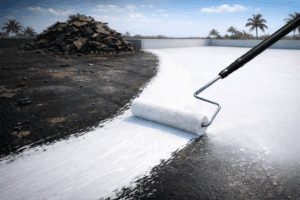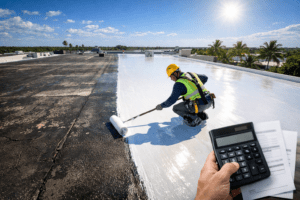



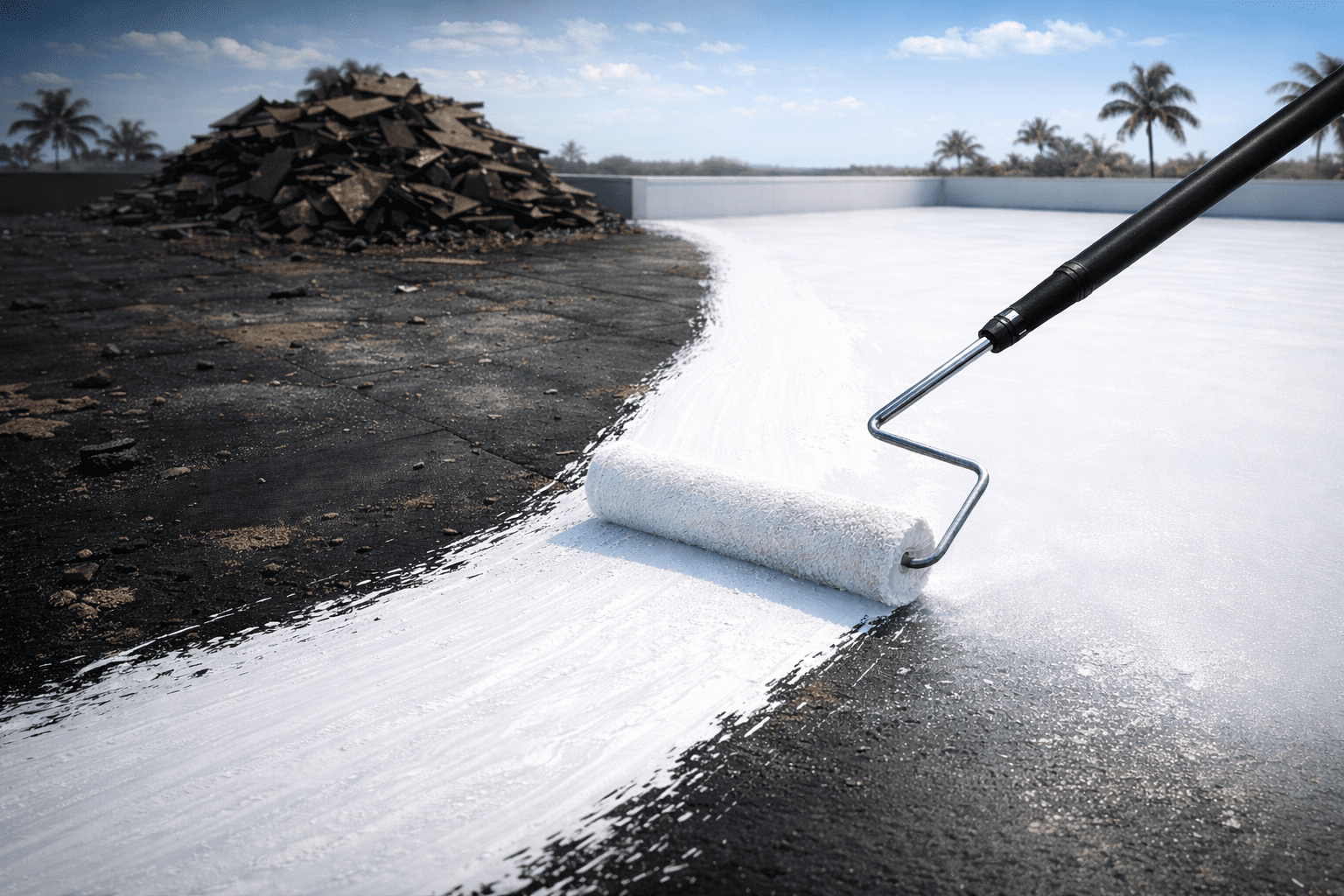
A silicone roof coating on a 20,000-square-foot commercial building in Florida typically costs $60,000 to $140,000. A full tear-off and TPO replacement on the same building runs $140,000 to $260,000 or more. The upfront savings are obvious, but the 20-year financial picture depends on maintenance cycles, tax treatment, energy savings, insurance requirements, and Florida-specific building code rules that can eliminate the coating option.
At CES Roofing, where we’ve installed over 15 million square feet of commercial roofing across Florida, including the Tampa Bay and Orlando markets, silicone coating restoration is the service we perform most frequently. We also install TPO, modified bitumen, metal, and SPF systems. We see both sides of this decision regularly, and the honest answer is that neither option is universally better. The right choice depends on your roof’s current condition, your insurance requirements, your tax situation, and how long you plan to hold the property.
Upfront Costs: Coatings vs. Full Replacement in Florida
Florida commercial roofing prices are higher than national averages due to hurricane-code compliance, labor demand, and transportation costs. In markets like Tampa and Orlando, where commercial construction stays active year-round, contractor availability also affects pricing. Here’s how the two options compare per square foot.
Coating Systems (Installed, Florida)
| Coating Type | Cost Per Sq Ft | Typical Warranty | Recoat Cycle |
| Acrylic | $0.65 – $3.00 | 5 – 10 years | Every 5 – 10 years |
| Silicone | $3.00 – $7.00 | 10 – 20 years | Every 10 – 15 years |
| Elastomeric / Polyurethane | $1.50 – $5.00 | 10 – 20 years | Every 10 – 15 years |
| Full silicone system (with fabric reinforcement) | $3.50 – $9.00 | 15 – 20 years | Every 12 – 15 years |
Replacement Systems (Installed, Florida)
| System Type | Cost Per Sq Ft | Typical Lifespan | Notes |
| TPO single-ply | $5.00 – $13.00 | 15 – 25 years | Most common commercial choice |
| Modified bitumen (2-ply) | $9.00 – $14.00 | 20 – 25 years | APP-modified preferred in FL heat |
| Modified bitumen (3-ply, R-25 insulation) | $14.00 – $20.00 | 25 – 30 years | Highest cost, longest life |
| SPF (spray polyurethane foam) | $5.00 – $13.00 | 20+ years with recoat | R-5 to R-7.5 per inch insulation |
| Standing seam metal | $10.00 – $20.00+ | 40 – 60 years | Best hurricane performance |
Tear-off and disposal adds $1.00 to $3.00 per square foot on top of replacement costs.
For a 20,000-square-foot building, the upfront gap is significant. A silicone coating system at $3.50 to $7.00 per square foot totals $70,000 to $140,000. A TPO replacement at $7.00 to $13.00 per square foot (with tear-off) runs $140,000 to $260,000.
What Does the 20-Year Total Cost of Ownership Look Like?
The upfront savings on coatings are dramatic, but the gap narrows over two decades once you factor in maintenance, recoating, and energy savings.
One of the most widely cited lifecycle cost studies in the roofing industry comes from Carl Cash at Simpson, Gumpertz & Heger, referenced by Buildings Magazine. The study modeled a 10,000-square-foot commercial roof over 20 years. A premium white reflective membrane cost $57,800 upfront but only $46,600 total over 20 years, thanks to its long service life and energy savings. A conventional dark built-up roof cost $56,800 upfront but ballooned to $115,220 over the same period. Its 13.9-year average service life forced a mid-cycle renovation that more than doubled the total cost.
The study’s core finding is worth repeating. Expected roof life is the dominant factor in lifecycle cost, not initial price. A roof that fails before the 20-year mark can cost 2.5 times more over that period than one that lasts the full term.
Here’s how a Florida-specific 20-year model breaks down for a 20,000-square-foot commercial building:
Coating Pathway (Silicone System)
- Initial coating (Year 1): $70,000 – $140,000
- Recoating at Year 12-15: $40,000 – $80,000 (less material than initial application)
- Annual maintenance at $0.14 – $0.20/sq ft: $56,000 – $80,000 cumulative
- Energy savings at $0.20 – $0.35/sq ft/year: ($80,000) – ($140,000) cumulative credit
- Estimated 20-year total: $86,000 – $160,000
Replacement Pathway (TPO Single-Ply)
- Full replacement (Year 1): $140,000 – $260,000
- Annual maintenance at $0.14 – $0.20/sq ft: $56,000 – $80,000 cumulative
- Energy savings (white TPO, similar reflectivity): ($80,000) – ($140,000) cumulative credit
- No mid-cycle replacement if system lasts 20+ years
- Estimated 20-year total: $116,000 – $200,000
The 50-70% upfront savings for coatings narrows to roughly 20-30% savings over the full 20-year lifecycle. Still meaningful, but the gap is not as dramatic as the initial sticker shock suggests.
One thing both pathways share: annual maintenance is not optional. Budgeting $0.14 to $0.20 per square foot per year for maintenance is standard practice regardless of which system you choose, and skipping it voids most manufacturer warranties.
How Tax Treatment Changes the Math for Coatings vs. Replacement
The IRS classifies roof coatings and full replacements differently. This creates a first-year financial advantage for coatings that many building owners overlook.
Under Treasury Decision 9636 (effective January 2014), the IRS tangible property regulations established the BAR test (Betterment, Adaptation, Restoration) to distinguish repairs from capital improvements.
Roof coatings are classified as repairs under IRC Section 162. They are 100% deductible in the year incurred. The IRS regulations include a directly relevant example: replacing a worn roof membrane with a comparable new one is explicitly not a betterment or restoration.
Full roof replacements are capital improvements under IRC Section 263(a). They typically require depreciation over 39 years under MACRS. However, the expanded Section 179 deduction now allows businesses to expense qualifying roof improvements in the year they’re placed in service. The IRS explicitly lists roofs as qualified Section 179 real property for nonresidential buildings.
Here’s how that plays out at a 21% corporate tax rate:
| Scenario | Year-1 Deduction | Year-1 Tax Savings |
| $100,000 coating (automatic repair deduction) | $100,000 | $21,000 |
| $500,000 replacement (39-year depreciation) | ~$6,410 | $1,346 |
| $500,000 replacement (Section 179 election) | $500,000 | $105,000 |
Without a Section 179 election, the coating delivers a significant first-year tax advantage. With Section 179, the replacement actually produces a larger absolute tax benefit. But it requires an election, is limited by taxable income, and forfeits future depreciation deductions. The coating’s advantage is simplicity. No election required, no income limitation, and no impact on future depreciation planning.
An additional deduction may be available under Section 179D (Energy Efficient Commercial Buildings Deduction) for buildings achieving 25% or greater efficiency than the ASHRAE reference standard. This applies to both coatings and replacements that improve energy performance.
Building owners should consult their tax advisor for guidance specific to their situation.
How Much Can a Reflective Roof Coating Save on Energy Costs in Florida?
Florida falls entirely within ASHRAE Climate Zones 1A and 2A, the most cooling-dominated zones in the continental United States. In Tampa and Orlando, commercial buildings run air conditioning 10 to 12 months per year. That makes reflective roofing surfaces more valuable here than in almost any other market.
The Florida Solar Energy Center (FSEC) at the University of Central Florida conducted field research testing reflective coatings on nine occupied Florida buildings. Results showed an average air conditioning energy reduction of 19%, ranging from 2% to 43% depending on building insulation and duct location. Peak electrical demand dropped by an average of 22%.
A separate FSEC study at a 10,000-square-foot school in Cocoa Beach found that applying a white elastomeric coating over a gray modified bitumen roof reduced annual chiller energy use by 10% and cut peak cooling demand by 30%.
For a 20,000-square-foot commercial building in Florida at the current average commercial electricity rate of approximately $0.11 to $0.12 per kWh, annual cooling cost savings from a reflective coating (or white replacement membrane) range from $4,000 to $7,000 per year. Over a 15-year coating life, that translates to $60,000 to $105,000 in cumulative energy savings. The simple payback period on energy savings alone is 4 to 9 years.
One important note. Both white silicone coatings and white TPO membranes deliver similar reflectivity. The energy savings argument favors coatings only when comparing against a non-reflective replacement system (like dark modified bitumen or aged metal). If you’re replacing with white TPO, the energy performance will be comparable.
Florida’s 25% Moisture Rule: When Coating Is Not an Option
Florida’s regulatory environment introduces factors that don’t exist in most other states. In some cases, these rules make the coating-versus-replacement decision for you.
The 25% Rule is codified in Florida Building Code Existing Building Code, Section 706.1.1. If more than 25% of a roof area or section is repaired, replaced, or recovered in any 12-month period, the entire existing system must be replaced to meet current code.
There is one important exception. Senate Bill 4-D (signed May 2022) added Section 553.844(5) to Florida Statutes, exempting roofs built, repaired, or replaced under the 2007 Florida Building Code or later. For those roofs, only the repaired portion must meet current code when the 25% threshold is exceeded. Pre-2007 roofs remain subject to mandatory full replacement.
This is where thermal imaging becomes critical. The only way to accurately determine whether a roof exceeds the 25% moisture threshold is through infrared thermography and core sampling. Without that data, any coating recommendation is a guess. We carry thermal imaging equipment in the truck specifically for this reason. Most commercial roofing contractors don’t have this capability, and it’s one of the things that separates a thorough evaluation from a surface-level inspection.
In the High-Velocity Hurricane Zone (Miami-Dade and Broward Counties), a separate and stricter moisture threshold applies. Roof membrane moisture must not exceed 5% by weight and rigid board insulation must not exceed 8% by weight, verified by moisture survey.
How Florida Insurance Requirements Affect the Coating vs. Replacement Decision
Even if your roof passes the 25% moisture test, insurance requirements can force a full replacement.
Citizens Property Insurance Corporation, Florida’s insurer of last resort, has stated that coatings or sealants used in place of a required replacement do not make the property eligible for coverage. An underwriter may extend remaining useful life by only 1 to 3 years for buildings with coating updates.
In one documented case, a condominium association applied a silicone coating restoration in 2020. Four years later, Citizens refused to renew coverage, forcing a $600,000 replacement. This single constraint can eliminate the coating option for properties with older roofs that need Citizens coverage.
Wind mitigation credits add another layer. These credits can reduce the wind-damage portion of premiums by 15% to 70%. They are tied to the underlying roof system’s compliance with Florida Building Code 2001 or later standards. A coating over an older system does not change the roof’s wind mitigation rating. A full replacement to current code qualifies for maximum credits. For properties in high-wind zones, this premium reduction can represent tens of thousands of dollars annually.
Do Roof Coatings or Replacements Perform Better in Hurricanes?
Post-hurricane damage analysis consistently shows that the coating-versus-replacement debate matters less for wind resistance than the condition of edge metal and attachment systems.
After Hurricane Ian (2022, Category 4, 150 mph winds), FEMA’s Mitigation Assessment Team found that roof covering failure was the single most common building envelope damage. The IBHS Hurricane Ian analysis found approximately 50% damage frequency for membrane and built-up low-slope roofs. Of those damaged roofs, 71% showed visible damage to flashing and coping. The perimeter edge metal is the primary failure point regardless of surface material.
That said, SPF systems have demonstrated exceptional wind uplift resistance in testing. This is attributed to their monolithic adhesion and absence of seams or fasteners. Our SPF roofing system carries a manufacturer-certified Category 5 Hurricane Warranty. CES is one of only two companies in Florida authorized to offer it.
Roof Coating Warranties vs. Replacement Warranties
Replacement systems generally carry longer initial warranty terms. TPO membranes can offer up to 30-year NDL (No Dollar Limit) warranties from manufacturers. Metal roofing warranties extend 20 to 50 years. Modified bitumen carries 10 to 20 years.
Coating warranties are structured around dry film thickness (DFT). Typical manufacturer terms are 10 years at 20 mils DFT, 15 years at 25 mils, and 20 years at 30 mils.
| Factor | Coating | Full Replacement |
| Initial warranty length | 10 – 20 years | 15 – 30 years (TPO NDL) |
| Renewability | Recoat and re-warrant every 10-15 years | New warranty only with new roof |
| Theoretical max life | Unknown (no failures from recoating cycles reported yet) | System-dependent (15-60 years) |
| Building code treatment | Classified as maintenance, does not count as a new system | Counts as a roofing system (max 2 before tear-off required) |
The coating advantage is renewability. After 10 to 15 years, a silicone coating can be cleaned, recoated to full thickness, and re-warranted for another full cycle. Building codes allow a maximum of two roofing systems before requiring full tear-off. But coatings classified as maintenance do not count as a new system. This gives coated roofs a significant longevity advantage in theory.
Progressive Materials, a coating manufacturer, notes that no one has yet reached the point where recoating cycles lead to system failure. That’s a promising data point, though it also means the upper limit hasn’t been tested over a truly long timeframe.
Business Disruption and Environmental Impact: Coating vs. Tear-Off
These two factors consistently favor coatings.
Downtime Comparison
Coating application takes 3 to 7 days for most commercial buildings. The business stays fully operational with minimal noise and no tear-off debris. Full replacement requires 1 to 3 weeks, involving tear-off noise, dumpsters blocking parking areas, dust, and sometimes partial shutdowns.
Landfill Waste
According to the National Roofing Contractors Association, over 8 million tons of roofing tear-off waste reach U.S. landfills each year. Florida alone generates an estimated 1.2 million tons of roofing waste annually. A typical 20,000-square-foot commercial roof tear-off produces 20 to 40 tons of material destined for the landfill. Coating eliminates this waste entirely by keeping all existing materials in place.
For building owners managing occupied properties in Tampa, Orlando, or anywhere along the I-4 corridor, whether restaurants, retail centers, or auto dealerships, the disruption difference alone can tip the decision.
When Is a Roof Coating the Right Choice?
Coating delivers the best return when:
- The existing roof structure is sound with less than 25% moisture damage
- The roof was built under the 2007 Florida Building Code or later
- Your insurer does not require full replacement for coverage
- You plan to hold the property long enough to benefit from the recoating cycle
- You want to minimize business disruption and capital outlay
- You want automatic Section 162 repair deduction without electing Section 179
When Is Full Roof Replacement the Better Investment?
Replacement makes more sense when:
- More than 25% of the roof has moisture saturation (Florida building code requires tear-off)
- The roof pre-dates the 2007 FBC and needs to meet current code
- Your insurer (especially Citizens) requires a new roof for coverage eligibility
- You need maximum wind mitigation credits for insurance premium reduction
- The substrate is compromised beyond what a coating can address
- You want the longest possible single warranty term without recoating
The First Step Before You Decide
Regardless of which direction you’re leaning, the most defensible first investment is a professional moisture survey and structural assessment. A few thousand dollars in diagnostics can prevent a six-figure mistake in either direction.
An infrared thermal scan tells you objectively whether your roof can be restored or whether it needs to come off. Without that data, any recommendation from any contractor is guesswork.We offer free roof evaluations for commercial properties across Tampa, Orlando, Sarasota, and surrounding Florida markets. Our evaluations include drone-assisted inspection and thermal imaging when conditions warrant it. If your roof can be saved with a coating restoration, we’ll tell you. If it needs to come off, we’ll tell you that too. Call us at (813) 419-1918 or visit cesroof to schedule yours.