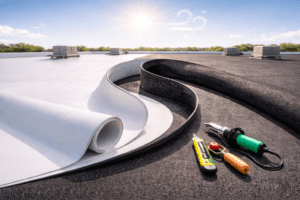



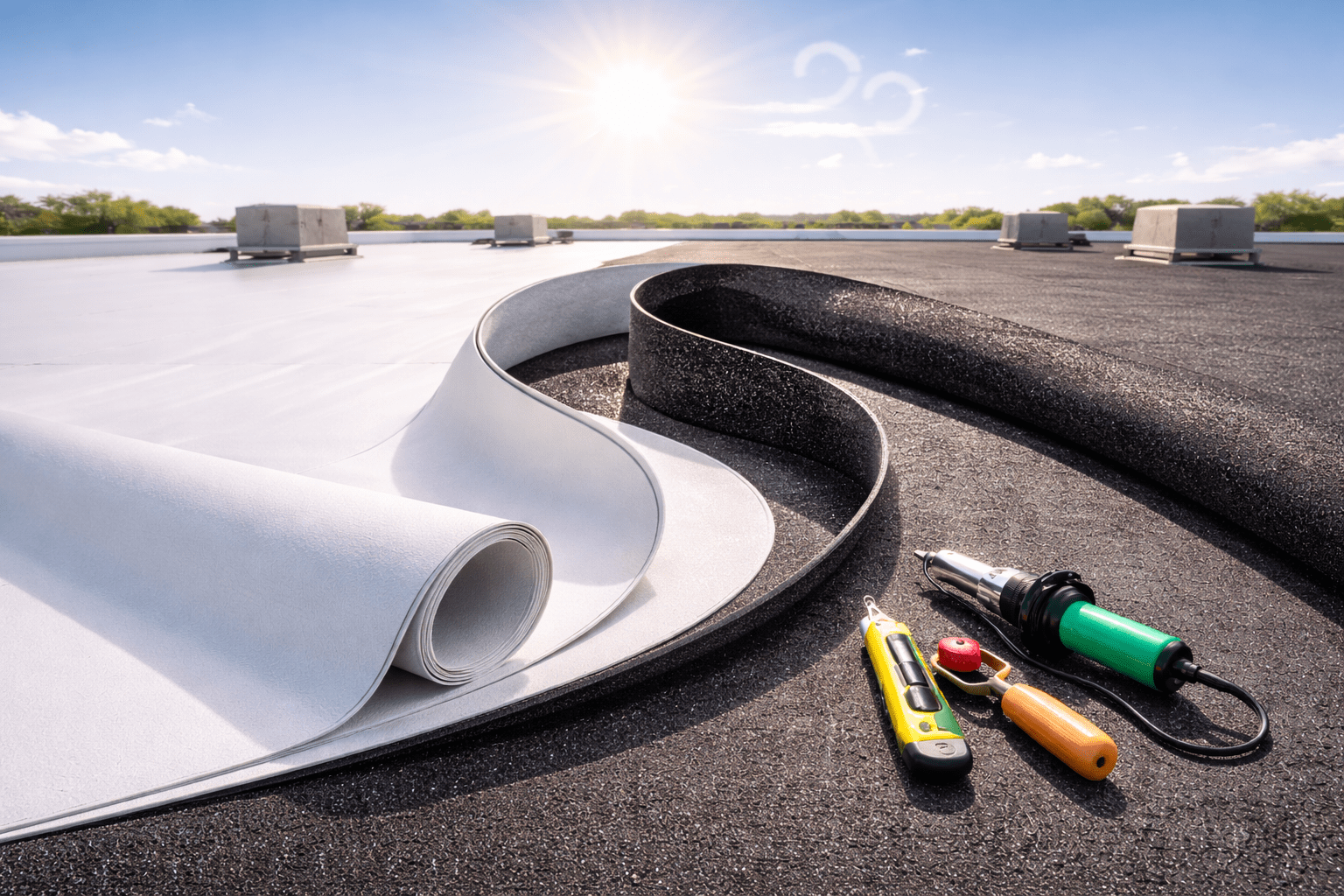
TPO dominates the commercial low-slope roofing market with roughly 40% market share, according to NRCA data. But modified bitumen remains the go-to system for high-traffic roofs and buildings that take a beating from equipment and foot traffic. Neither system is universally better. The right choice depends on your building type, your priorities, and what your roof actually needs to do.
At CES Commercial Roofing, we install both systems across Florida and have put over 15 million square feet of commercial roofing on buildings of all types. This comparison breaks down exactly where each system excels, where it falls short, and how to decide which one makes sense for your property.
What is TPO roofing?

TPO (Thermoplastic Polyolefin) is a single-ply membrane made from polypropylene and ethylene-propylene rubber, reinforced with a polyester scrim. It comes in 45-mil, 60-mil, 72-mil, and 80-mil thicknesses and is installed using hot-air welding at 600 to 800 degrees Fahrenheit. That welding process fuses overlapping sheets into a continuous, watertight bond.
Three attachment methods are available: mechanically fastened (the most common and cost-effective), fully adhered (best wind resistance), and ballasted (uncommon for TPO since it covers the reflective surface). Sheets come in widths up to 16 feet, which means fewer seams on large roofs.
TPO contains no chlorine and requires no plasticizers, making it more environmentally stable than PVC. It is also 100% recyclable at end of life.
What is modified bitumen roofing?
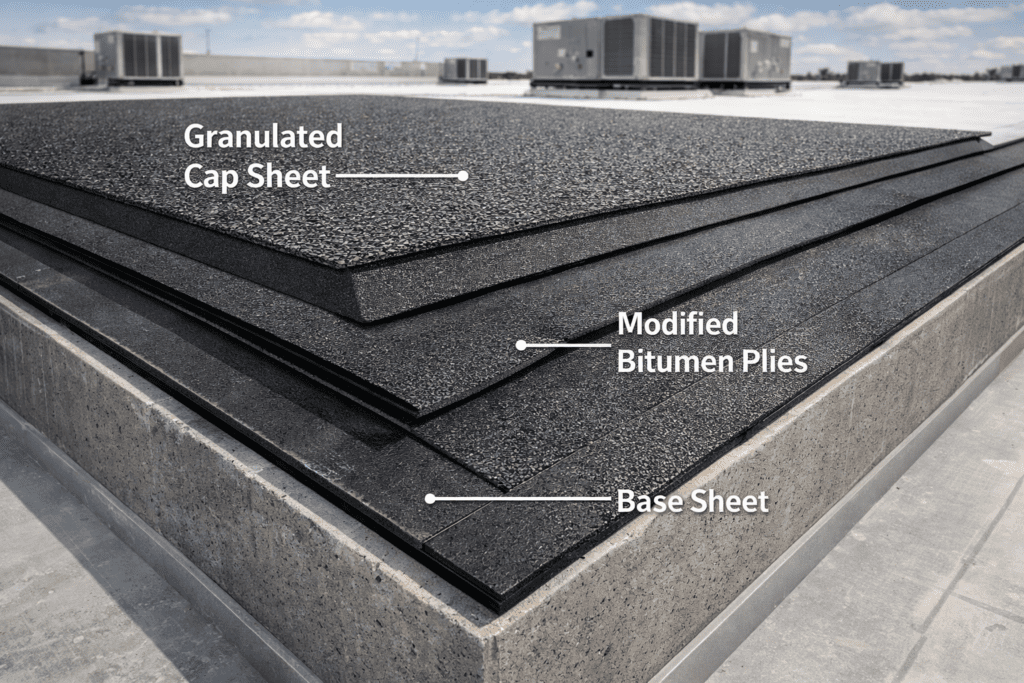
Modified bitumen is a multi-ply, asphalt-based system that evolved from traditional built-up roofing (BUR). The asphalt is modified with either SBS (styrene-butadiene-styrene), which creates “rubberized asphalt” with flexibility down to roughly negative 20 degrees Fahrenheit, or APP (atactic polypropylene), which offers better UV resistance and high-temperature stability.
A typical system includes a base sheet, one or more modified bitumen plies, and a granule-surfaced or coated cap sheet. Total thickness is around 240 mils, compared to TPO’s 45 to 80 mils.
Four application methods are available:
- Torch-applied (strongest bond, but introduces fire risk and requires CERTA certification)
- Cold-applied adhesive (no flame, suitable for occupied buildings)
- Self-adhered peel-and-stick (fastest, zero VOC)
- Hot-mopped (traditional method, declining in use)
Fire-rated assemblies are available for buildings that require enhanced fire protection.
How do TPO and modified bitumen compare on cost?
Upfront cost is where modified bitumen has a clear advantage. But the full picture changes when you factor in energy savings, maintenance, and service life.
| Metric | TPO | Modified Bitumen |
| Installed cost per sq ft | $6.50 to $15.00 | $4.00 to $9.00 |
| Material cost per sq ft | $1.75 to $3.75 | $3.00 to $5.00 |
| Annual maintenance cost per sq ft | $0.05 to $0.08 | $0.04 to $0.25 (recoating adds cost) |
| Expected lifespan | 20 to 30 years | 20 to 30 years (with maintenance) |
| Recoating cycle | Not required | Every 10 to 12 years at approximately $2.00/sq ft |
On a 20,000-square-foot building, modified bitumen’s lower upfront price looks attractive. But TPO’s energy savings (covered below) can generate $3,000 to $6,000 per year in reduced cooling costs. Modified bitumen also requires periodic recoating every 10 to 12 years at roughly $2.00 per square foot, which adds $40,000 per cycle on that same building.
Over a 25-year lifecycle, TPO typically delivers lower total cost of ownership despite the higher installation price.
Which system is more energy efficient?
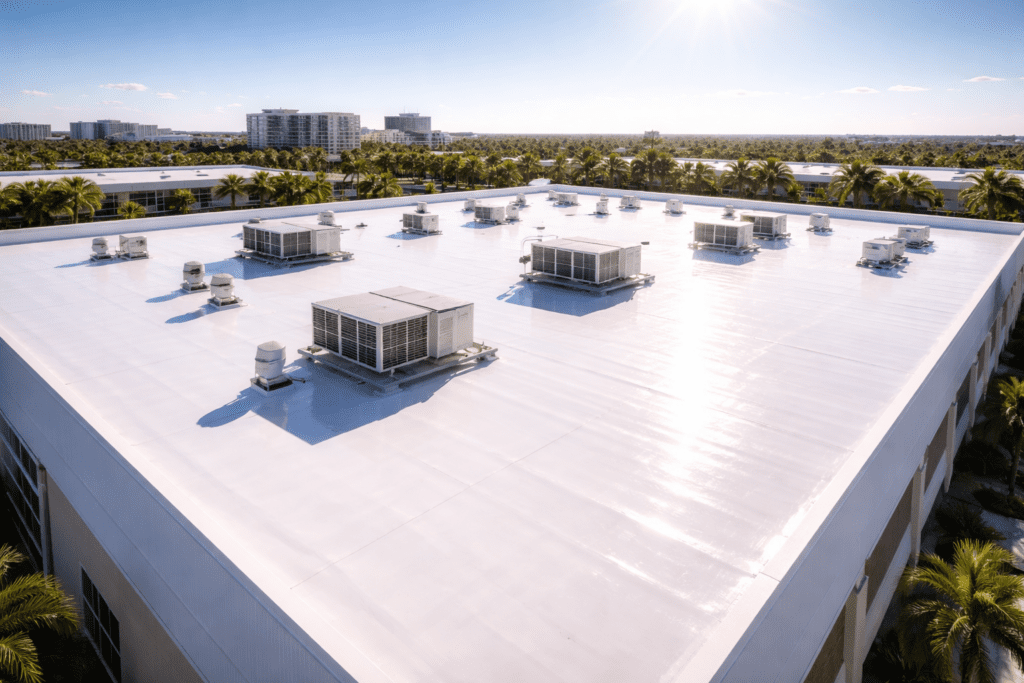
This is where TPO pulls ahead significantly.
White TPO membranes reflect 80 to 87% of solar radiation out of the box. Every major TPO product meets ENERGY STAR requirements without special coatings. Typical Solar Reflectance Index (SRI) values range from 82 to 104 initially, aging to 64 to 90 after three years. That exceeds LEED v4’s minimum requirement of 64 aged SRI for heat island reduction credit.
Research from Lawrence Berkeley National Laboratory documented cooling energy savings of 3.3 to 7.7 kWh per square meter per year from cool roofs, depending on climate zone and building type. Federal Energy Management Program analysis shows commercial buildings save up to $0.20 per square foot annually with white reflective roofs. On a 20,000-square-foot building, that translates to roughly $4,000 per year in cooling savings.
Standard dark modified bitumen reflects only 5 to 10% of solar radiation. Reflective cap sheets have closed this gap. Products from manufacturers like Polyglass and SOPREMA can achieve initial SRI values in the 90s. But reflective modified bitumen adds roughly $0.50 per square foot in premium over standard dark products. TPO’s reflective performance costs nothing extra.
For Florida specifically, the Florida Building Code (8th Edition) requires low-slope roofs above cooled spaces to achieve a minimum three-year aged solar reflectance of 0.55. TPO meets this automatically. Modified bitumen requires specification of reflective cap sheets or coatings to comply.
How do they perform in Florida weather and hurricanes?

Both systems perform well in Florida when properly installed. Each has distinct advantages depending on the specific threats your building faces.
TPO thrives in heat. Its reflective surface reduces thermal stress, and the thermoplastic composition handles thermal cycling without cracking. TPO resists mildew, mold, and algae, which matters in Florida’s persistent humidity.
For wind resistance, certified TPO systems achieve FM 1-90 to 1-120+ ratings. Fully adhered systems in High Velocity Hurricane Zones meet Miami-Dade County requirements for wind resistance exceeding 180 mph. Heat-welded seams outperform most modified bitumen seam methods by roughly 30% in tensile strength. TPO also handles ponding water better than modified bitumen, an important factor on Florida’s flat commercial roofs during heavy rainfall.
Modified bitumen excels at impact resistance. Its 240-mil multi-ply construction provides far superior protection against flying debris during hurricanes. If one layer is punctured, underlying layers maintain waterproofing. That redundancy is something no single-ply system can match.
SBS-modified bitumen handles temperature swings during Florida storms well, while APP-modified bitumen is generally recommended for southern Florida’s sustained heat.
Both systems from major manufacturers hold Florida Product Approvals and Miami-Dade County Notices of Acceptance. Non-approved products cannot legally be installed in Florida.
What about puncture resistance and foot traffic?
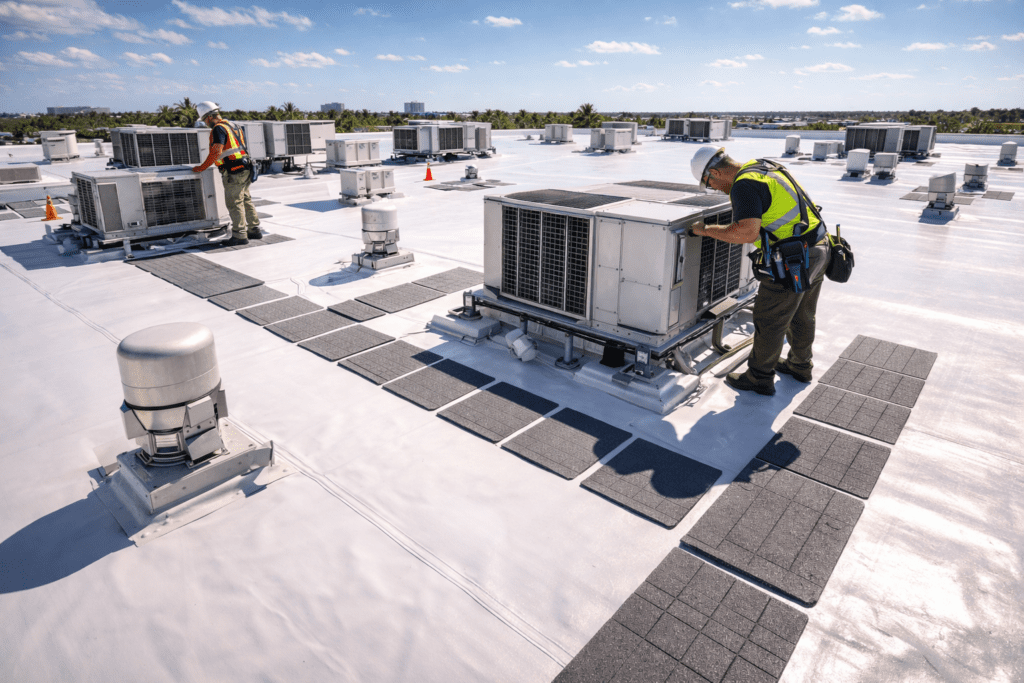
This is modified bitumen’s strongest advantage.
Modified bitumen’s multi-ply construction at roughly 240 mils total thickness is three to five times thicker than TPO. That thickness provides superior protection against punctures from dropped tools, HVAC equipment, and regular maintenance traffic.
TPO is a single-layer membrane. While modern formulations are durable, walkway pads are recommended for any areas with regular foot traffic. Buildings where HVAC technicians, maintenance crews, and other contractors regularly access the roof benefit from modified bitumen’s multi-ply armor.
Buildings where the roof is primarily a weather barrier benefit more from TPO’s reflective performance and lower total cost of ownership. This includes large warehouses, distribution centers, and retail facilities across Orlando and similar hot Florida markets.
How do warranty options differ?
TPO manufacturers generally offer longer maximum warranty terms.
| Warranty Detail | TPO | Modified Bitumen |
| Maximum manufacturer warranty | Up to 35 years NDL | Up to 30 years NDL |
| Typical warranty range | 15 to 30 years | 10 to 20 years |
| NDL (No Dollar Limit) available | Yes | Yes (select programs) |
| Reflectivity warranty | Up to 10 years (white membranes) | Not standard |
NDL warranties cover the full cost of materials and labor at current prices. If a roof installed for $100,000 needs warranty repair at year 19, when costs have inflated to $185,000, an NDL warranty covers the full amount. That protection matters over long warranty terms.
All manufacturers require certified contractor installation, manufacturer-specified materials, and ongoing maintenance programs for extended warranty coverage. This is why manufacturer certification matters. A non-certified contractor can only provide material warranties, which cover defects in the products themselves but not the installation. System warranties covering both labor and materials are only available through certified contractors.
Do both systems qualify for Section 179 tax deductions?
Yes. Both TPO and modified bitumen qualify identically under Section 179. The Tax Cuts and Jobs Act expanded Section 179 to include improvements to nonresidential real property, specifically naming roofs alongside HVAC, fire protection, and security systems.
The 2025 Section 179 deduction limit is $2.5 million (increased under the One Big Beautiful Bill Act), with phase-out beginning at $4 million in total qualifying property.
Roof coatings applied over either system also qualify for Section 179 expensing. Whether the coating restores a TPO, modified bitumen, or metal roof, the tax treatment is identical. At CES, we frequently work with property owners on silicone coating restorations that qualify for immediate deduction rather than 39-year depreciation.
An additional opportunity exists through Section 179D (Energy Efficient Commercial Building Deduction), which provides $0.50 to $1.00 per square foot in deductions when a roofing upgrade achieves energy savings of 10% or more. TPO’s reflective properties make this threshold easier to reach.
Consult your tax advisor for guidance specific to your situation.
What does the market share data tell us?
The commercial roofing industry’s shift toward TPO is well-documented. According to the 2025 Commercial Roofing Trends Report from Roofing Contractor magazine, 37% of contractors identified TPO as their chief product category, leading all other systems. The Western Roofing Market Survey reported TPO at 36.5% of the Western U.S. low-slope market, with all modified bitumen products combined at 20.5%.
SPRI shipment data shows thermoplastic membranes (TPO and PVC combined) grew 24.5% in recent years versus modified bitumen’s 10.4% growth over the same period. Major retailers including Walmart, Target, and Amazon, mandate TPO for new construction across billions of square feet of retail and logistics space.
The trend is driven partly by energy code compliance, partly by lifecycle economics, and partly by labor considerations. TPO is generally simpler to install, which matters in an industry where the majority of contractors report difficulty hiring skilled labor.
When is TPO the right choice?
TPO is the stronger option for:
- New construction on large flat roofs (warehouses, distribution centers, big-box retail)
- Buildings prioritizing energy efficiency or LEED certification
- Owners focused on lowest lifecycle cost over 20 to 30 years
- Florida projects needing straightforward energy code compliance
- Roofs with minimal foot traffic or rooftop equipment
- Properties in Tampa Bay, Orlando, and other hot Florida markets where cooling costs dominate operating budgets
When a customer needs a full roof replacement and asks us what we recommend, TPO is typically the answer. It is less expensive than modified bitumen over its lifecycle, more energy efficient, and simpler to maintain.
When is modified bitumen the right choice?
Modified bitumen is the better fit for:
- High-traffic roofs with extensive HVAC equipment or regular maintenance access
- Buildings with complex geometry and numerous penetrations
- Projects requiring Class A fire ratings with proven multi-layer fire performance
- Roofs needing maximum impact and debris resistance (industrial facilities, areas with heavy hail)
- Recovery or overlay projects on existing BUR or modified bitumen systems
- Owners who prioritize lowest upfront cost over lifecycle economics
Why contractor selection matters more than membrane selection
NRCA data consistently shows that nearly half of all roof assembly failures stem from contractor error and improper installation, not material defects. A properly installed system of either type, maintained according to manufacturer specifications and backed by an NDL warranty from a certified contractor, will protect a commercial building for decades.
That means the contractor you choose matters more than the membrane you select. When evaluating any commercial roofing contractor, verify their manufacturer certifications, confirm standalone workers’ compensation coverage for everyone on the roof, and ask whether they can provide system warranties (not just material warranties) for the specific products being installed.
Get a free roof evaluation from CES Commercial Roofing

If you are weighing TPO against modified bitumen for your commercial building in Florida, we can help you make the right call. CES Commercial Roofing provides free, no-obligation roof evaluations that include drone-assisted inspection and, when needed, thermal imaging to assess your roof’s actual condition. Call us at (813) 419-1918 or visit cesroof to schedule yours.