

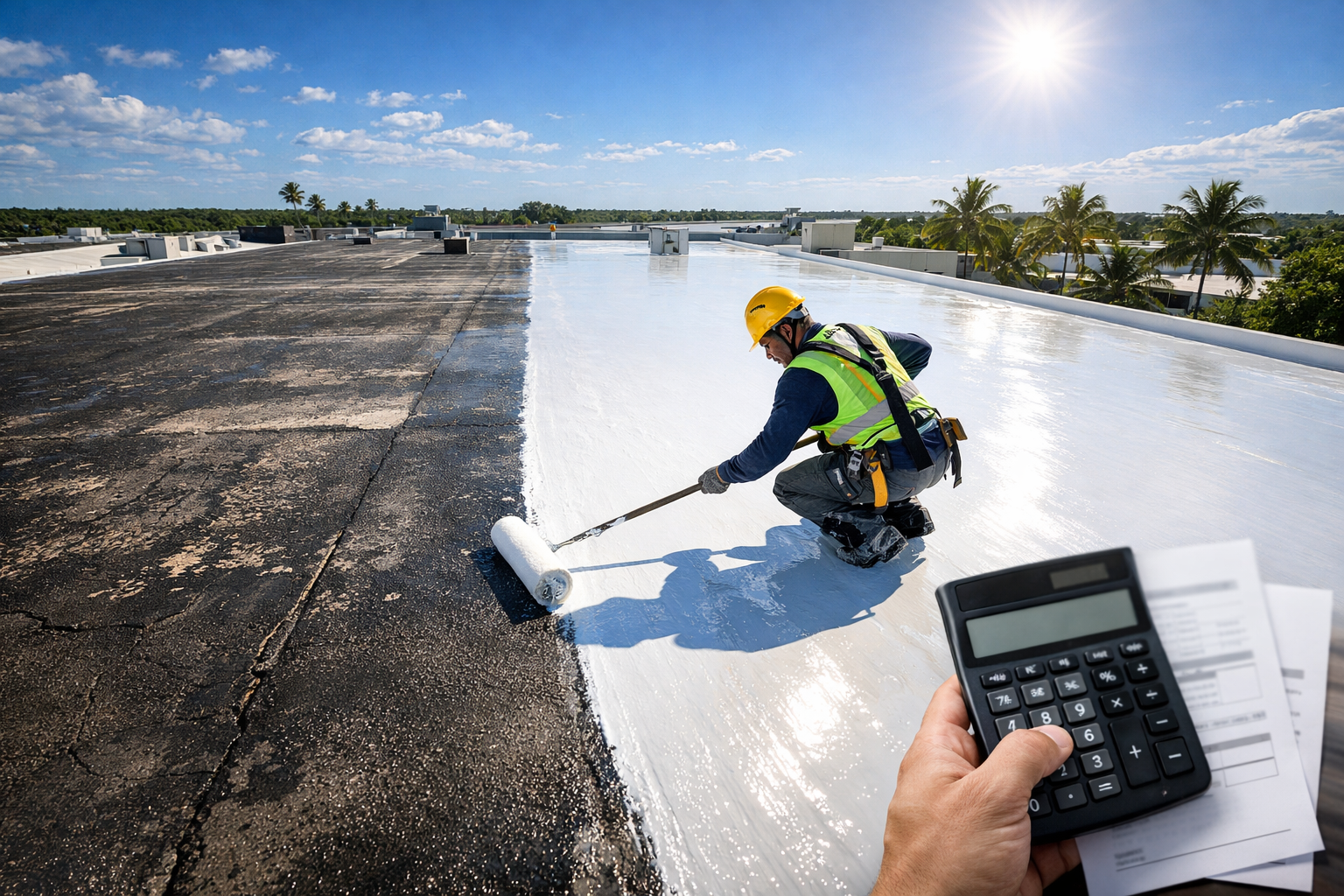
Yes, Section 179 can apply to commercial roof coatings, but the tax treatment depends on how the IRS classifies the work. In many cases, a roof coating project may qualify for an even better tax outcome: full deduction as a repair expense in the year the work is completed, without needing Section 179 at all.
At CES Roofing, silicone coating restorations are the service we perform most frequently across our 15 million square feet of commercial roofing work in Florida. We’ve seen firsthand how the tax treatment of a coating project can significantly reduce the net cost for building owners, sometimes making the difference between a property manager pulling the trigger on a project or delaying it another year. A coating restoration typically costs roughly one-third the price of a full roof replacement, and when you factor in same-year tax deductions, the financial case gets even stronger.
This guide breaks down exactly how the IRS treats commercial roof coatings, what Section 179 covers, and what Florida building owners need to know before filing.
What Is Section 179 and How Does It Apply to Roofing?
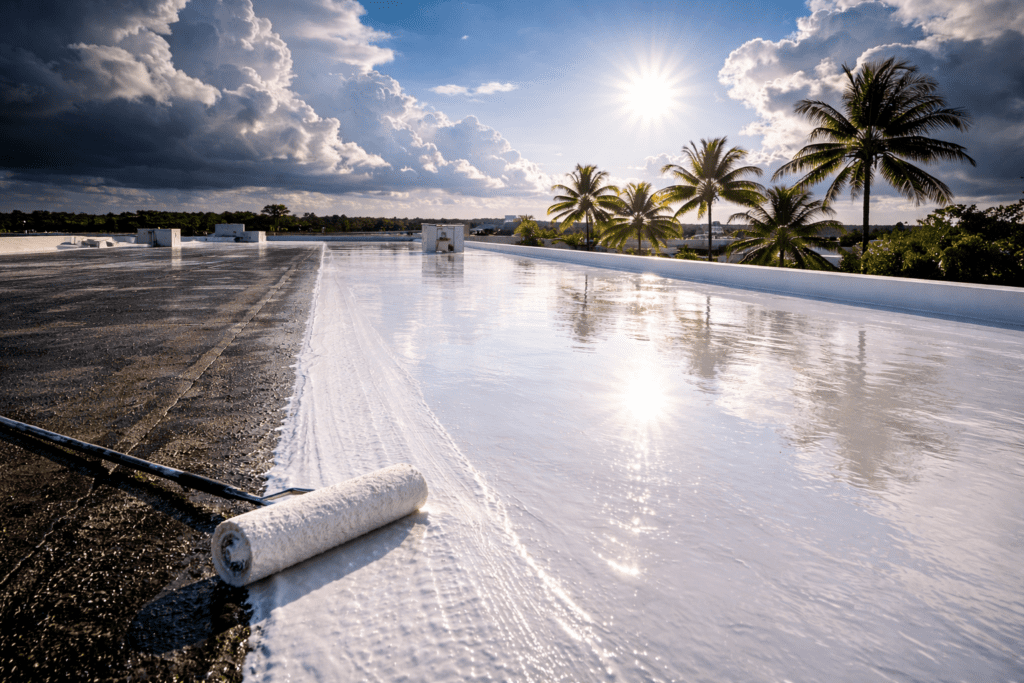
Section 179 of the Internal Revenue Code allows businesses to deduct the full purchase price of qualifying property in the year it’s placed in service, rather than depreciating it over time. For commercial building owners, this is significant because a new roof would otherwise be depreciated over 39 years under standard MACRS rules.
The Tax Cuts and Jobs Act of 2017 expanded Section 179 to explicitly include improvements to nonresidential real property, including roofs, HVAC systems, fire protection systems, and security systems. The One Big Beautiful Bill Act of 2025 then doubled the maximum deduction.
Current Section 179 limits:
| Tax Year | Maximum Deduction | Phase-Out Begins At | Full Phase-Out |
| 2025 | $2,500,000 | $4,000,000 | $6,500,000 |
| 2026 | $2,560,000 | $4,090,000 | $6,650,000 |
So yes, if your commercial roof coating project is classified as an improvement, you can expense it under Section 179 in the year the work is completed rather than spreading the deduction across decades.
But here’s where it gets interesting for coating projects specifically.
Roof Coatings: Repair Expense vs. Capital Improvement

The IRS draws a line between repair expenses and capital improvements, and which side your roof coating falls on determines the tax treatment.
Repair expenses are fully deductible in the current tax year under IRC Section 162 as ordinary business expenses. No Section 179 election needed. No depreciation schedule. You just deduct the full amount.
Capital improvements must be capitalized and can then be expensed through Section 179 (or depreciated over 39 years if you don’t elect Section 179).
For many commercial roof coating projects, the work qualifies as a repair, which means you get the full deduction without even needing to invoke Section 179. This is often the most favorable tax outcome.
The IRS BAR Test
The IRS uses three criteria, known as the BAR test, to determine whether work on a building is a capital improvement:
- Betterment: Does the work fix a material condition that existed before you acquired the building, or does it materially increase the capacity, productivity, or efficiency of the roof system?
- Adaptation: Does the work adapt the roof to a new or different use?
- Restoration: Does the work replace a major component or substantial structural part of the roof system, or return the property to a like-new condition after it has deteriorated?
If the answer to all three is no, the expense is generally treated as a deductible repair.
How This Applies to Coating Projects

A silicone coating restoration applied to an existing commercial roof that is structurally sound but showing age and wear often falls into the repair category. You’re not replacing the roof system. You’re not adapting it to a new use. You’re restoring its protective surface to maintain its original function.
That said, the classification isn’t always clear-cut. Factors that influence the IRS determination include:
- Scope of work: A coating applied over an otherwise intact roof system is more likely to be treated as a repair. A coating combined with significant structural work (tearing out wet insulation, replacing decking) may push the project into improvement territory.
- Percentage of roof affected: If more than 25% of a commercial roof is wet in Florida, state building code requires a full tear-off. At that point, you’re looking at a replacement, not a restoration.
- Timing relative to acquisition: If you coat a roof shortly after purchasing a building to fix a pre-existing condition, the IRS may view that as a betterment.
- Documentation: Contractor invoices, inspection reports, and before/after photos all matter. How the work is described on the invoice can influence how the IRS views it.
Tax Treatment Comparison
| Classification | How You Deduct It | When You Deduct It | Section 179 Required? |
| Repair expense | Full deduction as ordinary business expense | Year completed | No |
| Capital improvement (with 179 election) | Full deduction via Section 179 | Year placed in service | Yes |
| Capital improvement (without 179) | Depreciated over 39 years | Spread across 39 years | No |
The bottom line: many coating restorations qualify for full same-year deduction either way. If it’s a repair, you deduct it directly. If it’s an improvement, Section 179 lets you expense it immediately instead of depreciating it over four decades.
What About Section 179D? The Energy Efficiency Deduction
Section 179D is a separate provision that provides tax deductions specifically for energy-efficient improvements to commercial buildings. It’s different from the standard Section 179 deduction.
This matters for roof coatings because silicone-coated and SPF roofing systems create reflective “cool roof” surfaces that can significantly reduce cooling costs, particularly in Florida. If the coating contributes to measurable energy savings of at least 25% for the building’s envelope system, it may qualify for the 179D deduction.
However, Florida building owners should be aware of a deadline: the One Big Beautiful Bill Act terminated the 179D deduction for property whose construction begins after June 30, 2026. If you’re considering a coating project that could qualify, the window is closing.
The 179D deduction and Section 179 expensing are separate benefits. Depending on how a project is structured and classified, a building owner could potentially benefit from both. Talk to your tax advisor about whether your specific project qualifies.
Why This Matters More for Coatings Than Replacements
The tax advantage of a coating restoration over a full replacement goes beyond the upfront cost difference.
A full roof replacement is almost always classified as a capital improvement. There’s no ambiguity. You’re replacing a major building component. Under current rules, you’d either expense it through Section 179 or depreciate it over 39 years.
A coating restoration has a reasonable path to being classified as a repair expense, depending on the scope and circumstances. That means:
- Lower project cost (roughly one-third the price of a full replacement)
- Full same-year deduction without needing to elect Section 179
- No impact on your Section 179 annual limit, leaving that capacity available for other qualifying purchases
For building owners with multiple properties, this is a meaningful planning consideration. A $150,000 coating project deducted as a repair doesn’t count against your Section 179 cap. A $450,000 replacement deducted under Section 179 does.
How to Position Your Coating Project for the Best Tax Outcome
These steps won’t guarantee a specific classification, but they’ll give you the strongest foundation for claiming the deduction your project deserves.
Get a thorough roof inspection first. A professional evaluation that documents the current condition of the roof, identifies specific deficiencies, and confirms the structure is sound enough for restoration creates the factual basis for repair classification. At CES Roofing, our free evaluations include drone-assisted assessment, and we deploy thermal imaging when we suspect hidden moisture. That thermal data is particularly important because it objectively shows whether moisture damage exceeds the 25% threshold that triggers mandatory tear-off under Florida building code.
Keep detailed records. Invoices should describe the work accurately: surface preparation, cleaning, seam treatment, and coating application. If the work is maintaining and restoring the roof’s existing protective surface, the documentation should reflect that.
Separate repair work from improvement work. If your project involves some components that are clearly repairs (patching, seam treatment) and others that could be considered improvements, ask your contractor to itemize them separately on the invoice. This gives your tax professional the information they need to classify each component correctly.
Consult your tax advisor before the project starts. The time to plan the tax treatment is before the work begins, not at filing time. Your CPA or tax professional can advise on classification, documentation requirements, and whether a Section 179 election makes sense for your situation.
Florida-Specific Considerations
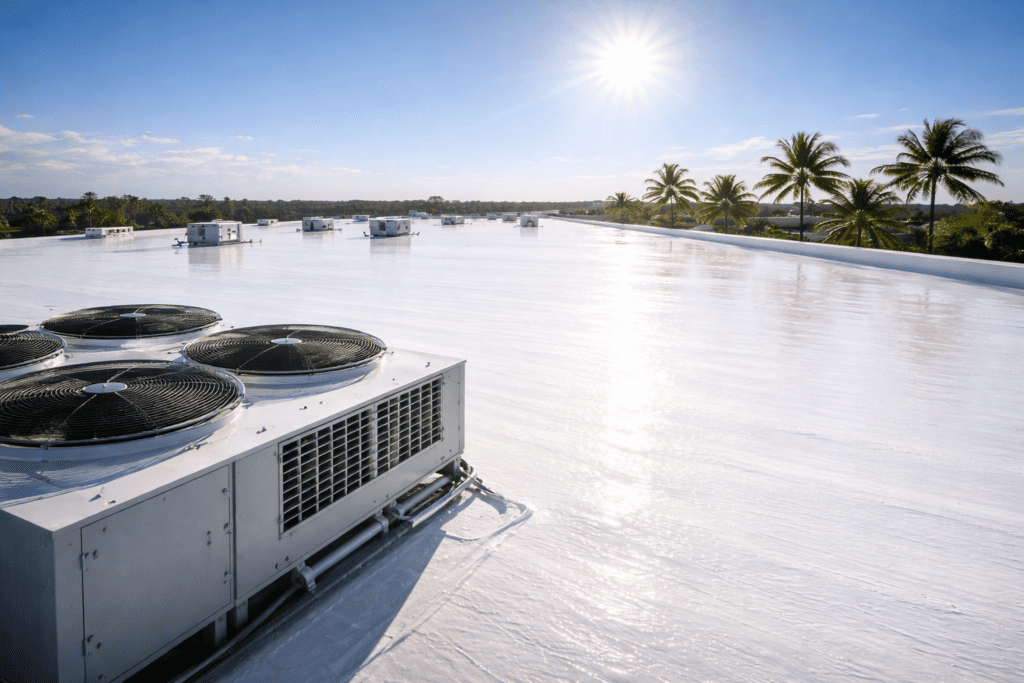
Florida’s commercial roofing environment creates some unique tax planning dynamics.
Year-round roofing season. Unlike northern states where roofing work is seasonal, Florida’s climate allows projects year-round. This gives building owners flexibility to time projects for the tax year where a deduction provides the most benefit.
Hurricane and storm damage. If a coating project is prompted by storm damage, the tax treatment may differ. Storm damage repairs to restore a roof to its pre-storm condition are generally deductible. Insurance proceeds, casualty loss deductions, and the interplay with restoration costs can get complicated. Work with your insurance adjuster and tax advisor in parallel.
The 25% moisture rule. Florida Building Code requires a full tear-off when more than 25% of a roof system is wet. This means a building owner who delays maintenance too long may lose the option of a coating restoration entirely, along with the potentially favorable repair expense treatment. Regular inspections and annual maintenance catch moisture problems early, when they can still be addressed within a restoration scope.
High cooling costs magnify energy savings. Florida’s climate means the reflective properties of a silicone-coated or SPF roof system produce measurable energy savings, which strengthens a potential 179D claim and reduces ongoing operating costs independently of the tax benefits.
Common Questions About Section 179 and Roof Coatings
Can I deduct the full cost of a roof coating in one year?
In most cases, yes. If the coating qualifies as a repair expense, you deduct it in full as an ordinary business expense. If it’s classified as an improvement, you can still deduct the full cost in one year by electing Section 179, provided you’re within the annual limits.
Does Section 179 apply to rental commercial properties?
Yes. Section 179 applies to improvements on nonresidential real property used in a trade or business. Commercial rental buildings qualify. The property must be used more than 50% for business purposes.
What if my coating project is part of a larger renovation?
The IRS looks at the substance of the overall project. If your coating is bundled with extensive structural repairs, new insulation, or other work that constitutes a major restoration, the entire project may be classified as a capital improvement. Where possible, separate routine coating work from more extensive renovation projects.
Is there a dollar limit on repair expense deductions?
No. Unlike Section 179, which has annual caps, there is no dollar limit on repair expense deductions under Section 162. If a $200,000 coating project legitimately qualifies as a repair, you can deduct the full amount.
What records should I keep?
Maintain inspection reports (before and after), thermal imaging data, contractor invoices with detailed scope descriptions, warranty documentation, photos, and any correspondence describing the purpose of the work. The IRS tangible property regulations place the burden of proof on the taxpayer.
The Bottom Line

Section 179 does apply to commercial roof coatings classified as improvements, and the expanded limits under the One Big Beautiful Bill Act make it more accessible than ever. But for many coating restoration projects, the repair expense classification may provide an even more straightforward path to a full same-year deduction.
Either way, the result is the same: a commercial roof coating completed this year can be fully deducted this year, reducing your taxable income and improving cash flow. When you combine that with the fact that a coating restoration costs a fraction of a full replacement and comes with 10, 15, or 20-year manufacturer warranties, the math works hard in your favor.
If you own a commercial property in Florida and your roof is showing its age, start with a professional evaluation to understand your options. We offer free, no-obligation roof evaluations that include drone-assisted inspections and thermal imaging when warranted. That evaluation gives you and your tax advisor the data you need to make the right decision for your building and your bottom line.
Call CES Roofing at (813) 419-1918 or request a free evaluation to get started.
Disclaimer: This article is for informational purposes only and does not constitute tax advice. Tax laws change frequently, and the classification of any roofing expense depends on the specific facts and circumstances of each project. Consult a qualified tax professional before making decisions about deductions, Section 179 elections, or expense classification.