

Most aging commercial metal roofs in Florida can be restored rather than replaced, and the restoration usually runs about one-third the cost of a full tear-off and reskin. Replacement is the right answer only in specific situations: when corrosion has eaten through the metal, when the structure underneath has lost its load-bearing capacity, or when widespread trapped moisture has saturated the insulation. At CES Roofing, coating restorations are the work we perform most, and across 15 million square feet of commercial roofing we have installed and serviced, the honest answer is usually the same: restore first, replace only when the roof leaves you no other choice.
A full replacement is the bigger payday, so plenty of contractors default to “tear it off and reskin it” whether the roof needs it or not. This guide lays out the condition factors that actually decide the question for a commercial metal roof, so you can tell the difference yourself before anyone hands you a quote.
The three options for an aging commercial metal roof
When a metal roof starts leaking or showing its age, you have three paths, not one. The condition of the roof determines which one fits.
| Path | What it involves | When it fits |
| Repair | Fixing isolated leaks, backed-out fasteners, or failed flashing | Localized problems on a roof that is otherwise sound and dry |
| Restore | Coating or foam-and-coating over the existing metal to renew the waterproofing | The metal is structurally sound and there is no widespread trapped moisture |
| Replace | Tearing off the existing roof and reskinning the building | Structural failure, perforation, or saturated insulation across the roof |
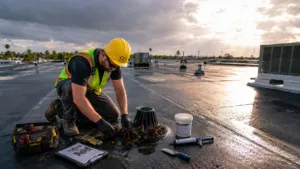
A restoration renews the waterproofing on a roof that still has good bones. It is not a structural fix. A fluid-applied coating relies on the integrity of the assembly it covers, which is why the restore-versus-replace decision can never be made from the ground or with a quick visual once-over. It takes a real diagnostic evaluation of the metal, the fasteners, the seams, and what is happening under the surface. Our commercial metal roofing and roof restoration work is built around that diagnosis.
When restoration is the right choice for a commercial metal roof
When the metal is sound, restoration is almost always the better financial and operational decision. There are four reasons.
- Cost. A coating or foam-and-coating restoration typically costs roughly one-third of a full tear-off and replacement. You avoid the labor of demolition, the disposal fees, and the heavy structural installation.
- Warranty. The same manufacturer warranties available on a new roof (10, 15, and 20 year) can be obtained through a qualifying coating restoration, at far lower cost.
- Disruption. A restoration happens over the top of an operating building. There is no tear-off exposing your interior to the weather, far less noise and dust, and your operations keep running underneath.
- Performance. A foam-and-coating system adds continuous insulation and improves energy performance, something a bare metal reskin does not do on its own.
We have seen the scale of that cost difference on real projects. On one commercial metal roof, a full reskin would have run roughly $1.2 million. We restored it with a foam-and-coating system for about $500,000, saving the owner around $700,000. That is one past project’s outcome, not a price quote, but it shows what is at stake when a sound roof gets torn off for no good reason. On another, we refurbished an 88,850-square-foot metal roof with a foam and hybrid system and finished it with a high-solids silicone coating instead of replacing it.
According to GAF, one of the manufacturers we hold certifications with, restoration is the appropriate path as long as the roof remains structurally sound, with replacement reserved for roofs that have lost that integrity.
The condition factors that decide restore vs. replace
Four things determine whether a commercial metal roof is a restoration candidate or a replacement. On a metal roof specifically, they behave differently than they would on a membrane or built-up roof.
Corrosion and substrate integrity
Surface rust is not a death sentence for a metal roof. White rust on zinc or aluminum coatings, or red oxide on bare steel, is treatable. Standard restoration prep involves pressure washing the surface, removing flaking rust, and applying a rust-inhibiting primer that arrests oxidation and gives the topcoat a stable surface to bond to.
The line gets crossed when corrosion turns structural. If rust has progressed to deep pitting or actual perforation, or if it has compromised the purlins and framing the panels are fastened to, a coating cannot bring that back. If the damage is localized, those specific panels can be replaced before the rest of the roof is coated. If it is widespread, replacement is the only sound option.
Fasteners and seams
How a metal roof is built changes where it fails and how it gets restored. The two common commercial types behave very differently.
An exposed-fastener roof, also called an R-panel roof, has ribbed panels screwed directly through the face of the metal into the deck or purlins below. That design is economical, but every screw is a penetration, and there are thousands of them. As the panels heat and cool through Florida’s daily thermal swings, they expand and contract against those fixed screws. Over time the screws back out, the holes widen, and the rubber washers under the screw heads degrade. Restoring this kind of roof means replacing backed-out screws with oversized fasteners that bite into fresh material, then encapsulating every fastener head before the coating goes on.
A standing seam roof is the higher-engineered system. The panels interlock at raised vertical seams and attach to the deck with concealed clips that let the metal glide as it expands and contracts. That floating design nearly eliminates fastener stress, so the panels themselves often last for decades. When a standing seam roof leaks, the problem is usually at the seams, the sealants, or transitions like HVAC curbs and pipe boots, not the panels. The Metal Construction Association has documented service lives well past 60 years for these systems in favorable conditions. Restoration here is about waterproofing the transitions, not fixing metal that is usually fine.
Trapped moisture in the roof assembly
This is the factor that most often rules restoration out, and the one you cannot see from the surface. In an insulated metal roof, water that has worked its way into the assembly soaks the insulation underneath. Coating over saturated insulation is a serious mistake. The new membrane is impermeable, so it seals that water inside. Under the Florida sun, the trapped moisture vaporizes, blisters the new coating, and accelerates rot in the steel deck and mold growth below.
A small, contained wet area can be cut out, dried, and rebuilt before the roof is coated. Widespread saturation across the roof means the roof has failed and needs to come off. The amount and spread of trapped moisture, not a fixed percentage, is what tips the decision. To map it accurately rather than guess, an infrared thermal scan reads the temperature differences between wet and dry insulation. When one of our inspectors finds signs of trapped moisture during a free evaluation, we bring in thermal imaging through a specialized third-party vendor to confirm the extent objectively before anyone commits to a restoration.
Silicone coating vs. foam-and-coating: which restoration fits your metal roof
When a metal roof qualifies for restoration, two systems dominate the Florida market: liquid-applied silicone coatings and spray polyurethane foam (SPF) paired with a protective topcoat. They are different tools for different roofs.
| Silicone coating | Foam-and-coating (SPF) | |
| What it does | Forms a single seamless waterproof membrane over the existing metal | Sprays an expanding foam that waterproofs and insulates, then gets a protective coating |
| Best suited to | Standing seam roofs and most sound metal roofs, especially low slopes that pond | Exposed-fastener and R-panel roofs and decks where added insulation pays off |
| Florida advantage | Moisture-cured, so it becomes rain-ready quickly in humid air and resists standing water | Adds continuous R-value and self-flashes around penetrations and curbs |
| Main caution | Requires thorough surface prep and seam treatment | Must be applied by a skilled crew and never in a way that binds standing seam clips |
A silicone coating is a fluid-applied membrane. In Florida it has a real edge over cheaper acrylic coatings: silicone cures using humidity in the air, becomes rain-ready fast, and will not re-emulsify under the permanent ponding water that collects on flat commercial roofs. Acrylic can wash off before it cures, and it breaks back down under standing water.
Spray polyurethane foam does two jobs at once. It expands into a seamless, self-flashing waterproof layer and adds significant insulation to the building envelope. The catch is that SPF demands genuine expertise. It cures through a hot chemical reaction, and on thin metal panels an unskilled applicator can warp the metal. More importantly, SPF should not be applied so it locks down a standing seam roof’s panels, because those panels need to move. The Spray Polyurethane Foam Alliance and metal panel manufacturers are clear on that point. A contractor who understands these limits will tell you which system your roof can take. One that does not will spray foam on everything.
Florida’s coastal and climate pressures on metal roofs
Florida is one of the harshest environments in the country for commercial metal roofing. Intense UV degrades materials, humidity feeds algae and lichen that hold moisture against the metal, and storm exposure tests every seam and fastener. The most underestimated threat is salt air.
Galvalume, the 55 percent aluminum-zinc alloy-coated steel that is the standard premium metal substrate, carries strong manufacturer warranties inland, often in the 25-to-50-year range. Near the coast, those warranties usually disappear. Most major metal manufacturers void their substrate warranties entirely for buildings within 1,500 feet of saltwater, because airborne chlorides mixed with humidity rapidly corrode both the metal coating and the fasteners holding the roof down.
This is where a coating earns its keep on a coastal building. A thick silicone coating seals the metal and the vulnerable fasteners away from salt air, acting as a sacrificial barrier. It also carries its own coating-manufacturer warranty in place of the factory warranty the coast voided. Lifespan, though, is never a flat number. A standing seam roof installed inland under good conditions can run several decades, while the same roof a few hundred feet from saltwater may need protective intervention far sooner. Actual longevity depends on the metal type, the coating system, installation quality, proximity to saltwater, and maintenance. We get into the specifics in our breakdown of how long metal roofs last in Florida.
Warranty implications of restoring vs. replacing
Owners are often surprised that restoration does not mean settling for a weaker warranty. A qualifying coating restoration can carry the same 10, 15, or 20-year manufacturer warranties available on a new roof, for a fraction of the cost. On a coastal building, that coating warranty replaces the factory metal warranty the saltwater exclusion took away.
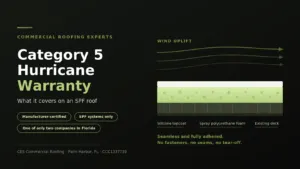
The foam-and-coating path also opens up our strongest storm-resilience option, the Category 5 Hurricane Warranty. CES is one of only two companies in Florida authorized to offer this manufacturer-certified warranty. A few things to understand about it:
- It applies to SPF systems only, not silicone coatings or other roof types.
- It warrants the foam roofing system, not the building structure.
- It is voided without the required annual maintenance.
That last point holds for coating warranties generally. The 10, 15, and 20-year warranties all require documented annual or bi-annual maintenance, including clearing drains and removing biological growth. A long warranty is a partnership, and the maintenance is a contractual condition, not a suggestion.
The Florida “25% rule” and what actually triggers a replacement
A lot of forced replacements trace back to a misunderstanding of Florida’s “25% rule.” It is worth getting right, because contractors sometimes use it to justify a tear-off you may not owe.
The 25% rule is an area-based provision, not a moisture measurement. Historically, if more than 25 percent of a roof section was repaired or replaced within a 12-month period, the entire section had to be brought up to current code. Then Senate Bill 4-D changed it in 2022, and the change was carried into the 2023 Florida Building Code. For any roof built, repaired, or replaced in compliance with the 2007 Florida Building Code (effective March 2009) or later, that forced-replacement trigger no longer applies. You repair the damaged portion, and only that portion has to meet current code. As the forensic consulting firm J.S. Held explains, the rule is about the physical scope of work performed.
If a contractor cites “the 25% rule” as the reason your structurally sound, post-2009 commercial roof has to be replaced, that is worth a second opinion.
Insurance, roof age, and why a restored roof helps
Florida’s commercial insurance market scrutinizes roofs hard, and age is the trigger. The key threshold is 15 years. Under state law, a carrier cannot deny coverage solely because a roof is under 15 years old. Once a roof passes 15 years, carriers can demand inspections, and if the roof has at least five years of useful life remaining, age alone cannot be the reason for denial.
The frustration for metal roof owners is that this generalized rule treats a 15-year-old metal roof like a worn-out shingle roof, even though commercial metal is engineered to last far longer. Some state-backed carriers acknowledge the difference. Citizens Property Insurance classifies metal, tile, and slate as “hard” roofs with longer eligibility than “soft” shingle roofs.
A manufacturer-warranted restoration changes this conversation. Applying a coating or SPF system to a structurally sound 15-year-old metal roof issues a fresh 10, 15, or 20-year warranty, which resets the roof’s profile in an underwriter’s eyes and can help secure favorable renewal terms without an expensive tear-off.
When full replacement really is the right call
Restoring first is the financially sound default, but coating a roof that has reached the end of its structural life wastes money and creates a worse problem. Replacement is genuinely the right answer when:
- The insulation is widely saturated. Coating over trapped moisture across the roof seals the water in and guarantees blistering, deck rot, and mold. A tear-off is the only sound fix.
- The metal has failed structurally. Widespread perforation, severe pitting, or corroded framing and purlins mean the substrate can no longer support a coating system.
- The roof type rules out the system. A standing seam roof that needs to keep moving cannot be locked down with rigid foam. In cases like that, the restoration approach has to change, or the roof has to be replaced.
We would rather tell you a roof needs to come off than coat over a problem and watch it fail. If a roof can be saved, we will say so. If it cannot, we will say that too.
Section 179 and the tax treatment of a restoration
There is often a tax advantage to restoration as well. Coating restorations are frequently treated as a repair expense that can be deducted in the year the work is completed, rather than depreciated over decades like a capital improvement. The exact treatment depends on the scope of the project, so confirm the details with your tax advisor before counting on a specific deduction.
How to get an objective restore-or-replace answer
The only way to know which path your roof actually needs is a real evaluation of the metal, the fasteners, the seams, and the moisture underneath. That is what a free roof evaluation is for. From our work across Florida, including Tampa and Orlando, most aging commercial metal roofs turn out to be restoration candidates. The ones that genuinely need replacement show clear, documentable reasons. When the surface inspection points to trapped moisture, we bring in third-party thermal imaging to confirm the extent before anyone commits to a direction.
If you own or manage a commercial building in Florida with an aging or leaking metal roof, get a straight answer before you pay for a tear-off you may not need. Book a free roof evaluation or call us at (813) 419-1918, and we will tell you honestly whether your roof should be restored or replaced.