


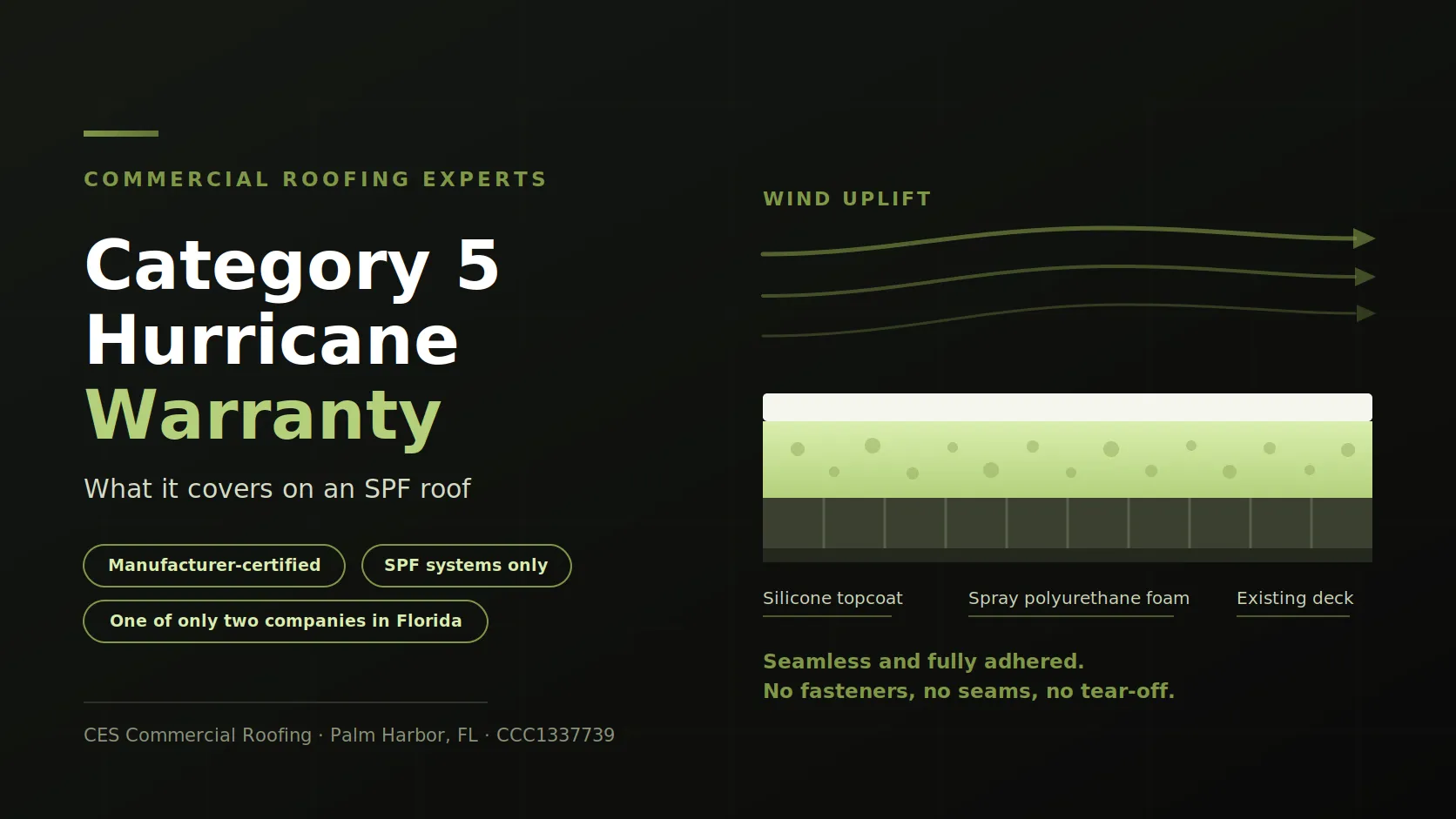
The Category 5 Hurricane Warranty is a manufacturer-certified warranty available only on spray polyurethane foam roofing systems. It covers the foam system staying intact with the substrate it is bonded to under Category 5 wind conditions, and it transfers to a new owner if the building sells. CES Commercial Roofing is one of only two companies in the state of Florida authorized to offer it.
Most commercial roofing warranties are written around leaks and material defects. Wind is usually where the coverage stops, which is a difficult place for it to stop in a state that takes a direct hit most years. This article explains what this warranty covers, the two conditions that void it, how it sits alongside the other coverage on an SPF roof, and how to tell whether your existing roof qualifies.
What the warranty covers
The coverage is specific, and the specifics are the part worth understanding before you compare it to anything else.
It is issued by the manufacturer, not by CES and not by a state or federal body. That distinction matters because a manufacturer-issued warranty is only available through a contractor the manufacturer has certified to install the system. We hold active certifications with 14 or more roofing manufacturers, including GAF, Polyglass, Tropical Roofing Products, Henry, Carlisle, NCFI, and Sherwin-Williams.
What it covers is the foam system remaining intact with the substrate it is attached to, rated for Category 5 wind speeds. It applies to SPF roofing systems only. It does not extend to TPO, metal, modified bitumen, or shingle systems, and no contractor can attach it to those.
It also warrants the foam system rather than the building underneath it. That is a real limit and we would rather you hear it from us than find it in a document later. If the metal panels or deck the foam is bonded to separate from the building, the warranty does not cover that outcome, because the foam stays bonded to those panels and leaves with them.
"Our Category 5 Warranty isn't just protection, it's proof that commercial roofing has entered a new era," said Bob Qualey, President of CES Commercial Roofing. "At CES Roofing, we're building roofs that don't just survive storms, they're built for them."
Why the warranty attaches to SPF and not to other systems
Wind does not usually tear a commercial roof off in one piece. It finds an edge, gets underneath it, and lifts. Every fastener, seam, and lap on a conventional low-slope roof is a place that can start.
SPF is sprayed on as a liquid and rises into a dense closed-cell layer that bonds to the deck across its entire surface. The finished roof is monolithic, with no fasteners, no seams, and no laps for wind to get under. That construction is the reason a manufacturer will underwrite wind performance on it at all.
The foam is not UV tolerant on its own, so it is protected with a primer and a white silicone topcoat. The completed assembly is a cool roof that reflects solar heat and reduces cooling load, and the closed-cell foam absorbs debris impact rather than puncturing the way a thin membrane can. If you are weighing the system itself against the alternative, our comparison of spray foam and TPO roofing covers that decision in full.
The two conditions that void it
Both are worth knowing before you sign, and neither is unusual for a warranty of this type.
Annual maintenance is required. If the roof is not maintained on the schedule the warranty specifies, coverage lapses. This is the condition property owners most often lose coverage on, and it is entirely avoidable. Putting the inspection on a recurring schedule at handover is the whole fix.
The substrate has to stay attached to the building. As above, the warranty covers the foam system, not the structure. If the underlying panels detach, the coverage does not follow.
It transfers when the property sells
The warranty is transferable to a new property owner. For an asset manager or an owner with a disposition timeline, that is a line item at closing rather than a marketing point. A buyer inheriting documented, manufacturer-backed wind coverage on a roof with years of service life left is in a different diligence position than a buyer inheriting an undocumented roof of the same age.
How it fits with the rest of the coverage on an SPF roof
The Category 5 Hurricane Warranty is one of three coverages that can sit on the same roof, and they answer different questions.
| Coverage | What it addresses | Applies to |
|---|---|---|
| Category 5 Hurricane Warranty | The foam system staying intact with its substrate under Category 5 wind conditions | SPF systems only |
| Manufacturer Lifetime Renewable Leak-Proof Warranty | Labor and materials against leaks, renewable on defined terms such as every 10 years | SPF systems and coating restorations only |
| Manufacturer system warranty | The installed system as a whole, in 10, 15, or 20 year terms | New installations and coating restorations by a certified contractor |
A material warranty is a different instrument again, and a weaker one. It covers product defects only, with no recourse on installation workmanship. When a contractor offers a lifetime warranty without naming the manufacturer or the term, that is usually what is on the table.
Whether your existing roof qualifies
SPF can go directly over an existing roof when that roof is in acceptable condition and meets the manufacturer's requirements, which removes the cost, disruption, and disposal of a full tear-off. On one metal roof we restored with a foam and coating system, the owner spent roughly one-third of what a full reskin would have cost.
The variable that decides eligibility is moisture trapped inside the existing assembly, and it cannot be judged by eye. Under the Florida Building Code, a new roof covering cannot go over a section that is water soaked or deteriorated to the point that it no longer works as a sound base. In practice, once more than 25% of a roof is wet, the roof has to come off.
Thermal imaging is how that gets measured rather than estimated. It reads the temperature differentials caused by water trapped between the membrane and the deck, and it produces a number you can act on. Our commercial roof inspections are free and drone-assisted, and we bring thermal imaging in whenever hidden moisture is a real possibility. If the roof can be restored we will say so. If it needs to come off, we will say that instead.
A properly installed and maintained SPF roof generally delivers 20 to 30 or more years of service life. The actual figure depends on the system specified, the substrate underneath it, sun and weather exposure, and whether the roof is recoated and maintained on schedule.
Frequently asked questions
Can the Category 5 Hurricane Warranty go on a TPO or metal roof?
No. It is available on SPF systems only. A metal roof can qualify once it is restored with a foam and coating system, because at that point the roof is an SPF assembly. The warranty cannot be attached to a bare TPO, metal, modified bitumen, or shingle roof.
Does the warranty cover the building or just the roof?
It covers the foam roofing system staying intact with the substrate it is bonded to. It does not cover the building structure. If the panels or deck the foam is attached to detach from the building, coverage is void.
What happens to the warranty if I sell the building?
It transfers to the new owner, which is one of the reasons it carries weight in a sale or a portfolio transfer.
What voids the Category 5 Hurricane Warranty?
Two things. Failing to perform the required annual maintenance, and the substrate detaching from the building.
Does an SPF roof require a full tear-off first?
Usually not. SPF can be applied over an existing roof when that roof is in acceptable condition and meets the manufacturer's requirements. A roof with more than 25% trapped moisture has to be removed, which is what the thermal imaging evaluation determines.
Schedule a free roof evaluation
Whether your roof is a candidate for an SPF system with this warranty comes down to what is happening inside the existing assembly, and that takes someone on the roof with the right equipment. We work with commercial property owners, facility directors, and asset managers across Tampa, Orlando, St. Petersburg, Clearwater, Fort Myers, Sarasota, and the surrounding Florida commercial markets.
CES Commercial Roofing is 100% commercial. We have installed 15 million square feet of commercial roofing across Florida, we hold an active Florida Certified Roofing Contractor license, CCC1337739, and our team carries 125 or more years of combined experience. We are one of only two companies in Florida authorized to offer the Category 5 Hurricane Warranty on SPF and coating systems.
Book a free, drone-assisted roof evaluation: Call (813) 419-1918 or request an inspection online.