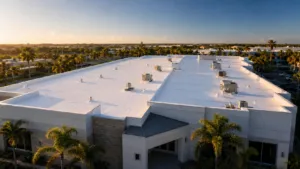


The best commercial roofing material for a Florida building depends on roof slope, budget timeline, energy goals, and proximity to the coast. TPO, SPF (spray polyurethane foam), and standing seam metal consistently outperform other systems across Florida’s combination of hurricane winds, extreme UV exposure, and year-round heat.
At CES Commercial Roofing, we have installed over 15 million square feet of commercial roofing across Florida, working with every major system type on this list. The material breakdowns below draw on manufacturer technical data, government research, FEMA post-hurricane reports, and what we see firsthand on roofs throughout Tampa, Orlando, Sarasota, and surrounding areas.
Florida enforces some of the strictest building codes in the country, including the 25% repair threshold rule, HVHZ requirements in Miami-Dade and Broward counties, and wind design speeds that can exceed 170 mph in South Florida. These factors narrow the field of viable commercial roofing materials compared to other states.
How Do Florida’s Major Commercial Roofing Systems Compare?
The table below compiles lifespan, energy performance, and wind resistance data from manufacturer technical sheets (GAF, Carlisle, Sika), government sources (DOE, ENERGY STAR), FM Global testing standards, and industry publications.
| Material | Lifespan (Years) | Wind Uplift Performance | Best Florida Use Case |
| TPO | 15-30 | FM 1-90+; mechanically attached 60-90 psf | Flat commercial roofs, energy savings |
| SPF (Spray Foam) | 20-50+ (recoat every 10-15 yrs) | Monolithic; exceeded UL test capacity at 160-165 psf | Hurricane zones, insulation + waterproofing |
| Silicone Coatings | 10-20 per application | Inherits substrate rating | Roof restoration and life extension |
| Modified Bitumen | 15-20 | Excellent; multi-ply ~240 mil thick | Debris-prone areas, high foot traffic |
| Standing Seam Metal | 40-70 | 140-180 mph tested per ASTM E1592 | Long-term investment, sloped commercial |
| R-Panel Metal | 20-30 | Good but inferior to standing seam | Budget metal option, non-HVHZ |
| PVC | 20-30 | Excellent; heat-welded seams | Chemical exposure, restaurants, industrial |
| Commercial Shingles | 10-25 in FL | 70-150 mph by grade | Budget sloped roofs only |
| EPDM | 25-40 | Good; large sheet sizes reduce seams | Poor choice in Florida (black absorbs heat) |
| BUR (Built-Up) | 20-40 | Excellent; monolithic multi-layer | Heavy equipment rooftops, high traffic |
One note on TPO lifespan: published ranges vary significantly across sources, from 10-25 years to 20-30 years. The variance largely comes down to membrane thickness (45-mil vs. 80-mil) and Florida’s intense UV, which tends to push lifespans toward the lower end of those ranges.
What Is the Most Popular Commercial Roofing Material in Florida?
TPO (thermoplastic polyolefin) dominates Florida’s commercial roofing market. According to the Roofing Contractor 2025 Commercial Roofing Trends Report, 37% of contractors named TPO as their primary product category, with TPO driving 49% of single-ply sales in 2024. More than 50% of new commercial roofs in North America now use single-ply membranes.
White TPO reflects 85-90% of solar radiation, with an initial solar reflectance of 0.85-0.90 based on GAF EverGuard technical data. The DOE estimates cool roofs like white TPO reduce cooling costs by 10-30%. After three years of weathering, GAF’s aged TPO data shows white membranes retain an SRI (Solar Reflectance Index) of 81, still well above Florida code minimums.
Heat-welded seams are TPO’s standout feature for Florida. The welds create bonds stronger than the membrane itself, which matters during hurricanes. The main weakness is puncture vulnerability. At 45-80 mils thick, TPO offers less debris resistance than multi-ply systems like modified bitumen.
When a customer needs a full roof replacement on a flat or low-slope building, TPO is typically what we recommend at CES Commercial Roofing. Installed by a certified contractor, TPO systems are eligible for up to 30-year NDL (No Dollar Limit) manufacturer warranties.
Why Does SPF Roofing Perform So Well in Hurricanes?
SPF has accumulated the strongest hurricane performance data of any commercial roofing system. NIST Technical Note 1476 (2006), the agency’s reconnaissance report on Hurricanes Katrina and Rita, found that SPF roofs were the only system type described as having performed “extremely well.” Only one examined SPF roof sustained notable damage, and that was confined to just 1% of the total roof area.
UL testing sponsored by the Spray Polyurethane Foam Alliance found that SPF applied to steel and plywood decks resisted uplift loads up to the capacity of the test equipment (160-165 psf) without any sign of delamination. FM Global testing measured SPF adhesion to concrete at over 990 psf of uplift pressure.
University of Florida Hurricane Research Center testing in 2008 showed that a 3-inch closed-cell SPF fill increased wind uplift resistance 3.0-3.2 times the original capacity of roof assemblies built to Florida high-wind code.
Six properties explain SPF’s hurricane resilience:
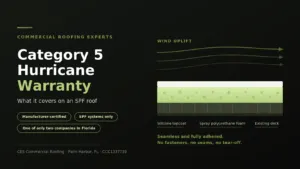
- Fully adhered application with no fasteners to fail
- Seamless, monolithic construction with no edges for wind to grab
- Self-flashing around penetrations
- Dense foam absorbs wind-driven debris impact
- Functions as an air barrier, reducing internal pressurization
- Distributes loads across the entire roof surface
SPF also delivers the highest R-value of any commercial roof insulation at R-6.5 to R-7.0 per inch, per DOE and SPFA consensus data. A typical 1.5-inch application over an existing roof adds approximately R-10 while creating a seamless, fully adhered membrane with zero mechanical fasteners. When coated with white silicone, SPF systems achieve SRI values above 100.
At CES Commercial Roofing, SPF is our flagship system. We are one of only two companies in the state of Florida authorized to offer a manufacturer-certified Category 5 Hurricane Warranty on SPF roofing systems. One of the biggest advantages for building owners is that SPF can be applied directly over an existing roof, eliminating the cost and disruption of a full tear-off.
The main limitations are that SPF cannot be applied during rain (a real scheduling challenge during Florida’s wet season) and it requires highly skilled contractors. Improper application is the primary failure mode. Only 19% of commercial contractors offer SPF, according to Roofing Contractor’s 2024 survey.
Is a Silicone Roof Coating Worth It in Florida?
Silicone roof coatings are the most cost-effective way to extend an existing commercial roof’s life by 10-20 years at a fraction of the cost of full replacement. GAF’s Unisil silicone coating achieves an initial solar reflectance of 0.83 and aged SRI of 88 (CRRC-rated).
Silicone performs especially well in Florida because it handles ponding water far better than acrylic alternatives. That matters on flat roofs during heavy rain events. The tradeoffs are that silicone adds negligible R-value and the surface becomes slippery when wet.
The coatings market is growing. Fortune Business Insights valued the U.S. roof coating market at $342.4 million in 2022 with 4.3% annual growth. According to Roofing Contractor’s 2025 report, 59% of commercial contractors are now involved in coatings, and 64% anticipate further growth.
Silicone coating restoration is the service we perform most frequently at CES Commercial Roofing. For property owners with existing roofs that are aging but still structurally sound, a coating restoration can deliver 10, 15, or 20-year manufacturer warranties at roughly one-third the cost of a full replacement.
How Do Metal Roofs Hold Up in Florida Hurricanes?
Standing seam metal offers the longest lifespan of any commercial roofing system (40-70 years for steel, up to 100 for copper or zinc) and some of the strongest wind ratings available, tested to 140-180 mph per ASTM E1592.
FEMA’s Hurricane Ian MAT report (P-2342) found that only 21% of metal panel roofs sustained visible damage, compared to 90% of asphalt shingle roofs older than 7 years. Florida insurers commonly offer 5-35% premium reductions for metal roofs, according to the Metal Roofing Alliance.
The primary barrier is upfront cost. Standing seam metal is the most expensive commercial roofing system to install. Within one mile of saltwater, aluminum panels are recommended over steel to prevent corrosion.
Metal roofs are also prime candidates for coating restorations. For property owners whose metal roof is aging but structurally sound, a coating or foam-and-coating application can extend the roof’s life by decades at a fraction of the cost of a full reskin. We do extensive coating restoration work on metal roofs for industrial storage facilities and warehouses across Florida.
How Does Modified Bitumen Compare to TPO in Florida?
Modified bitumen provides the best debris impact resistance among flat-roof systems. At approximately 240 mils thick (2-3 plies), it offers roughly four times the puncture resistance of single-ply TPO. SBS-modified bitumen is the preferred Florida variant because its rubberized flexibility handles thermal cycling better than APP.
The main drawback is energy performance. Standard dark-surface modified bitumen absorbs significant heat, increasing cooling costs unless a reflective cap sheet is specified. When a customer is replacing an existing modified bitumen roof, we typically recommend upgrading to TPO for better long-term value.
When Is PVC Roofing a Better Choice Than TPO?
PVC membranes offer similar energy performance to TPO (SRI of 104 for Sika Sarnafil white) with superior chemical resistance. That makes PVC the better choice for restaurants, industrial facilities, and any building with rooftop grease exhaust. Heat-welded seams perform identically to TPO in hurricane conditions. PVC typically costs more than comparable TPO systems, which is why TPO holds the larger overall market share.
Is BUR (Built-Up Roofing) Still Used in Florida?
BUR provides excellent multi-layer redundancy with 3-5 alternating plies of bitumen and reinforcement. It handles heavy rooftop equipment and foot traffic better than any single-ply option.
However, BUR’s market share is declining. Only 28% of commercial contractors’ low-slope asphalt work is BUR, and 36% reported declining BUR/modified bitumen sales in 2024. BUR is the heaviest commercial roofing option, installation produces fumes, and gravel surfacing makes leak detection difficult.
Should Commercial Buildings in Florida Use Asphalt Shingles?
In most cases, no. Asphalt shingles carry real risk on commercial buildings in Florida.
FEMA’s Hurricane Ian MAT report found that 90% of asphalt shingle roofs older than 7 years sustained visible damage. While architectural shingles rated to 130 mph (like GAF Timberline HDZ) perform adequately when new, Florida’s UV and heat degrade adhesive sealant strips. This dramatically reduces effective wind resistance within a decade.
Commercial shingle roofing can make sense on buildings where curb appeal matters and the roof slope requires it. For flat and low-slope commercial buildings in Florida, membrane systems like TPO, SPF, or silicone coatings are better choices on nearly every metric.
What Does Florida Building Code Require for Commercial Roofs?
The 8th Edition (2023) Florida Building Code, effective December 31, 2023, governs all commercial roofing in the state. It is based on the 2021 IBC with Florida-specific amendments and references ASCE 7-22 for wind load calculations.
Wind Speed Design Requirements
| Florida Region | Design Wind Speed (Risk Category II) |
| Interior/North Florida | 115-130 mph |
| Coastal areas | 140-160 mph |
| South Florida coast (non-HVHZ) | 150-170 mph |
| HVHZ (Miami-Dade/Broward) | 170-195+ mph |
The 25% Repair Threshold Rule
FBC Existing Building, Section 706.1.1 sets a hard threshold. If repairs exceed 25% of a roof area or roof section within 12 months, the entire roof system or section must be brought into compliance with the current code. This typically triggers a full tear-off and replacement.
A key exception: roofs permitted after March 1, 2009 (per Senate Bill 4, signed May 2022) are exempt from mandatory full replacement. Only the damaged portion needs to meet current code.
This rule interacts directly with moisture conditions. Florida code prohibits recovering over water-soaked or deteriorated materials. Thermal imaging accurately measures moisture content to determine whether a coating or recover is viable, or whether a full tear-off is required. In Florida, if more than 25% of a roof is wet, building code requires a full tear-off.
HVHZ Requirements (Miami-Dade and Broward Counties)
The High Velocity Hurricane Zone designation, established after Hurricane Andrew in 1992, imposes the most demanding commercial roofing standards in the country. Key provisions include a 2:1 safety margin on all wind uplift test results, prohibition of Exposure Category B (which effectively increases design wind pressures), and mandatory product approval for every roofing component through Miami-Dade’s Notice of Acceptance system.
HVHZ-approved products typically cost significantly more than standard products, and the limited number of approved products narrows material selection in South Florida.
How Much Can a Cool Roof Save on Energy Costs in Florida?
Florida sits in IECC Climate Zones 1 and 2, where cool roofs deliver the greatest energy savings anywhere in the U.S.
Oak Ridge National Laboratory researcher Bill Miller noted that in the Southeast and other hot climates, consumers could save up to 40% on electric bills during months they use air conditioning. ORNL conducted three-year side-by-side studies evaluating 18 single-ply membranes, 11 metal roofs, and 24 roof coatings to establish these benchmarks.
Lawrence Berkeley National Laboratory demonstrated that reflective coatings increased roof albedo from an average of 0.20 to 0.60, dropping surface temperatures from 175°F to 120°F on hot sunny afternoons. Multiple LBNL experiments in Florida showed cool roofs reduced summertime average daily A/C electricity use by 2-63%, with the wide range reflecting differences in building insulation and HVAC efficiency.
The DOE confirms that conventional roofs can reach 150°F or more on sunny Florida afternoons, while reflective cool roofs stay more than 50°F cooler under identical conditions.
The 2023 Florida Building Code requires low-sloped commercial roofs above cooled spaces to meet a 3-year aged SRI of at least 64 (or 75 in Climate Zone 1A, which covers South Florida). This effectively mandates reflective surfaces for new commercial roofs, making white TPO, PVC, silicone-coated SPF, and cool-color metal the code-compliant options. Standard black EPDM and uncoated dark modified bitumen fail to meet current energy code.
Can Section 179 Help Offset Commercial Roofing Costs?
Yes. The tax treatment of commercial roofing was significantly improved by the Tax Cuts and Jobs Act (2017) and the One Big Beautiful Bill Act (signed July 2025).
For tax year 2026, the maximum Section 179 deduction is $2,500,000 (roughly doubled from the 2024 limit of $1,220,000) under the One Big Beautiful Bill Act, signed July 2025. The OBBBA also permanently restored 100% bonus depreciation for qualifying property acquired after January 19, 2025.
The practical distinction that matters most is the difference between a repair and an improvement. Under the IRS Tangible Property Regulations, a maintenance-oriented coating that preserves the existing roof without materially improving it may qualify as a deductible repair under IRC Section 162, fully deductible in the year performed. Even if classified as an improvement, the cost can be expensed in Year 1 under current Section 179 or bonus depreciation rules.
This is one of the strongest financial reasons to consider a coating restoration over a full replacement when the existing roof is structurally sound. The building owner spends significantly less while achieving similar tax treatment. Customers should always consult their tax advisor for guidance specific to their situation.
What Is the Best Overall Roofing Material for a Florida Commercial Building?
There is no single answer because the best system depends on the building’s conditions, the owner’s priorities, and the budget. But the data narrows the field clearly.
For standard flat commercial roofs that need a new installation, TPO delivers the strongest combination of energy performance, hurricane-rated seams, and cost efficiency. It is the market leader for good reason.
For maximum hurricane protection and combined energy savings, SPF has the strongest body of wind-performance research from NIST, UL, FM Global, and university testing. It requires specialized contractors and periodic recoating, but no other system matches its documented performance in Category 4 and 5 hurricanes.
For sloped commercial roofs where longevity is the priority, standing seam metal offers 40-70 year lifespans and the lowest hurricane damage rates documented by FEMA.
For existing roofs in serviceable condition, silicone coatings offer the best return on investment, extending roof life 10-20 years at a fraction of replacement cost with favorable tax treatment.
At CES Commercial Roofing, we evaluate every roof individually and recommend the system that makes the most sense for that specific building and owner. We offer free roof evaluations that include on-site inspection, drone-assisted assessment, and thermal imaging when conditions suggest potential moisture issues. If you have questions about which material is right for your building, call us at (813) 419-1918.