

If you have a water stain spreading across a ceiling tile, standing water that sits on the roof for days, or open seams you can see from the ground, call a licensed contractor for commercial roof repair now. On a flat or low-slope commercial roof, those signs usually mean water is already inside the system. Waiting almost always makes the repair larger and more expensive.
The harder calls are the early ones: a slightly raised seam, a small blister, an energy bill creeping up with no obvious cause. Those still warrant a professional look, because flat commercial roofs are remarkably good at hiding how bad things actually are underneath.
At CES Commercial Roofing, we have installed more than 15 million square feet of commercial roofing across Florida, and the most common pattern we see in Tampa Bay is a small problem that sat too long. This guide covers the warning signs that mean you should call, why low-slope roofs disguise their real condition, how Florida’s building code can turn a repair into a full re-roof, what a qualified contractor actually does on the first visit, and how to tell a real commercial roofer from a residential crew claiming commercial capability.
Warning signs your commercial roof needs a contractor
Most warning signs on a commercial roof fall into two groups: problems that mean water is actively getting in or about to, and earlier indicators that justify a professional roof inspection before they escalate. The table below is a quick reference. The sections that follow explain what each one typically means.
| Call a contractor promptly | Worth a professional inspection soon |
| Active interior leaks or fresh water stains | Membrane blistering or bubbling |
| Standing water that does not drain within 48 hours | Surface cracking or chalking |
| Split membrane or open seams | Rising cooling bills with no other cause |
| Failed or lifting flashing at walls, curbs, and penetrations | Granule loss or worn coating |
| Visible sagging or a soft, spongy deck underfoot | Debris buildup around drains and scuppers |
A note on the second column: “worth an inspection” does not mean “safe to ignore.” It means the damage may not have breached the building yet. On a commercial roof in Florida, the gap between “early sign” and “active leak” can close fast, especially during summer.
Active leaks and water stains
A visible leak means water has already found a path through the membrane, insulation, and deck. By the time it shows on the ceiling, the water has often traveled several feet from the actual entry point on the roof. This is the clearest call-now signal there is.
Standing water that will not drain
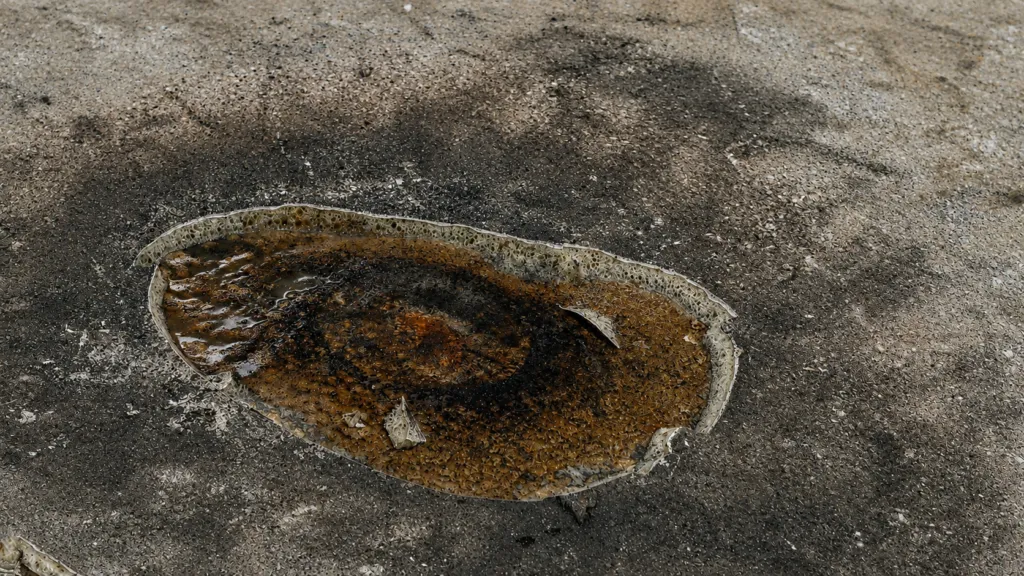
Water that remains on a roof longer than 48 hours after rain qualifies as ponding, according to the Asphalt Roofing Manufacturers Association (ARMA). Ponding adds weight to the deck, accelerates membrane aging, and breeds algae and vegetation that work into the roofing material. A flat commercial roof is built with a slight slope toward drains for a reason. When water sits instead of draining, either the slope or the drainage has failed, and the standing water itself starts causing damage.
Split seams and failed flashing
Seams and flashing are where most commercial roofs leak first. Years of Florida heat drive thermal expansion and contraction that gradually pull seams apart, and flashing at walls, curbs, drains, and rooftop equipment takes the most movement of any part of the system. An open seam or a lifted piece of flashing is an open door for water.
Blistering, cracking, and rising energy bills
Blisters form when moisture or air trapped under the membrane expands in the heat. Surface cracking points to a membrane approaching the end of its serviceable life. A cooling bill that climbs without a rate change can indicate wet insulation, which loses its R-value (its ability to resist heat transfer) once it absorbs water. None of these mean an emergency today, but each is a reason to get a professional on the roof.
Why flat and low-slope roofs hide their true condition
A pitched roof sheds water and shows damage. A commercial flat roof does the opposite: it holds water and conceals where that water goes. When water enters at a failed seam, it can travel sideways under the membrane and through the insulation before it finds a gap in the deck and drips into the building below. The stain on your ceiling is rarely under the actual leak.
This is also why a roof can look fine from the parking lot while the insulation underneath is saturated. Trapped moisture is quiet. It degrades the insulation, corrodes fasteners, and weakens the deck until the problem surfaces all at once. Accurate diagnosis on a low-slope roof means tracing water back to its source and confirming how far moisture has spread, which a visual glance from the ground cannot do.
Common leak sources on commercial flat roofs
When we trace leaks across Tampa Bay properties, the same culprits come up repeatedly:
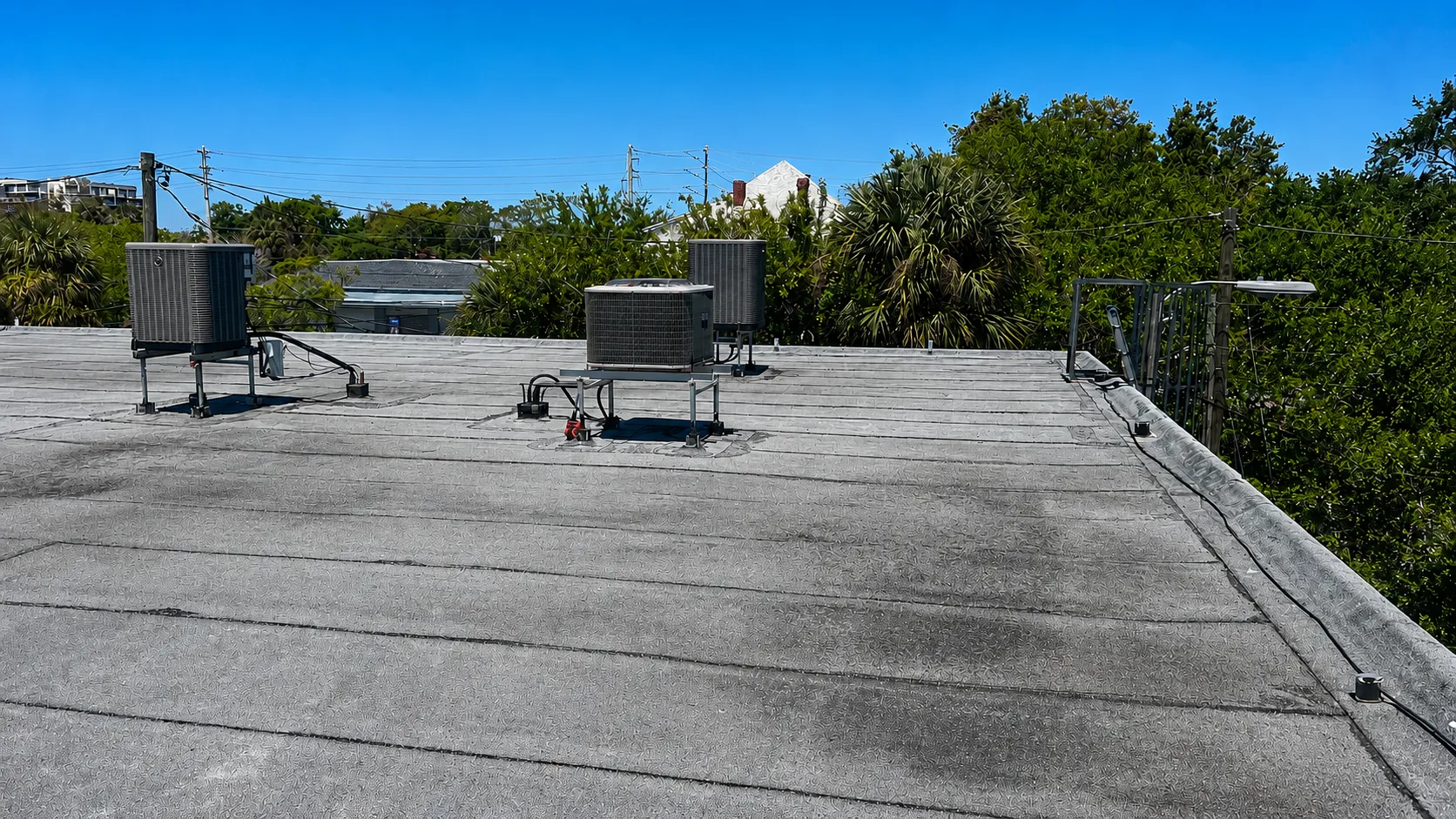
- Penetrations and rooftop equipment. HVAC units, vents, pipes, and conduit are the most common entry points. A frequent repair call starts with another trade entirely: an HVAC technician services a unit, accidentally punctures the membrane, and weeks later the tenant below reports a drip.
- Open or split seams. Where two sheets of membrane meet, age and movement eventually break the bond.
- Flashing failure. Base flashing at parapet walls and curbs lifts, cracks, or pulls away.
- Ponding water. Poor slope, a clogged drain, or a settled deck creates a low spot that holds water and degrades the membrane over time.
- Blisters and punctures. Trapped moisture, foot traffic, and dropped tools all create weak points in the membrane.
- Aged or failed coatings. A worn coating stops protecting the membrane underneath, and UV exposure does the rest.
For a property with persistent or hard-to-find leaks, professional commercial roof leak detection traces water to its true source instead of chasing the stain.
Why waiting costs more
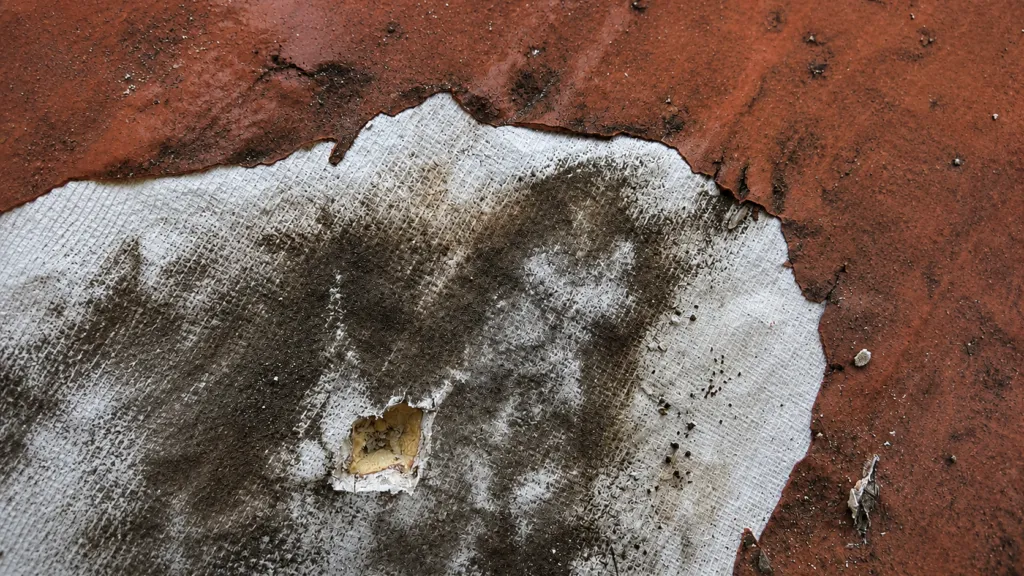
The cost of a roof repair rarely stays still. A small membrane breach lets water into the insulation, where it spreads laterally and stays. From there the damage compounds: saturated insulation has to be removed and replaced, the deck can corrode or rot, and interior finishes, equipment, and inventory take the hit when the leak finally reaches occupied space. For many commercial tenants, the real cost ends up being business interruption, not the patch itself.
A repair that would have been straightforward at the first sign of a failed seam can become a partial tear-off once the insulation is wet across a wide area. In our experience, the owners who spend the least over the life of a roof are the ones who call when the problem is still small.
Florida’s 25% rule, and how a repair can become a re-roof
This is the part of commercial roof repair in Florida that surprises the most property owners, and it is widely misunderstood. The rule lives in Section 706.1.1 of the Florida Building Code, Existing Building. Here is the part that matters, paraphrased: no more than 25 percent of a roof section can be repaired, replaced, or recovered in any 12-month period unless the entire roof section is brought up to current code.
The common misconception is that the rule is triggered when 25 percent of a roof is damaged or wet. It is not. The trigger is how much of the roof area is worked on within 12 months, and it adds up cumulatively. Several smaller repairs in the same year can cross the threshold together.
Senate Bill 4-D, signed in May 2022, and the corresponding Florida Statute 553.844(5) changed the rule for roofs permitted on or after March 1, 2009. For those roofs, only the repaired portion has to meet current code, regardless of how much area is worked on. For roofs permitted before March 1, 2009, the original 25 percent rule still applies in full.
| Roof permitted | How the 25% rule applies |
| On or after March 1, 2009 | Only the repaired area must meet current code, regardless of percentage |
| Before March 1, 2009 | Crossing 25% of a roof section in 12 months can require the full section be brought to code |
A few practical notes for Tampa Bay owners. Tampa Bay sits outside the High Velocity Hurricane Zone (Miami-Dade and Broward), which carries extra requirements that do not apply here. Code interpretation can still vary by local building department, so confirm specifics with your contractor and your authority having jurisdiction before assuming a repair is or is not subject to the rule.
Separately, extensive trapped moisture can make restoration unviable regardless of the percentage worked on, because you cannot coat or recoat over saturated insulation and expect it to perform. That is a practical limit of the materials, and it is one more reason confirming the extent of moisture matters before choosing a path.
What a qualified contractor does on the first visit
A first visit should give you a clear, honest answer about the condition of your roof and your real options. Here is what that looks like:
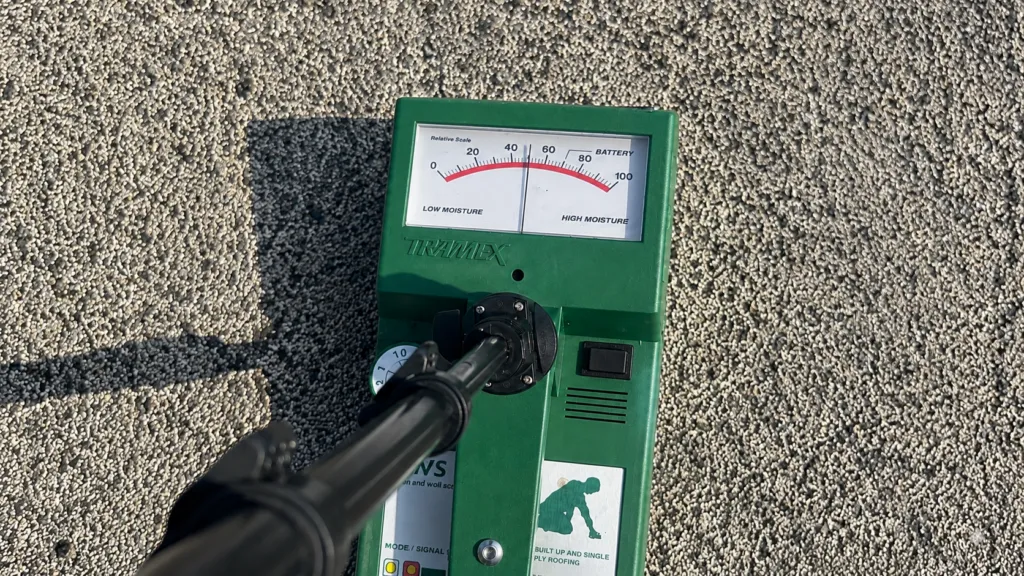
- A physical walkdown. The default is a hands-on inspection of the roof surface, seams, flashing, penetrations, and drainage, with a handheld moisture scanner to check suspect areas. Drones come into play when roof access is limited, and thermal imaging is deployed when the findings warrant a closer look at moisture spread.
- Tracing the actual problem. Good diagnosis follows the water to its source instead of patching where the stain appears. On a commercial flat roof, those are often two very different locations.
- An honest recommendation. A repair call often reveals that a roof is older than the owner realized, may be out of warranty, and is approaching the point where restoration or replacement makes more sense than another patch. We would rather tell you a roof has years left and only needs a targeted fix than sell you a replacement you do not need.
- A clear, itemized proposal. You should leave with the scope of work, the recommended system, warranty options, and pricing laid out plainly. No vague line items.
Responsiveness is the other half. The most common complaint commercial property owners have about roofers is simple: they do not call back, and they do not show up. At CES Commercial Roofing, our standard is same-day response to inquiries and a same-day or next-day site visit, because a leak does not wait for a callback. Learn more about why we prioritize responsive commercial roofing service.
How to tell a real commercial roofer from a residential crew
Plenty of residential roofers will take a commercial job if you offer one. Commercial low-slope roofing is a different discipline, with different materials, different code exposure, and far more liability for you as the property owner. Here is what separates a genuine commercial contractor from a crew working outside its lane.
| Capability | Residential crew on a commercial job | Qualified commercial contractor |
| Warranty offered | Material-only warranty from a supplier | Manufacturer system warranty covering labor and materials |
| Manufacturer certifications | Few or none for commercial systems | Active certifications across major commercial product lines |
| Licensing | License class unclear or not offered for verification | Active Florida Certified Roofing Contractor license, verifiable through DBPR |
| Moisture diagnostics | Visual inspection only | Moisture scanning and thermal imaging when warranted |
| Workers’ compensation | Frequently a “ghost” or office-only policy | Standalone policy covering every worker on the roof |
Licensing is worth confirming before anyone quotes the job. We hold an active Florida Certified Roofing Contractor license, CCC1337739, which covers the full commercial roofing scope statewide. When a leak has reached the deck, ask any contractor to tell you in writing which parts of the repair fall under their license and which will be handled by another trade.
The insurance point is the one that creates direct exposure for you as the property owner. Roofing is consistently ranked among the most dangerous trades. Florida requires workers’ compensation coverage to hold a contractor’s license, even for sole proprietors. Some operations satisfy that requirement on paper with a “ghost” policy that covers only the business owner, or with employee-leasing arrangements that insure a single office employee while the crew on your roof is uncovered. If an uninsured worker is hurt on your property, the claim can land on you. We carry standalone workers’ compensation insurance that covers every person on the roof. Any contractor you hire should be able to hand you a current certificate of insurance listing workers’ comp for all employees.
A reasonable habit before any commercial roofing project: ask for the certificate of insurance, confirm both general liability and workers’ comp are active for the full project window, and verify the roofing license before anyone steps on the roof. For a more detailed walkthrough, see our guide on how to choose a commercial roofing contractor in Tampa Bay.
Repair, restoration, or replacement: which one you actually need
A leak does not automatically mean a new roof. On a roof that is structurally sound and not widely saturated, a targeted repair or a full roof coating restoration is often the better value. Restoring a viable commercial roof with a coating or spray foam system typically runs roughly one-third the cost of a full tear-off and replacement, and it can extend the roof’s service life significantly when the underlying system still has integrity.
How long any given system lasts depends on the specifics. A TPO (thermoplastic polyolefin), modified bitumen (a multi-layered asphalt-based membrane), spray polyurethane foam, silicone-coated, or metal roof will perform differently based on the material, the quality of the original installation, climate exposure, and whether the roof is maintained over its life. Two identical systems on two different buildings can age very differently based on those factors alone. The honest path is to confirm the roof’s actual condition first, then match the recommendation to it.
Frequently asked questions
How quickly should I call about a commercial roof leak?
As soon as you notice it. Water moves through a commercial roof and into insulation, decking, and interior space faster than most owners expect, and the repair grows with every day of delay. Our standard is same-day response and a same-day or next-day site visit.
Does standing water on my flat roof mean I need a new roof?
Not necessarily. Standing water that does not drain within 48 hours is a problem worth addressing, but the cause is often a clogged drain, a low spot, or failed slope rather than a roof that needs full replacement. A proper inspection determines whether the fix is a repair, improved drainage, or something larger.
Will repairing my roof trigger Florida’s 25% rule?
It depends on how much of the roof section is worked on within 12 months and when the roof was last permitted. Roofs permitted on or after March 1, 2009 generally only need the repaired portion brought to code. Roofs permitted before that date can be subject to the full 25 percent rule. Your contractor should be able to walk you through this before work begins.
Can a coating fix my leaking commercial roof?
Often, if the roof is structurally sound and the insulation is not widely saturated. When moisture has spread too far, a coating will not perform and a tear-off becomes the responsible choice. Confirming the extent of moisture, through a proper inspection with diagnostic tools, is the deciding step.
Get a clear answer on your commercial roof
If your commercial roof in Tampa Bay, Orlando, or Sarasota is showing any of the signs above, the fastest way to know what you are dealing with is a professional evaluation. We will trace the problem, tell you honestly whether you need a repair, a restoration, or a replacement, and put it in writing with no pressure. Learn more about our commercial roof repair service in Tampa Bay. Call us at (813) 419-1918 for a free commercial roof evaluation, and we will respond the same day.