

Most standard commercial roof warranties do not cover hurricane damage. The typical manufacturer system warranty stops protecting your roof once local wind gusts pass 55 mph, and many add a “named storm” clause that voids coverage the moment a tropical system gets a name, no matter what the wind actually did at your building. A Category 1 hurricane starts at 74 mph, so a warranty capped at 55 mph leaves you exposed well below the weakest hurricane on the scale. At CES Commercial Roofing, a 100% commercial roofing company that has installed more than 15 million square feet across Florida, we have this conversation with property owners constantly, usually a few weeks before storm season, when there is not much time left to fix it.
We would rather you read the speed cap now than discover it in a denied claim. This article covers what your warranty actually protects, what quietly voids it, and how coverage works on a system built to hold up in a major storm. A roof warranty and a property insurance policy guard against different failures, and neither one alone makes a building whole after a hurricane. If you run a commercial property anywhere from Tampa to Orlando and the storm-exposed coast in between, knowing where the warranty ends is worth your time before the next named system forms.
What a Commercial Roof Warranty Actually Covers
A roofing warranty guarantees the product against its own defects. It is not storm insurance, and that single fact explains nearly every exclusion in the fine print. Commercial roof warranties come in three types, and they cover very different things.
| Warranty Type | Who Issues It | What It Covers | What It Excludes |
| Material warranty | The material manufacturer | Manufacturing defects in the membrane, coating, or insulation | Labor, tear-off, disposal, and any collateral building damage |
| Workmanship warranty | The installing contractor | Installation quality, flashing adhesion, and fastener placement | Material defects, long-term weathering, and structural settling |
| Full system warranty (NDL) | The material manufacturer | All approved system components, materials, and labor together | Natural disasters, unauthorized alterations, and trade-induced punctures |
A material-only warranty looks attractive because it is the cheapest, but labor is where most of the cost of a commercial roof repair lives. Cover the material only, and the building owner still pays for the crew, the tear-off, and the disposal. Full system warranties, often called No Dollar Limit (NDL) warranties, are the standard for serious commercial properties. An NDL warranty covers both materials and labor with no preset cap on the repair cost.
One catch traps a lot of owners. A system warranty is only available when the roof is installed by a contractor who holds an active certification with the manufacturer of the products being used. If your contractor is not certified with the manufacturer, you cannot get a system warranty, regardless of what they tell you on the phone. We hold active certifications with 14 or more manufacturers, including GAF, Polyglass, Carlisle, Henry, NCFI, and Sherwin-Williams, which is what lets us put a true system warranty on the roofs we install.
Material Warranty vs. System Warranty: Why the Difference Matters
A material warranty covers defects in the roofing materials. It says nothing about whether the roof was installed correctly or whether the system performs as a whole. A system warranty covers the entire installed roof, materials and labor together. After a storm, that distinction decides whether you file a claim that gets paid or hold a piece of paper that covers a fraction of the real bill. A non-certified contractor cannot provide a system warranty, whatever they promise verbally.
Why Standard Warranties Stop at 55 MPH
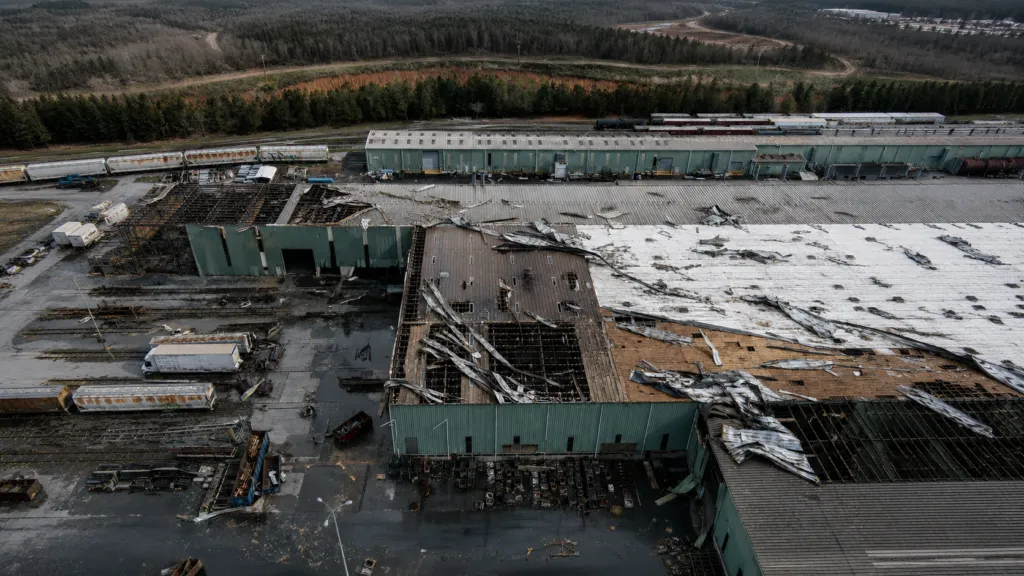
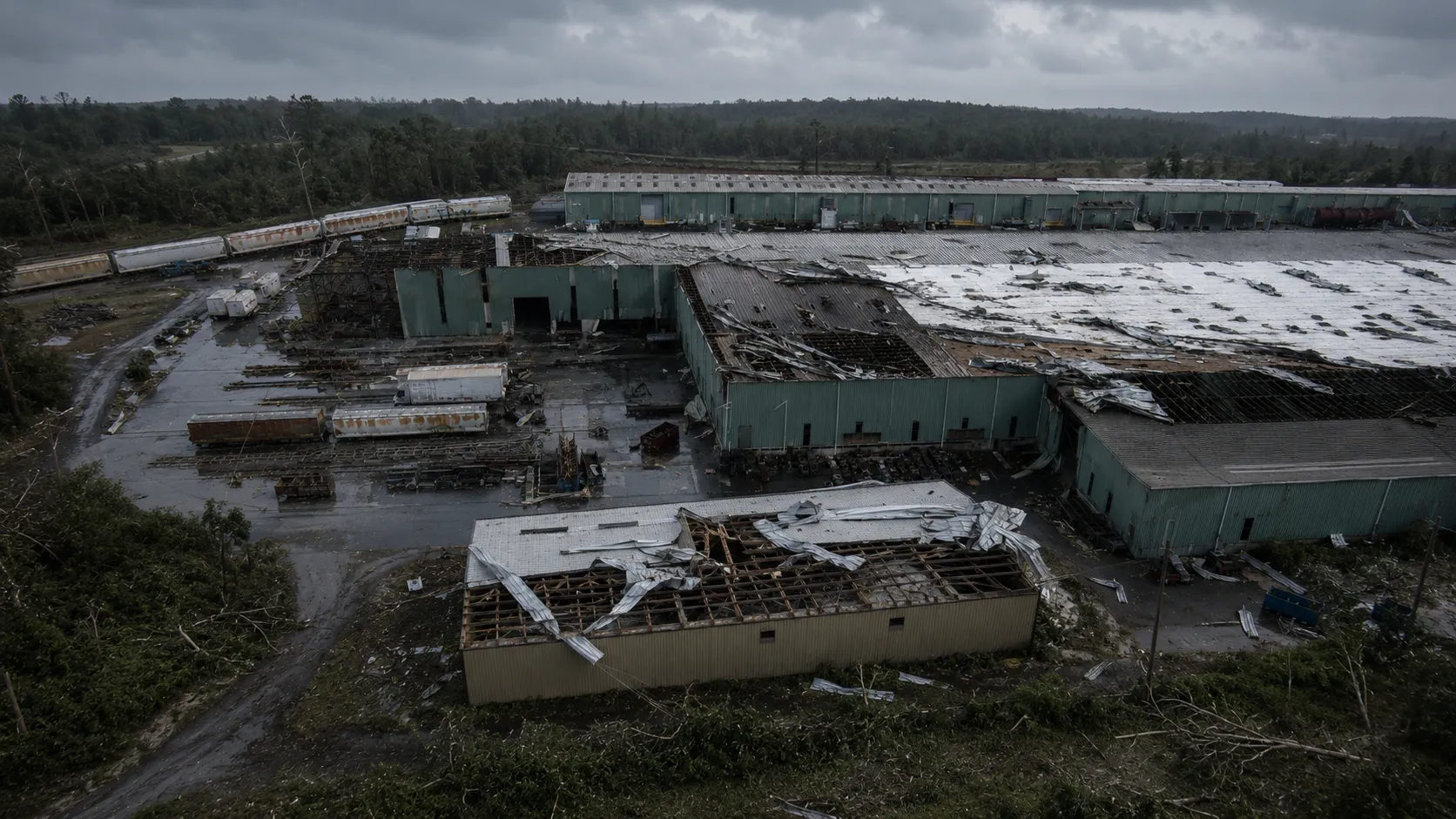
Most standard commercial system warranties limit their watertight repair obligation to wind gusts of 55 mph or less. GAF, one of the manufacturers we install, states plainly that its standard guarantees do not cover wind damage above 55 mph unless extra wind coverage is purchased, and the other major programs are built around the same baseline. If a leak follows an event where gusts passed 55 mph, the manufacturer generally has no obligation to repair the roof under the standard warranty.
That number is the whole problem for a building in a storm zone. On the Saffir-Simpson scale, a Category 1 hurricane begins at 74 mph of sustained wind and a Category 5 begins at 157 mph, according to NOAA’s National Hurricane Center. A warranty that protects you to 55 mph quits well short of the weakest hurricane, and a strong Florida thunderstorm can clear it.
Manufacturers do sell wind speed riders that lift the threshold to 90, 100, or 120 mph, but the upgrade is not a line item you check at signing. It requires physical changes to the roof assembly: thicker reinforced membranes, high-density cover boards, denser fastening in the perimeter and corner zones, and tighter adhesive spacing. The higher number is only valid if the roof was built to that specification from the start. You cannot buy a better warranty after the fact without rebuilding the assembly to match it.
The Named Storm Exclusion
The harshest clause in many wind warranties is the named storm exclusion. These warranties void coverage for any leak that occurs during a storm that has been officially named as a tropical storm or hurricane.
Read that carefully, because the consequence is severe. Even if the wind at your specific building never touched the warranty’s stated limit, say a 50 mph gust during a passing tropical storm, the manufacturer can still deny the claim because the damage happened inside the timeline and footprint of a named system. In a state where named storms are a normal part of the calendar, that clause removes coverage during exactly the events you bought the warranty to survive.
What Voids Your Warranty Before the Storm Arrives
A 20-year warranty is only worth what your compliance with its conditions makes it worth, and those conditions are stricter than most owners assume. The most common reason hurricane-related warranty claims get denied is not the storm. It is missing maintenance records.
The two failures we see most often:
- Skipped annual maintenance. Manufacturers require commercial roof systems to be inspected and maintained on a set schedule, usually once or twice a year and after any major weather event. Miss it and the warranty can be void before a storm ever arrives. This is mandatory, written into the terms of nearly every commercial roofing warranty, and it applies to system warranties, the Category 5 Hurricane Warranty, and the Manufacturer Lifetime Renewable Leak-Proof Warranty alike.
- Ponding water and blocked drainage. Standing water that sits on the membrane more than 48 hours after rain is an automatic exclusion under most single-ply warranties, and clogged drains, scuppers, and gutters are the usual cause.
Federal guidance backs the schedule up. FEMA’s hurricane mitigation handbook recommends inspecting a low-slope roof at least twice a year, ideally in spring and fall, plus again after any high-wind event, then completing needed repairs quickly so small problems do not compound. A maintained commercial roof lasts materially longer than a neglected one, and on a building this size that added service life is worth a large share of the replacement cost. Keeping the warranty valid is one reason to stay current. Catching small problems while they are still cheap to fix is the other.
We are direct with every client on this point. For most commercial roofing warranties, annual maintenance is mandatory, not a courtesy. Our program covers power washing, debris removal, patching, and a full photo report, and we issue a maintenance certificate after each visit that documents the warranty is still in force. If you want the warranty to pay when you need it, that paper trail has to exist before the storm, not after.
Systems Built to Survive a Major Storm
Why single-ply roofs tend to fail in high wind comes down to physics. As wind moves over a building it creates uplift, a vertical pull on the roof plane that rises with the square of the wind speed, so doubling the wind roughly quadruples the force trying to peel the roof off. Mechanically fastened and seamed membranes concentrate that load at the fasteners and seams, which is exactly where they peel and tear.
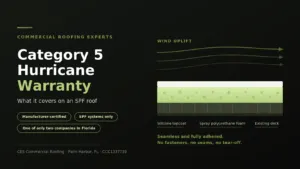
Spray Polyurethane Foam (SPF) handles uplift differently. SPF is a closed-cell foam sprayed on as a liquid that expands and bonds directly to the roof deck, forming a seamless surface with no fasteners and no seams. Because the whole system is adhered to the deck, it spreads uplift across the entire roof instead of loading a few weak points. That seamless, fully bonded construction, with no edges, seams, or fasteners for the wind to catch, is why foam has earned a strong track record in high-wind regions. SPF is our flagship system at CES Commercial Roofing for that reason, and we run three dedicated foam rigs to keep up with the work. You can read more about how the system goes on in our spray foam roofing guide.
How the Category 5 Hurricane Warranty Works
Because SPF holds up the way it does in real storms, select manufacturers back qualifying SPF installations with a Category 5 Hurricane Warranty. CES Commercial Roofing is one of only two companies in the state of Florida authorized to offer this manufacturer-certified warranty. It covers the foam system staying intact and bonded to its substrate under Category 5 wind conditions, which is the rare case where a roof warranty accounts for the wind speeds a hurricane actually brings.
A few details matter for any owner weighing it:
- Manufacturer-certified, not a government designation. The warranty is issued and backed by the manufacturer, and it is available only on qualifying SPF systems.
- Transferable. Coverage passes to a new owner, which adds real value when a commercial property is sold or transferred.
- Voided by skipped annual maintenance. The same maintenance condition that governs every other warranty applies here. No maintenance, no coverage.
- It warrants the foam, not the building. If the underlying substrate, for example the metal panels beneath the foam, detaches from the building, the warranty is void, because the foam stays bonded to those panels. We stand behind the roof system, not the structural integrity of the building it sits on.
Qualifying SPF installations and silicone coating restorations are also eligible for a Manufacturer Lifetime Renewable Leak-Proof Warranty on both labor and materials, renewable on defined terms over the life of the system. That coverage applies only to SPF and coating systems, not to other roofing products.
Wind Coverage Across Common Commercial Systems
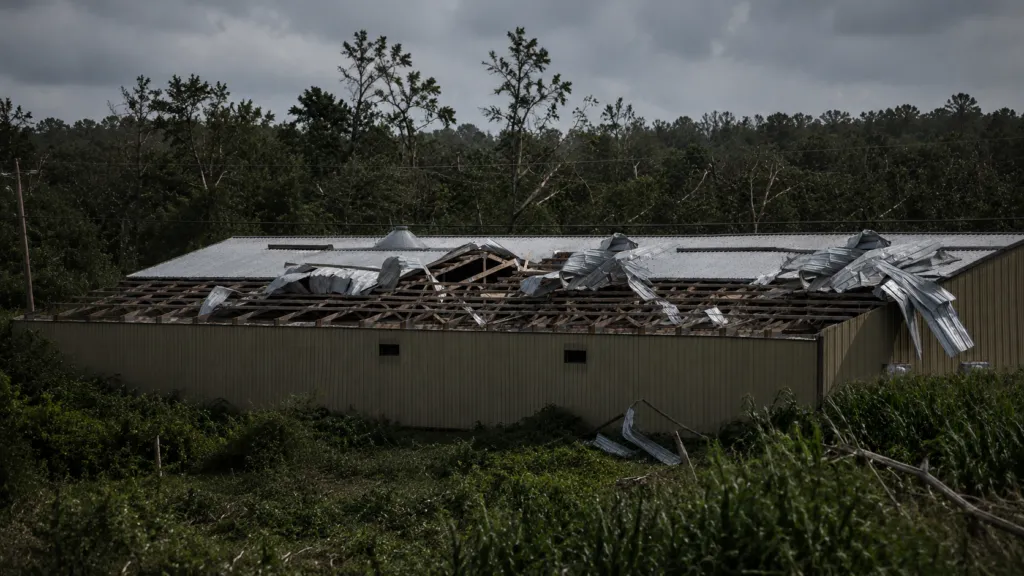
Wind protection looks different depending on what is on your building. The table below shows how standard warranty wind coverage tends to work across the systems we install, before any purchased upgrades.
| System | Typical Lifespan | Standard Wind Coverage | Upgrade Path |
| Single-ply (TPO) | 15 to 25 years | Baseline near 55 mph | Wind rider with assembly upgrades |
| Modified bitumen | 20 to 30 years | Baseline near 55 mph | Wind rider with assembly upgrades |
| SPF (spray foam) | 20 to 30+ years with recoating | Engineered for Category 5 wind speeds | Category 5 Hurricane Warranty on qualifying systems |
Lifespan depends on installation quality, the materials used, the local climate, and whether the roof is maintained. In Florida’s mix of hard sun, heavy rain, and hurricane wind, that last factor carries more weight than owners expect.
How Warranty Coverage and Insurance Work Together
Because manufacturer warranties exclude hurricane wind and water damage, commercial property insurance is the main tool for financial recovery after a storm. Manufacturers say so themselves: Carlisle notes that a roofing warranty is not building insurance, and that critical weather events like hurricanes fall to the building owner’s insurance carrier. The two cover opposite failures. A roof warranty handles problems that start inside the system, like a defective membrane or a failed adhesive bond. Property insurance handles sudden outside losses, like flying debris puncturing the roof or a breach that lets water in.
The deductible is where it gets expensive. Unlike a standard flat deductible, a hurricane deductible is calculated as a percentage of the insured property value and is triggered by a named storm. On commercial property, that percentage commonly runs from the low single digits up to around 10 percent of insured value, so on a high-value building, it can reach six figures before the insurer pays a cent toward repairs. That is exactly why an upgraded wind warranty or a Category 5 SPF guarantee works as a financial hedge. When a covered high-wind event damages a roof within the warranty’s terms, the manufacturer or contractor is obligated to restore the watertight roof, which can take that portion of the building out of the deductible math entirely.
It also pays to keep your documentation in order before a storm: a clear, dated photo walkthrough showing drains clear and flashing secure, plus off-site copies of maintenance records and warranty certificates. Adjusters routinely blame post-storm leaks on pre-existing wear to deny claims, and clean pre-storm documentation is your best defense. Roof work can carry tax advantages as well, though you should consult your tax advisor on how any specific project applies to your situation.
Closing the Gap Before Storm Season
Here is the sequence we walk owners through, well ahead of the season rather than during a watch:
- Find your wind speed cap. Pull the warranty and locate the exact wind limit. If it reads 55 mph, you have almost no hurricane protection under that document.
- Check for a named storm exclusion. If the warranty voids during named systems, your real hurricane coverage may be zero regardless of the speed cap.
- Confirm your maintenance is current and documented. A lapsed record can void the warranty before the storm hits. Make sure the certificates exist.
- Compare the warranty limit to your insurance deductible. The space between what the warranty covers and what the deductible costs is your true exposure.
- Weigh your upgrade options. Depending on the building, that means a purchased wind rider on a new system or a fully adhered SPF system with the Category 5 Hurricane Warranty.
The roofs that come through a major storm intact are almost always the ones where this work was done in advance. The owners who get blindsided are the ones who assumed a long warranty meant full storm protection and never read the speed cap.
If you are not sure where your commercial roof stands, we will tell you straight. A free CES Commercial Roofing evaluation includes an on-site inspection and a clear read on your roof’s condition, your current coverage, and whether an upgrade makes sense for your building. We work with commercial properties across the Tampa and Orlando markets and the storm-exposed regions of Florida around them. Book a free roof evaluation before the next named system forms: CALL (813) 419-1918