

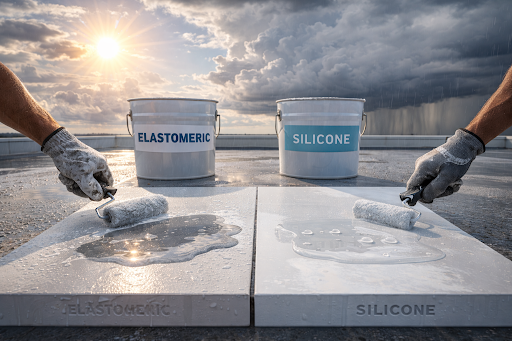
Elastomeric acrylic and silicone are the two primary chemistries used in commercial roof coating restorations. Both reflect solar heat, extend roof life, and cost significantly less than a full replacement. But they perform very differently under the conditions that Florida’s Gulf Coast throws at commercial roofs: heavy seasonal rainfall, persistent humidity, intense UV, and the flat roof profiles that dominate commercial construction here.
At CES Commercial Roofing, silicone coating restorations are the service we perform most frequently across Tampa and Orlando. After installing over 15 million square feet of commercial roofing in Florida, we’ve seen firsthand how each coating type holds up under real Gulf Coast conditions. This guide breaks down the technical differences, climate considerations, cost factors, and code requirements so you can make an informed decision for your building.
What is the difference between elastomeric and silicone roof coatings?
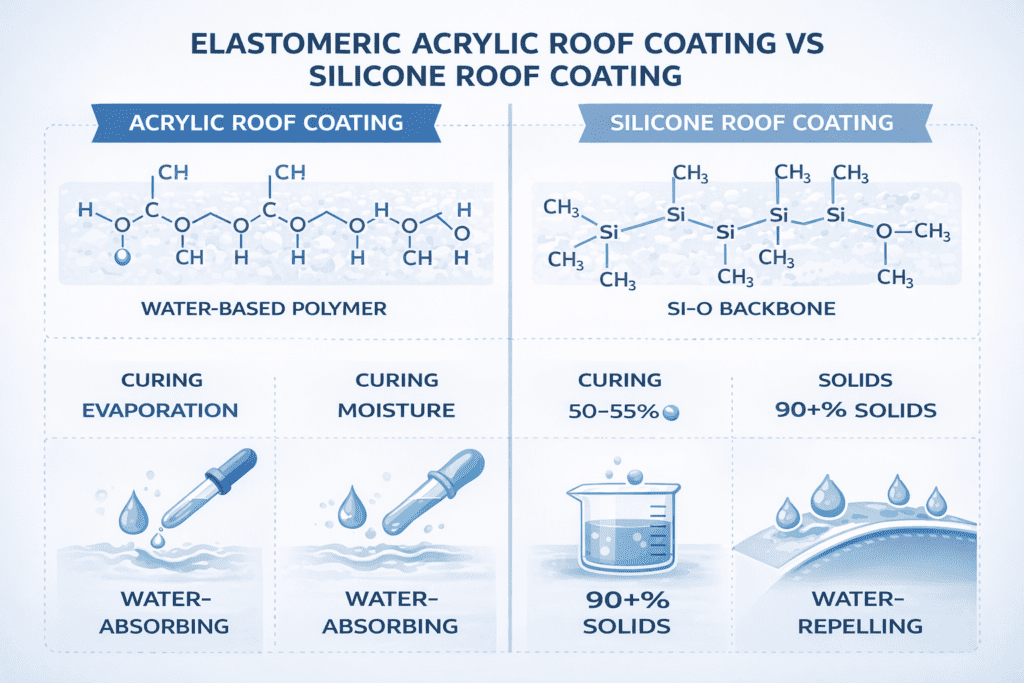
The fundamental difference comes down to how each coating interacts with water.
Elastomeric (acrylic) coatings are water-based, liquid-applied membranes built on acrylic latex polymer chemistry. They cure through evaporative coalescence: as water evaporates from the emulsion, acrylic polymer particles fuse into a continuous, flexible film. The term “elastomeric” refers to the cured film’s ability to stretch to at least twice its original length and snap back without damage. They comply with ASTM D6083, the standard specification for liquid-applied acrylic coatings in roofing.
Acrylics are typically 50 to 63% solids by volume, meaning roughly half the wet film evaporates during curing. Two coats are required to reach the minimum 20 to 30 mil dry film thickness needed for roof protection. They function like a breathable barrier, blocking bulk water but allowing moisture vapor to pass through.
Silicone coatings are built on polydimethylsiloxane (PDMS) chemistry with an inorganic silicon-oxygen backbone. They cure through a moisture-cure mechanism, reacting with atmospheric humidity to cross-link into a durable polymer network. As Henry Company describes their 887 Tropi-Cool product, the coating starts curing by pulling water molecules from the air as soon as the container is opened.
Modern high-solids silicone formulations are 90 to 96% solids by volume, meaning virtually all applied material remains on the roof. The inorganic Si-O backbone does not degrade from UV exposure, giving silicone inherent, permanent weather resistance. They comply with ASTM D6694, the standard specification for liquid-applied silicone coatings.
In short: acrylic is water-based and water-sensitive. Silicone is moisture-cured and permanently water-resistant. That single distinction drives most of the performance differences that matter in Florida.
How do these coatings perform side by side?
Both coatings deliver strong solar reflectance and thermal performance. Where they diverge is in water resistance, UV durability, application characteristics, and lifespan.
| Performance Metric | Acrylic Elastomeric | Silicone |
| Solids by volume | 50–63% | 90–96% |
| Initial solar reflectance | 0.80–0.90 | 0.85–0.90 |
| Aged (3-year) reflectance | 0.65–0.80 | 0.60–0.77 |
| Elongation | 250–600% | 100–302% |
| Tensile strength | 150–400 psi | 250–400 psi |
| Ponding water resistance | Poor: swells and delaminates | Excellent: permanent resistance |
| UV resistance | Good; chalks ~0.5 mils/year | Excellent; inorganic backbone resists UV permanently |
| Dirt pickup resistance | Good | Poor; accumulates dirt over time |
| Recoatability | Excellent; accepts any chemistry | Only silicone adheres to cured silicone |
| Cure time | 24–48 hours; rain-sensitive | 1–4 hours; rain-safe in ~15 minutes |
| Typical lifespan | 10–15 years | 10–20 years (up to 25 with premium systems) |
| Installed cost per SF | $2.50–$5.00 | $3.50–$7.00 |
Data synthesized from manufacturer specifications (Rust-Oleum, Henry, Gaco, CSL Silicones), ASTM standards, and industry publications (FacilitiesNet, IIBEC, American WeatherStar).
Three things stand out from this comparison. First, silicone’s ponding water resistance is its defining advantage on flat roofs. Second, acrylic has better dirt pickup resistance and aged reflectivity, which matters if appearance is a priority. Third, acrylic costs 30 to 50% less upfront, but silicone lasts longer and requires fewer recoat cycles.
Which coating handles Florida’s ponding water problem?
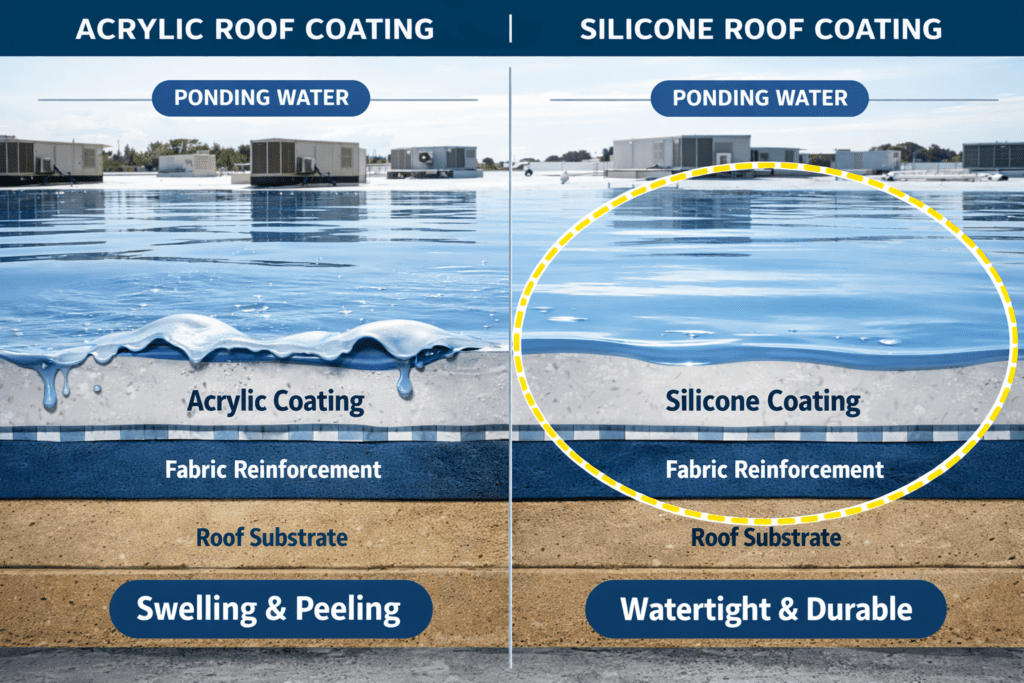
Silicone. And ponding water resistance is the single most important factor for flat commercial roofs in Florida.
The Roof Coatings Manufacturers Association states plainly that acrylic coatings are subject to adhesion loss and may peel from the roofing substrate when submerged. American WeatherStar warns that standing water for more than 48 hours over any acrylic coating will ultimately cause the system to fail.
In contrast, Gaco’s silicone products will not soften, bubble, or degrade under permanent ponding water. Henry Company was the first manufacturer to pass ASTM D7281 (the FM waterproofing standard) using a liquid-applied silicone membrane. Acrylic coatings alone cannot pass this test.
Bob Creighton of GE Sealants offers a useful perspective on why this matters in practice: almost every low-slope roof has, or will develop within a 20-year warranty period, at least a small area that ponds water. A building owner doesn’t care that 99% of the roof is performing if 1% is leaking.
On Florida’s flat commercial roofs, where settled decks, clogged drains, and poor original slope mean water often sits far longer than the 48-hour drainage standard defined by the Florida Building Code, ponding water resistance isn’t a nice-to-have. It’s a baseline requirement.
How does Florida’s Gulf Coast climate affect coating performance?
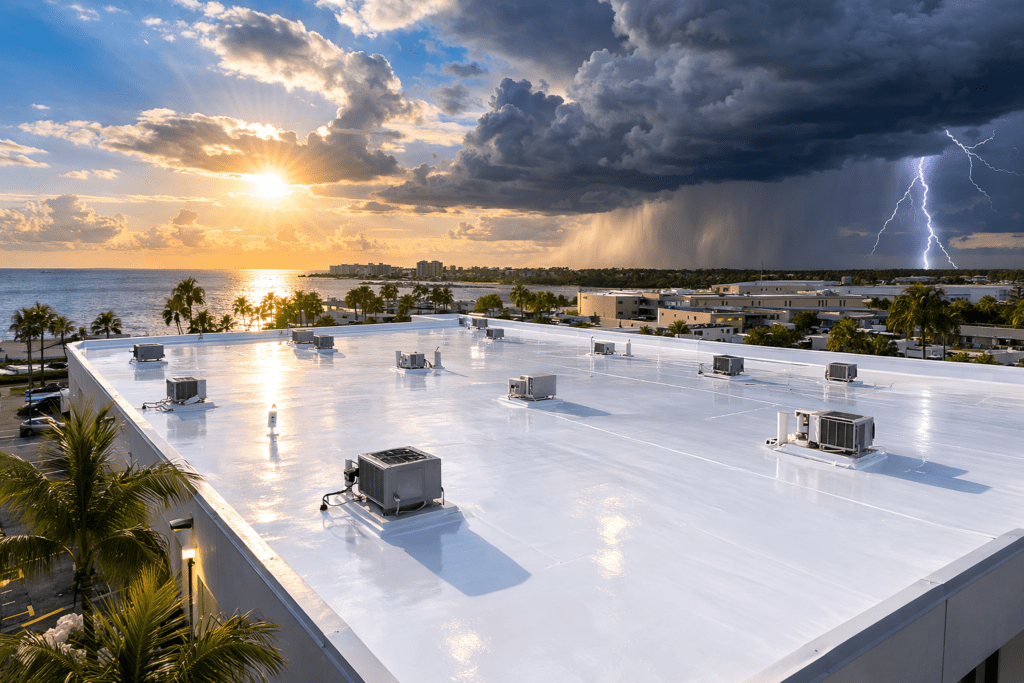
The Tampa Bay corridor presents a uniquely demanding combination of conditions that systematically tests roof coating performance across multiple dimensions.
Rainfall intensity and volume. Tampa Bay receives approximately 49 inches of annual rainfall, with 30 inches concentrated between June and September. Summer thunderstorms deliver brief, intense downpours almost daily, and July alone averages 5.67 inches. This volume, combined with the flat profiles typical of commercial buildings here, creates persistent ponding water conditions that acrylic coatings cannot survive long-term.
UV exposure. Tampa Bay averages 246 sunny days per year with a UV index reaching 7 (EPA “High” rating) from May through September. Silicone’s inorganic backbone does not degrade from UV radiation. It won’t chalk, crack, or become brittle over decades. Acrylic coatings offer good initial UV resistance but lose approximately 0.5 mils of film thickness per year through UV-driven chalking and erosion, gradually consuming the protective layer.
Humidity. Year-round humidity averages 72 to 77%, creating ideal conditions for mold, mildew, and algae growth. The Florida Community Association Professionals (FCAP) group notes that silicone is the most effective coating chemistry for resisting biological growth because it contributes no food source and resists microbial attachment. Acrylics and urethanes can support biological growth in warm, damp environments unless specially formulated.
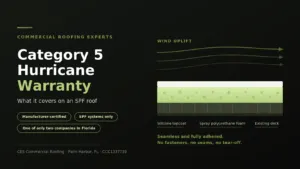
Hurricane and wind exposure. Pinellas County mandates a minimum design wind speed of 145 mph for Risk Category II buildings. Liquid-applied silicone coatings form a monolithic, seamless membrane that eliminates the wind-vulnerable seams found in sheet systems. SPF systems with silicone topcoats have demonstrated wind uplift resistance that exceeded the capacity of both FM and UL test equipment. Our Category 5 Hurricane Roof Warranty on SPF and silicone systems reflects this proven performance.
Cure time advantage. Because silicone cures by reacting with atmospheric moisture rather than requiring water to evaporate, it becomes rain-safe in as little as 15 minutes after application. Acrylic coatings need 24+ hours of dry weather for proper cure. During Florida’s wet season (which accounts for 60% of annual rainfall), that dry window is difficult to guarantee. Silicone systems can be installed year-round. Acrylic projects are largely restricted to the November-through-April dry season.
What do industry experts recommend for flat roofs in wet climates?
The industry consensus on silicone for wet, humid climates is remarkably uniform across independent organizations and competing manufacturers.
Tim McQuillen, RCMA Technical Director, has stated that in cases where standing water may be an issue, a silicone coating would be the preferred choice. RCMA’s official classification notes that acrylics are best suited for metal roofs with positive pitch, while silicones are best suited for most flat roofs.
The Spray Polyurethane Foam Alliance is similarly direct: for flat (low-slope) roofs, silicones or urethanes are preferred because they are better suited to withstand ponding water. SPFA recommends a minimum of 20 mils of silicone over SPF systems, with up to 40 mils depending on warranty requirements.
Among manufacturers, Henry Company markets its 887 Tropi-Cool silicone line as especially suited for extreme tropical environments with intense UV and wet weather exposure. GAF product manager Jessica Soder notes that while silicone is more expensive, it typically weathers at a much slower rate than other coatings, and explicitly warns that acrylics shouldn’t be installed where there is ponding water.
How do the costs compare over time?
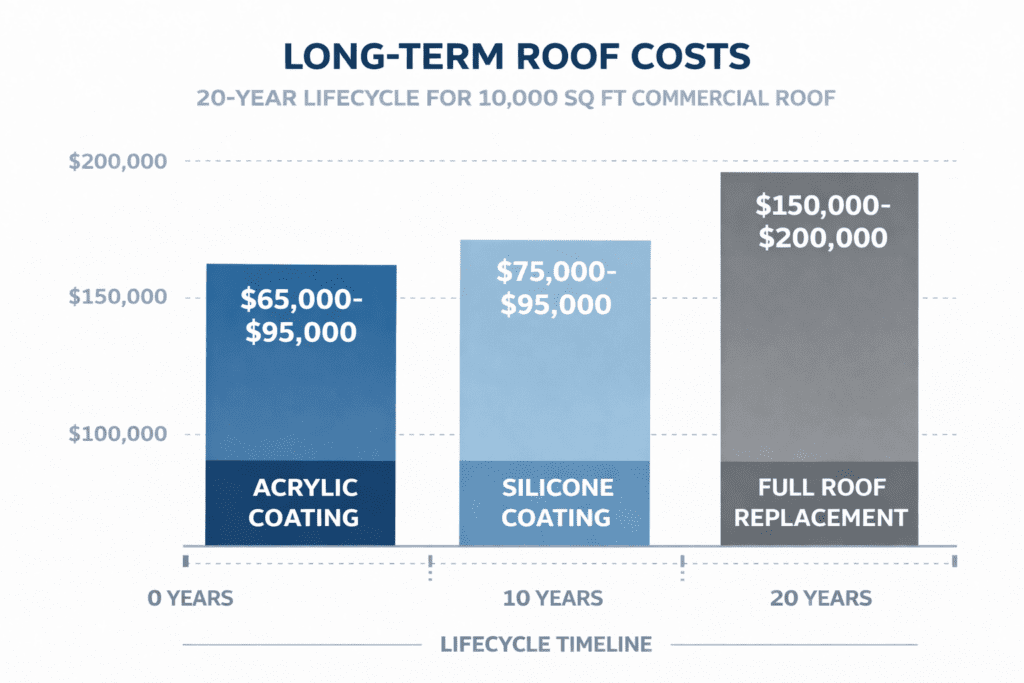
Silicone costs more upfront but delivers better long-term value for most Florida flat roofs. Both coating types offer dramatic savings compared to full replacement.
| Cost Factor | Acrylic Elastomeric | Silicone | Full Replacement (TPO) |
| Installed cost per SF | $2.50–$5.00 | $3.50–$7.00 | $5.50–$16.00 |
| 10,000 SF roof total | $25,000–$50,000 | $35,000–$70,000 | $55,000–$160,000 |
| Savings vs. replacement | 50–70% | 40–60% | Baseline |
| Expected service life (FL) | 5–10 years | 10–20 years | 20–30 years |
| Recoat cost (% of original) | 40–60% | 30–50% | N/A |
| 20-year total cost (10,000 SF) | $75,000–$150,000 | $65,000–$130,000 | $55,000–$200,000 |
The 20-year total cost tells the real story. Acrylic’s lower upfront price is offset by the need for two to three recoat cycles in Florida’s climate, while silicone typically needs only one to two. On a 10,000-square-foot roof, silicone’s 20-year cost can actually come in lower than acrylic despite the higher initial investment.
How do Section 179 tax deductions affect the math?
Section 179 tax benefits dramatically improve the financial case for either coating type. The Tax Cuts and Jobs Act of 2017 explicitly expanded Section 179 to include roofs on nonresidential property, and the One Big Beautiful Bill Act (OBBBA), signed July 4, 2025, further expanded these limits. For 2026, the maximum deduction is $2,560,000 with a phase-out beginning at $4,090,000.
Roof coatings can qualify for immediate deduction as a repair and maintenance expense under IRC §162 when the coating restores the roof surface to its prior condition without materially improving capacity or quality. Even if classified as a capital improvement, Section 179 now allows full immediate expensing.
For a hypothetical $45,000 silicone coating project on a 10,000 SF commercial roof:
- Section 179 deduction: $45,000 fully expensed in year one
- Tax savings at 21% corporate rate: approximately $9,450
- Net after-tax cost: approximately $35,550
- Compared to $80,000+ for full replacement, the coating saves $35,000+ upfront and $27,000+ after tax
Building owners should consult a qualified CPA, as the IRS “plan of betterment” doctrine and fact-specific analysis apply.
What Florida building code requirements apply to roof coatings?
Several Florida Building Code provisions directly affect commercial roof coating decisions. Understanding them upfront can prevent costly surprises.
The 25% moisture rule. If infrared scanning reveals that more than 25% of the roof insulation is wet, industry consensus holds that coating is not a viable option and full replacement is required. This is why a thorough roof inspection with thermal imaging should always precede any coating project. At CES, we carry thermal imaging equipment on every inspection specifically because this threshold determines whether a roof is a candidate for restoration or not.
The 25% repair rule (FBC Existing Building §706.1.1). No more than 25% of total roof area may be repaired, replaced, or recovered in any 12-month period unless the entire system conforms to current code. However, SB-4D (signed May 2022) added an exception: if the existing roof was installed in compliance with the 2007 FBC or later (effective March 1, 2009), only the repaired portion must meet current code. For pre-2009 roofs, exceeding the 25% threshold can trigger full replacement requirements.
Cool roof requirements (FBC Energy Conservation §C402.3). Low-slope commercial roofs in Climate Zone 2A (which includes Pinellas County and most of central Florida) must meet a minimum 3-year aged solar reflectance of 0.55 and thermal emittance of 0.75, or an aged Solar Reflectance Index (SRI) of 64. Both silicone and acrylic coatings comfortably exceed these thresholds when properly maintained. Silicone coatings typically achieve aged SRI values of 70+, while acrylics reach 65+.
Wind uplift requirements. All roof coating products must carry a Florida Product Approval number with tested uplift resistance values meeting or exceeding project-specific calculations under ASCE 7-16 for the local design wind speed.
Material standards. FBC §1507.15 references ASTM D6083 (acrylic) and ASTM D6694 (silicone) as the compliance standards for each chemistry.
When is elastomeric acrylic coating the right choice?
Acrylic elastomeric coatings are a viable, cost-effective option when the conditions are right. Specifically:
- Well-drained metal roofs with positive slope (1:12 pitch or greater) where ponding water is not a factor
- Properties where upfront budget is the primary constraint and the roof geometry supports acrylic’s performance characteristics
- Roofs where dirt pickup resistance matters, such as highly visible commercial properties where a cleaner appearance is a priority
- Situations requiring future recoatability with multiple chemistries, since acrylic accepts any coating type on recoat, while cured silicone only bonds to more silicone
RCMA’s official guidance supports this: acrylics are best suited for metal roofs that have positive pitch. In drier climates like Arizona and Nevada, acrylics are often the smarter and more economical choice. But on flat roofs in Florida’s wet climate, the risk of ponding water failure makes acrylic a poor fit.
When is silicone coating the right choice?
For most flat and low-slope commercial roofs on Florida’s Gulf Coast, silicone is the technically superior option. It’s the right choice when:
- The roof is flat or low-slope with any history of or potential for ponding water
- The building is in a high-rainfall, high-humidity climate (all of central and south Florida qualifies)
- Year-round installation flexibility is needed, since silicone’s moisture-cure chemistry makes it rain-safe in minutes
- Maximum lifespan per coating cycle matters, as silicone typically delivers 10 to 20 years versus 5 to 10 for acrylic in Florida conditions
- Hurricane and wind resistance is a priority, particularly when combined with an SPF substrate
Multiple Florida case studies support silicone’s real-world performance here. The Cape Canaveral Joint Venture Building selected Gaco’s silicone system specifically for Central Florida’s heavy UV and rainfall conditions, eliminating all leaks with a 15-year warranty. WaterCrest’s 19-building condo complex in Florida restored approximately 117,000 square feet of a modified roof system with solvent-free silicone at a fraction of replacement cost.
DOE and Lawrence Berkeley National Laboratory research confirms both coating types deliver significant energy savings, with cool white roofs reducing commercial AC energy use by 10 to 30%.
Need help choosing the right coating for your commercial roof?
If you’re evaluating coating options for a commercial roof in Tampa Bay, Orlando, or anywhere across Florida, we can help you determine which system fits your building. Every project starts with a free roof evaluation that includes thermal imaging to assess moisture levels and a clear, honest recommendation on whether your roof is a candidate for coating restoration or needs a different approach.
Call us at (813) 419-1918 or request a free roof evaluation to get started.