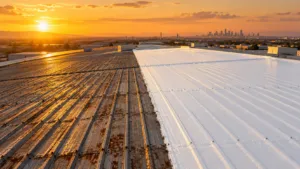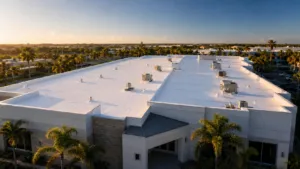


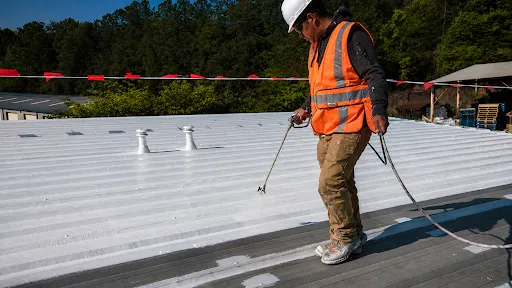
A silicone roof coating restoration can extend the service life of an aging but structurally sound commercial roof for roughly one-third the cost of a full tear-off and replacement. The process applies a fluid silicone membrane over the existing roof, sealing leaks and reflecting heat without the demolition, disposal, and downtime a replacement requires. Two things decide whether it works: whether the roof actually qualifies, and whether the crew does the prep before any coating goes down.
Silicone coating restoration is the service we perform most often at CES Commercial Roofing, and it is the work we know best. We have installed more than 15 million square feet of commercial roofing across Florida, including large silicone restorations on single-ply and metal roofs in the Tampa and Orlando markets. This guide covers how these systems work, how to tell whether your roof is a candidate, what a coating costs relative to replacement, and how to tell a contractor who will get it right from one who will roll silicone over a wet roof and leave you with a bigger problem.
What a silicone roof coating restoration actually is
A silicone roof coating is a fluid-applied membrane that cures into a seamless, rubber-like layer over your existing roof. It is a restoration, not a new roof. The existing system stays in place, and the coating renews its waterproofing and adds a reflective surface on top.
Premium commercial silicone is a high-solids, solvent-free material that cures by reacting with moisture in the air. Because so little of the applied material evaporates away, the coating does not shrink, crack, or form pinholes as it sets. The wet layer that goes down stays close to the same thickness once it cures.
These systems bond to most commercial roof surfaces when the surface is prepared correctly, including:
- Weathered single-ply membranes such as TPO (thermoplastic polyolefin), PVC (polyvinyl chloride), and EPDM (a synthetic rubber membrane)
- Built-up roofing (BUR) and modified bitumen cap sheets
- Spray polyurethane foam (SPF) roofs
- Metal panel roofs
- Structurally sound concrete decks
We use silicone coatings across our commercial roof restoration work, and they make up the bulk of our roof coatings projects. The reason is simple. For the right roof, a coating delivers waterproofing close to a new roof for a fraction of the cost and disruption.
Does your commercial roof qualify for a silicone coating?
A silicone coating restores a roof that is aging or weathered but still structurally sound. It cannot rebuild a roof that has failed. To be a candidate, a roof generally needs to meet these conditions:
- A sound structural deck. The deck must be free of advanced rot, severe corrosion, and excessive deflection. A coating seals the surface. It does nothing for a deck that is failing underneath.
- Positive drainage. Water should be able to move toward drains, gutters, or scuppers rather than sitting in large permanent pools.
- Dry insulation. The insulation beneath the membrane needs to be dry. Coating over saturated insulation traps the moisture and causes the system to fail.
- Limited active leaking. A roof with active, unrepaired leaks across more than about a quarter of its surface area is usually past the point where a coating makes sense.
If your roof meets these conditions, a coating is worth evaluating. If the deck is compromised or a large share of the insulation is wet, a full replacement is the honest answer, and any contractor who tells you otherwise is selling you a coating that will not last.
Why silicone outperforms acrylic on Florida roofs
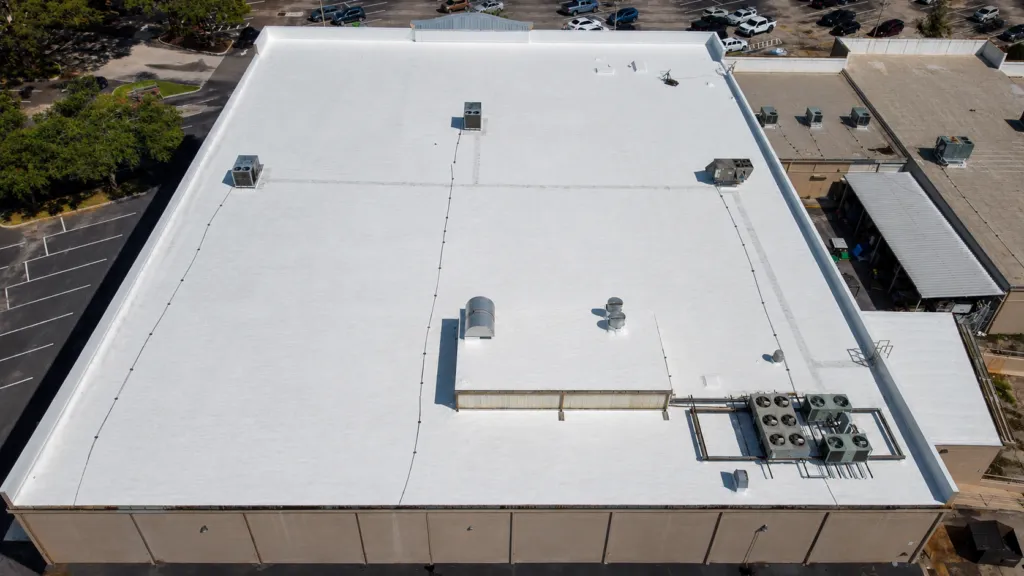
Florida punishes roofing materials. High humidity, frequent afternoon storms, standing water on flat roofs, and intense sun all work against a coating at the same time. This is where silicone earns its place over acrylic, the other common coating chemistry.
Acrylic coatings are water-based and cure as the water evaporates. In humid air that evaporation slows down, which leaves a fresh acrylic film vulnerable to a sudden rainstorm washing it off before it sets. Acrylic also absorbs standing water. On a flat roof where water ponds for a day or more, acrylic can swell, soften, and lose its grip on the surface.
Silicone behaves the opposite way. It cures through a reaction with moisture, so humidity speeds the process up instead of slowing it down, and a properly applied coat can become rain-safe in as little as 15 minutes. Once cured, silicone repels water rather than absorbing it, so it holds up under the ponding water that flat Florida roofs are prone to. Its inorganic backbone also stands up to the sun, keeping its thickness instead of chalking and thinning the way acrylic does over years of UV exposure.
Acrylic is a reasonable choice in a dry climate like Arizona. In Florida, silicone is the material built for the conditions.
The prep work that decides whether a coating lasts
This is the single biggest difference between a coating that protects a building for years and one that fails within months. The coating itself is the easy part. The diagnostics and preparation underneath it are where the job is won or lost, and they are exactly the steps an underqualified crew skips to come in cheap.
Proper preparation follows a sequence:
- Moisture scan. An infrared survey maps wet areas in the roof. Trapped water holds heat differently than dry insulation, so a thermal camera reading the roof after sunset can reveal saturated sections that look fine from above.
- Core sampling. Suspected wet areas are confirmed by cutting small cores to check moisture levels in each layer and the condition of the deck. A scan finds the suspects. Cores confirm them.
- Cut out and replace wet insulation. Any saturated insulation is removed down to the deck and replaced with dry, compatible material before anything is coated.
- Pressure wash. The whole roof is cleaned to strip off dirt, chalk, grease, and biological growth so the coating can bond.
- Detail the seams and penetrations. Joints, transitions, flashings, and roof penetrations are reinforced with silicone mastic or with polyester fabric embedded in a base coat, so the most failure-prone spots are sealed before the field coat goes on.
- Test adhesion. Field adhesion tests confirm whether the surface needs a primer to hold the coating, following recognized ASTM test methods.
Skipping the moisture work is what sets a coating up to fail. When the sun heats a roof that was coated over trapped water, that water turns to vapor and builds pressure under the membrane. Silicone is a low-permeability barrier, so the vapor has nowhere to go. It pushes up against the coating until it overcomes the bond, and the result is widespread blistering, loss of adhesion, and decay of the deck below. Concrete decks are especially prone to this, which is why they often need a vapor-retarding primer before any coating is applied.
In our experience, the property owners who get burned by silicone are almost never the ones whose coating chemistry was wrong. They are the ones whose contractor never scanned the roof.
What a silicone coating costs compared to a full replacement
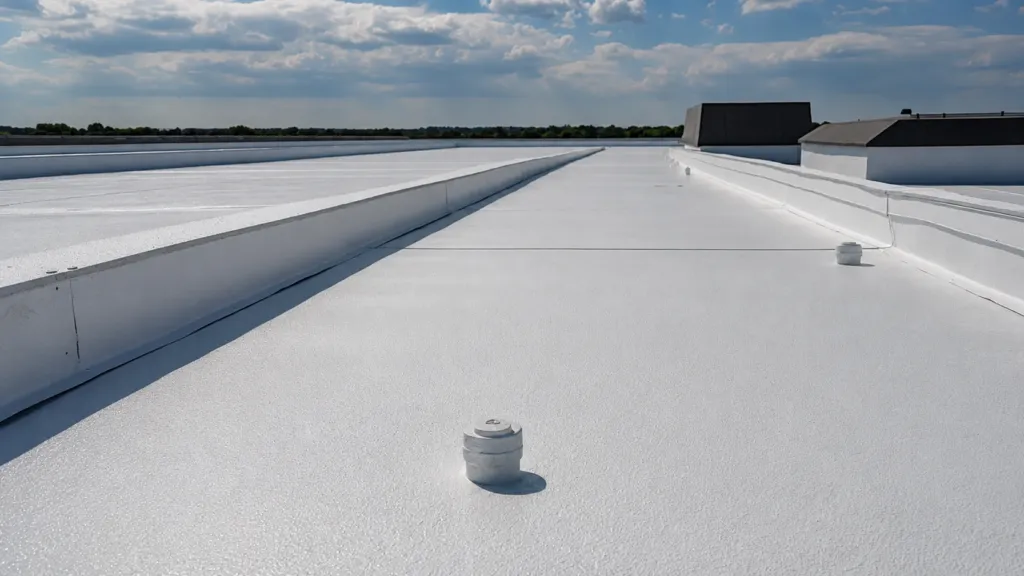
A silicone restoration typically runs about one-third the cost of a full tear-off and replacement. The savings come from what a coating avoids:
- No demolition labor to strip the old roof
- No heavy equipment rental for the tear-off
- No disposal fees for old roofing material
- Fewer labor hours, since a liquid coat goes down faster than a multi-layer roof is built
- No shutdown, because the building stays open and tenants keep working during the application
There is an energy payoff, too. A white silicone coating works as a cool roof. It reflects most of the sun’s energy instead of absorbing it, which lowers the roof’s surface temperature and reduces the cooling load on the building below. The Cool Roof Rating Council publishes independent reflectance and emittance ratings that property owners can use to compare cool roof products. Keeping the roof cooler also eases the thermal expansion and contraction that wears roofing materials down over time. Our energy-efficient coatings are built around this reflective performance.
How long a coating lasts depends on the underlying roof, the quality of the application, the climate exposure, and whether the system is maintained and recoated on schedule. We do not put a single flat number on it, because anyone who does is guessing. What we can tell you is that a properly applied system can carry a manufacturer warranty of up to 20 years, and the system is renewable, meaning it can be recoated at the end of its term rather than torn off.
How a silicone coating is taxed differently than a roof replacement
The tax treatment is one of the most overlooked reasons to restore instead of replace. A full roof replacement is generally treated as a capital improvement, which usually has to be capitalized and depreciated over a 39-year schedule. That spreads the deduction across decades.
A silicone restoration is often treated differently. Because it is a protective layer applied to an existing sound roof rather than a new structure, it can qualify as a repair and maintenance expense under IRS rules. That may allow the full cost to be deducted in the year the work is completed, instead of spread across decades, and it can preserve a building owner’s Section 179 expensing capacity for other purchases. The IRS outlines how property improvements and depreciation work in Publication 946.
Tax rules are fact-specific and change from year to year, so treat this as background, not advice. Consult your tax advisor or CPA before you file to confirm how a coating would be handled for your property.
Florida’s 25% roof rule and how a coating avoids a full replacement
Florida’s building code includes a provision often called the 25% rule. It is triggered by the percentage of roof area that is repaired, replaced, or recovered within a 12-month period. It is not about how much of the roof is wet, a common misreading. Historically, if more than 25% of a roof area was worked on within that window, the entire roof had to be brought up to current code.
Senate Bill 4-D added an exception for newer roofs. If a roof was permitted on or after March 1, 2009 and built to the 2007 Florida Building Code or a later edition, only the repaired portion has to meet current code, even when the work exceeds the 25% threshold. Local governments cannot override that exception. You can read the underlying statute in the Florida Statutes, Section 553.844.
For older roofs still subject to the legacy rule, a silicone coating offers a way to restore the roof without forcing a full-code replacement. The Florida Building Code and the model codes treat a liquid-applied coating as a maintenance activity, not as an added roofing layer or a recover. Because of that classification, applying a coating does not count toward the 25% threshold. Industry guidance from the National Roofing Contractors Association covers this distinction between coatings and recovers in detail in its analysis of roof coatings and code compliance.
Warranty options for commercial silicone coatings
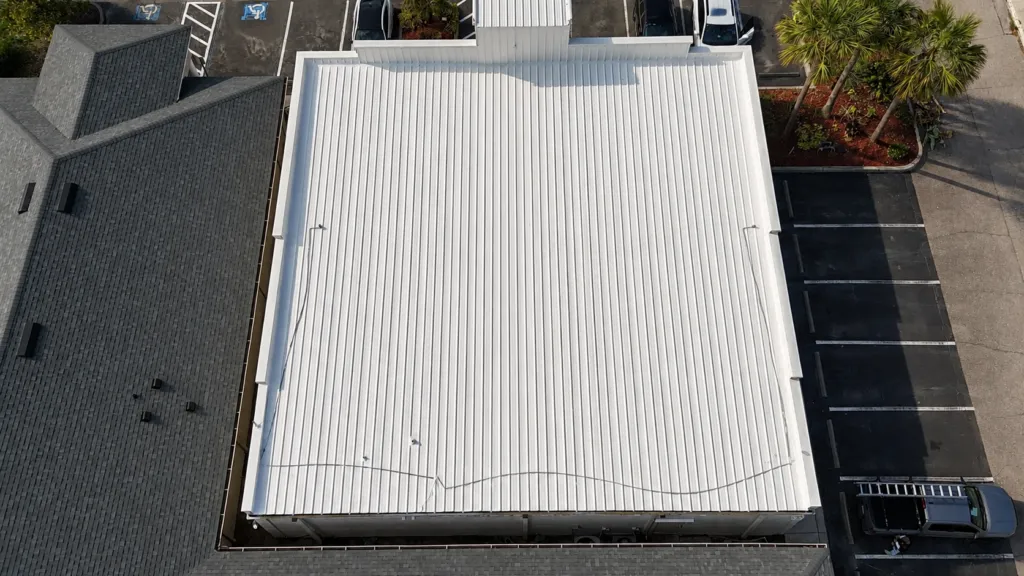
Not all coating warranties are the same, and the differences matter when a leak shows up three years in. There are three to understand.
The manufacturer system warranty, also called a No Dollar Limit (NDL) warranty, is the strongest protection available. It folds material and labor into a single manufacturer-backed document, and if a covered failure occurs, the manufacturer pays for the full repair with no cap. If the installing contractor goes out of business, the manufacturer still stands behind the system. The catch is that manufacturers only issue these warranties when the work is done by a certified applicator and passes an on-site inspection by a manufacturer representative.
We hold certifications with more than 14 manufacturers, including the coating makers behind the systems we install most, such as Tropical Roofing Products, Henry, and Sherwin Williams. That access is what lets us offer manufacturer-backed system warranties up to 20 years, including our Manufacturer Lifetime Renewable Leak-Proof Warranty on qualifying coating restorations. A contractor without those certifications can only offer their own workmanship warranty, which is worth exactly as long as that contractor stays in business.
How to vet a commercial silicone coating contractor in Florida
The Florida coating market is crowded with crews who can buy a bucket of silicone and roll it on. Many are residential roofers who added “commercial” to their website without the equipment, certifications, or diagnostic capability the work requires. A bad coating traps moisture and leaves you worse off than before you started. Before you hire anyone, confirm the following:
- A current Florida roofing license. Verify a Certified Roofing Contractor (CRC) license issued by the Florida Department of Business and Professional Regulation.
- Certified applicator status. The contractor should be a certified applicator with the coating manufacturer whose system they are proposing. Without it, you cannot get a manufacturer system warranty.
- Real insurance, including workers’ compensation. Ask for active certificates of liability and workers’ comp that cover anyone who will be on your roof. Some contractors use leasing arrangements that satisfy the paperwork while leaving the actual roof crew uninsured, which puts the liability on you if someone is hurt.
- A moisture-first process. A qualified contractor scans and cores the roof before quoting a coating. A crew that wants to coat without checking for moisture is the crew most likely to fail you.
We are 100% commercial, and we carry a standalone workers’ compensation policy that covers every person on the roof, not a leased certificate. We make a point of it because in this market it is a real differentiator, and because it protects you as much as it protects our crew.
When a silicone coating is the wrong call
A coating is the right answer for many commercial roofs in Florida, but not all of them. We would rather tell you that up front than sell you a system that will not hold. A silicone restoration is the wrong move when:
- The deck or structure has failed. Advanced rust, rot, or deflection calls for a tear-off, not a coating. A coating cannot restore structural integrity.
- Too much of the insulation is wet. When a moisture survey finds saturation across a large share of the roof, replacement becomes the only sound option, and the math no longer favors a coating.
- The roof sees heavy foot traffic. Wet silicone is slick. Roofs with frequent maintenance traffic need walking pads with non-slip granules to keep people safe.
- There are highly active structural joints. Silicone has lower tensile strength than a single-ply membrane, so active joints and split seams need fabric reinforcement rather than a plain field coat.
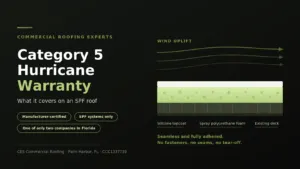
One related point for owners focused on hurricane resilience is that silicone is also the top coat in a spray polyurethane foam roofing system, which adds insulation and a monolithic seal underneath. That foam-and-coating system is what carries our Category 5 Hurricane Warranty. CES Commercial Roofing is one of only two companies in Florida authorized to offer that warranty, and it applies to SPF systems only.
Get an honest evaluation of your roof
The right first step is a real assessment, not a sales pitch. We will scan for moisture, check whether your roof qualifies for a restoration, and tell you straight whether a silicone coating is the smart move or whether your building is better served by a different system. We handle commercial roofs across the Tampa Bay, Orlando, and Sarasota region.
Call us at (813) 419-1918 to schedule a free inspection.