

Florida leads all U.S. states in cumulative hurricane-related disaster costs, with approximately $450 billion in losses since 1980. The Insurance Institute for Business and Home Safety (IBHS) estimates that 70 to 90 percent of catastrophe-related insurance claims include damage to the roof. For commercial property owners, that figure alone changes the calculus on roofing decisions.
Spray Polyurethane Foam (SPF) roofing behaves differently from virtually every other commercial system when a hurricane hits. At CES Commercial Roofing, we’ve installed over 15 million square feet of commercial roofing across Florida, and SPF roofing consistently performs where mechanically-fastened membrane systems fail. This guide explains why, what the independent testing shows, and what Florida commercial property owners should understand before their next roofing decision.
Why do Florida commercial roofs fail in hurricanes?
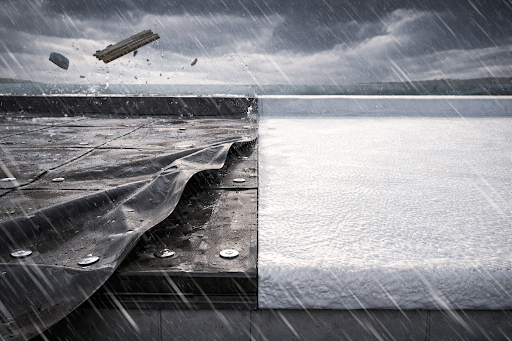
Most commercial roofing failures during hurricanes start at the edges. RICOWI investigated roofing performance following Hurricane Michael (2018, Category 5 at landfall) and found that 80% of surveyed mechanically-attached single-ply roofs sustained perimeter damage, and 70% incurred edge metal failures.
During Hurricane Ian (2022), IBHS remote sensing analysis found a damage frequency of nearly 50% for membrane and built-up commercial roofs. Of those, 71% showed visible damage to flashing and coping. Even newer structures built under Florida’s more stringent post-2007 building code approached 40% damage frequency.
The physics explain why this keeps happening. Wind pressures at roof edges and corners can be up to three times greater than at the center field. Mechanically-fastened systems rely on fasteners driven through the membrane into the deck. When wind lifts the edge, it gets underneath the membrane. Progressive peeling can spread rapidly from there.
These aren’t freak failures. They’re predictable outcomes of how traditional systems are designed.
How does SPF roofing resist hurricane-force winds?
SPF is spray-applied as a liquid that expands on contact, flowing into cracks, gaps, and irregularities across the entire roof surface. It cures into a closed-cell foam that adheres directly to the substrate below.
The result is a system with no seams, no laps, no fasteners, and no separate edge terminations for wind to exploit. The foam also self-flashes around HVAC curbs, vents, skylights, and parapet walls. Rather than creating separate termination points that require flashing, the foam encapsulates these transitions as part of one continuous, monolithic surface. There is no edge to catch wind.
What does the wind uplift testing show?
The adhesion strength of SPF is not theoretical.
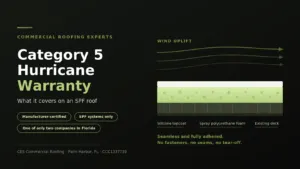
Underwriters Laboratories conducted independent wind uplift testing and found that SPF exceeded the capacity of the test equipment, which maxed out at 160 to 165 pounds per square foot. The equipment failed before the foam did.
FM Global testing measured SPF pull resistance on concrete at over 990 pounds of uplift pressure. On metal deck assemblies, the failure mode was fastener back-out, not foam delamination. The foam outlasted the metal structure it was attached to.
University of Florida researchers tested wood roof deck assemblies under ASTM E 330-02 and published findings in the Journal of Architectural Engineering showing that a 3-inch SPF fill increased wind uplift resistance by 3.0 to 3.2 times. This was on assemblies that already met Florida’s high wind requirements. A follow-up 2012 study found that foam-adhesive roof joints maintained their strength with no statistically significant reduction in failure pressure even after 150 days of simulated water leakage.
IBHS summarizes the practical implication: tensile adhesive failures in tested SPF assemblies occur at approximately 900 psf.
How does SPF compare to other commercial roofing systems in a hurricane?
| System | Typical Wind Uplift Resistance | Common Failure Mode | Seams or Fasteners |
| SPF (closed-cell) | ~900 psf tensile failure (IBHS) | Substrate failure, not foam | None |
| Mechanically-fastened TPO/EPDM | FM 1-60 to 1-120 (60-120 psf) | Perimeter peeling, fastener pull-out | Yes |
| Modified bitumen | Varies by attachment | Edge and flashing failure | Yes (seams) |
| Standing seam metal | High inherent strength | Fastener back-out, panel seams | Seams |
| Built-up roofing (BUR) | Moderate | Surface blow-off, flashing failure | Fasteners at edges |
One important clarification on FM ratings: numbers like 1-60, 1-90, and 1-120 represent uplift pressure resistance in pounds per square foot, not wind speed in miles per hour. A 1-60 rated assembly resisted 60 psf during testing. FM applies a 2:1 safety factor, meaning a 1-60 rated roof was actually tested to 120 psf. SPF regularly exceeds the ratings achievable by any other commercial system.
What happens to SPF when hurricane debris hits the roof?
Wind-driven debris is a separate threat from uplift, and SPF handles it differently than membrane systems.
When a membrane takes a debris impact, the puncture creates a direct water entry point and can initiate peeling from the damage site. With SPF, debris may gouge or penetrate the surface foam layer, but the closed-cell structure prevents water from migrating through the foam. Any resulting leak stays localized to the point of impact.
Thomas L. Smith, former research director of the National Roofing Contractors Association, documented this after inspecting SPF roofs following Hurricane Andrew (1992, Category 5, South Florida). In his assessment of 11 SPF roofs in Dade County, he found that most sustained only minor missile damage while surrounding buildings with conventional roofing suffered catastrophic losses. As Smith reported after his field studies: “A missile will tear into or gouge out the foam, but the roof will not leak. Typically there are a lot of missiles flying around during a hurricane, so that’s a significant advantage.”
Buildings.com documented similar findings across multiple post-hurricane inspections: gouged foam can remain without repairs for months without leaking, a meaningful advantage when the number of damaged roofs in a disaster zone outstrips available contractors.
What does real-world hurricane performance data show?
The post-storm investigation record for SPF is the strongest of any commercial roofing system in documented literature.
After Hurricane Katrina (2005, Category 3 at landfall), NIST released Technical Note 1476 documenting roof performance in the Pascagoula, Mississippi area. The report found that SPF roofing systems, some estimated to be about 20 years old at the time, survived “extremely well.” SPF was the only roof type in the report to receive that characterization. RICOWI investigators separately documented more than 2 million square feet of SPF installed to metal roof decks that survived with minimal damage while adjacent buildings sustained serious structural failures.
A case study from Hurricane Dolly (2009, Category 2, Texas) illustrated the SPF advantage in a controlled real-world comparison. At a single building, new metal panels installed in 2008 without SPF blew off during the storm. Old metal panels from 1980, insulated with closed-cell SPF, remained fully intact. Both sections used 29-gauge metal with similar fasteners. The only variable was the foam.
What is the Category 5 Hurricane Warranty, and how does it work?
Category 5 on the Saffir-Simpson Hurricane Wind Scale represents maximum sustained winds of 157 mph or greater. It is the highest hurricane classification and is associated with catastrophic damage to well-built structures.
CES Commercial Roofing is one of only two companies in the state of Florida authorized by our manufacturer to offer a Category 5 Hurricane Warranty on SPF roofing systems. This is a manufacturer-certified warranty covering the SPF system remaining intact under Category 5 wind conditions. It is also transferable to new property owners, which adds real value in any commercial property sale.
Two conditions void the warranty:
- Annual maintenance must be performed each year. Most manufacturer system warranties carry this requirement. Skipping annual maintenance voids coverage.
- Substrate failure voids coverage. If the substrate beneath the foam, for example metal roof panels, detaches from the building structure, the warranty is voided. The foam stays bonded to those panels. The foam system is covered; the underlying building structure is not.
For a full breakdown of how this warranty is structured, see our Category 5 Hurricane Roof page.
Does SPF protect against flooding and moisture intrusion?
FEMA classifies closed-cell SPF as a Class 5 flood-damage resistant material, capable of withstanding direct contact with floodwater for at least 72 hours without degradation. That is the highest classification available.
The same closed-cell structure that limits debris penetration also prevents moisture migration within the foam. If a portion of the surface is compromised, water cannot travel through the foam body to other areas. Damage stays isolated.
This matters in Florida not only during hurricanes but also during the rainy season, when flat and low-slope commercial roofs regularly deal with ponding water. The silicone topcoat applied over SPF resists ponding water far better than acrylic alternatives. Silicone maintains its adhesion and UV resistance even when submerged, which is a meaningful advantage in Florida’s wet climate.
How does SPF affect energy costs?
Wind protection tends to dominate the conversation about SPF, but the thermal performance matters equally for Florida commercial property owners.
Closed-cell SPF provides R-5.6 to R-7.0 of insulation value per inch. That exceeds every other commonly-used commercial insulation material. It also functions as a continuous air barrier, eliminating the thermal bridging and air infiltration that undermine the rated performance of board insulation products.
| Insulation Type | R-Value Per Inch |
| Closed-cell SPF (roofing grade) | R-5.6 to R-7.0 |
| Polyisocyanurate (polyiso) board | R-5.6 to R-6.5 (degrades over time) |
| Extruded polystyrene (XPS) | R-5.0 |
| Open-cell SPF | R-3.5 to R-3.7 |
| Fiberglass batts | R-2.9 to R-3.8 |
Industry data supports 30 to 40% cooling cost reductions for commercial buildings after SPF installation. Our customers have reported savings in the 25 to 30% range. The white silicone topcoat also qualifies the system as a cool roof, reflecting solar heat rather than absorbing it.
There is also a financial angle worth noting for property owners considering restoration over full replacement. A silicone coating restoration on an eligible existing roof qualifies for Section 179 tax treatment, meaning the entire project cost can be written off in the tax year it is completed. Consult your tax advisor for specifics on your situation.
How long does an SPF roof last?
The foam itself has an indefinite functional lifespan when properly maintained and recoated. One of the oldest documented SPF installations is at Playhouse Square in Cleveland, Ohio, where foam installed in 1972 is still performing as of 2025, more than 50 years later.
The silicone topcoat erodes at roughly 0.5 mils per year in harsh environments. Recoating every 10 to 15 years restores full performance and restarts the warranty term. Recoat cost is typically around one-third of the original installation cost, which compares favorably to full replacement.
Standard manufacturer warranties are available in 10, 15, or 20-year terms. The same options apply to silicone coating restorations on eligible existing roofs.
What should you ask before choosing a hurricane-resistant roofing system?
Not all SPF installations produce the same results. Foam density, substrate preparation, and silicone topcoat thickness all directly affect performance. A few questions worth putting to any contractor:
- What density foam do you install? The minimum for roofing applications is 2.5 lb/ft3. Standard for structural performance is 2.7 to 3.0 lb/ft3.
- What topcoat thickness are you applying? 20 mils is the minimum for a 10-year warranty. 30 mils for a 20-year warranty.
- Are you certified with the foam manufacturer to issue system warranties?
- Can you offer a manufacturer-certified Category 5 Hurricane Warranty?
- Do all workers on the roof carry coverage under a standalone workers’ compensation policy?
That last question matters more than most property owners realize. Many contractors use employee leasing companies that provide insurance certificates covering only a single office employee. Roofing crews may have no coverage at all. If an uninsured worker is injured on your property, the liability follows the property owner. We carry a standalone workers’ compensation policy that covers every person on the roof.
Is SPF the right system for every commercial building?
No, and we’ll say that directly. If a thermal scan shows that more than 25% of a roof’s insulation is saturated with moisture, Florida building code requires full tear-off and replacement. Restoration with SPF or coatings is not an option at that threshold.
For roofs that qualify, SPF is particularly well-suited to metal buildings, warehouses, manufacturing facilities, and properties where both hurricane resilience and long-term energy performance are priorities. For full replacements on flat and low-slope buildings, TPO is often the most cost-effective path and is what we most commonly recommend in those cases.
The right answer depends on the current condition of the roof. That is what the inspection is for.
Get a free commercial roof evaluation
CES Commercial Roofing provides free evaluations for commercial properties across Florida, including drone-assisted inspection and thermal imaging for moisture detection. If you want an honest assessment of where your roof stands heading into storm season, call us at (813) 419-1918 or schedule your free inspection.