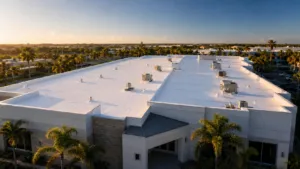


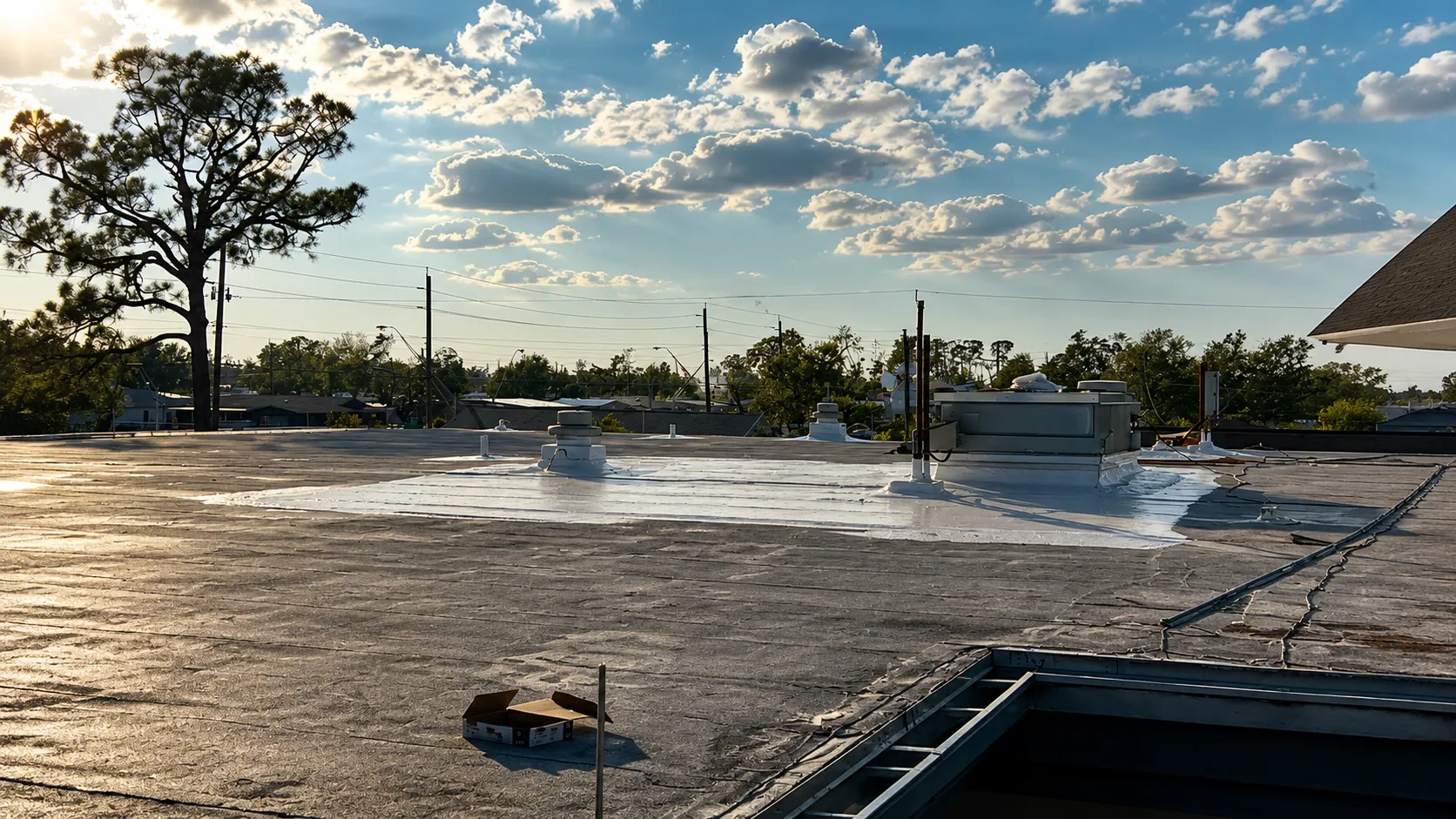
When a commercial roof fails during a Tampa storm, the first call you make decides how much of your building and inventory you save. Here is what a legitimate commercial roofer does on that call. They answer the phone, or return it promptly through an after-hours service. They get eyes on the roof the same day or the next day. They perform an emergency dry-in to stop the water, document everything for your insurer, and then lay out a permanent repair plan.
At CES Commercial Roofing, we built our entire customer experience around the single biggest complaint property owners have about roofers contractors who do not answer, do not call back, and do not show up. With 15 million square feet of commercial roofing installed across Florida and a same-day response standard, our model is simple. Be the contractor that actually picks up.
This guide covers the response timeline, the emergency process step by step, how emergency dry-in works, and the insurance documentation that protects your claim. It also covers how to tell whether the contractor you are about to call is built for commercial work or is a residential crew claiming commercial capability.
What counts as a commercial roof emergency
Not every roof problem is an emergency, but several situations call for an immediate response on a commercial building. The common thread is active or imminent water getting into an occupied or inventory-filled space.
- Active leaking into the interior, especially near electrical panels, server rooms, or production equipment
- Ponding water that appears suddenly after a drain failure or a structural low spot, which adds weight and stresses the deck
- Debris penetration, such as a downed limb or wind-driven object punching through the membrane and deck
- Wind-lifted flashing or coping at the perimeter that exposes the roof edge to driving rain
A warehouse with water spreading across stored pallets, a retail center with ceiling tiles bulging over the sales floor, a restaurant with water tracking toward kitchen equipment, a distribution facility with a soaked conveyor line all of these qualify. The longer water sits, the further it travels through the insulation, and the more the damage spreads beyond the original breach.
What to do in the first hour, before the crew arrives
The first hour is about protecting people, protecting assets, and protecting your insurance claim. A few actions on your end make a real difference before any roofer arrives.
- Shut off power to the affected area at the breaker if water is anywhere near electrical panels, conduits, outlets, or machinery, and keep people clear until it is verified safe
- Move or cover what you can, including inventory, computers, and networking gear, using heavy plastic sheeting
- Place containment under active drips. If a drop-ceiling tile or drywall cavity is visibly bulging with trapped water, set a bucket underneath and puncture the center to drain it in a controlled way, rather than letting the whole ceiling let go at once
- Document everything with time-stamped photos and video before you move or clean anything. That documentation becomes the backbone of your claim
- Keep untrained staff off a wet commercial roof, which is a fall and electrocution risk
Once the area is safe and documented, the priority is getting a qualified commercial roofer on site.
How fast a commercial roofer should respond in Tampa
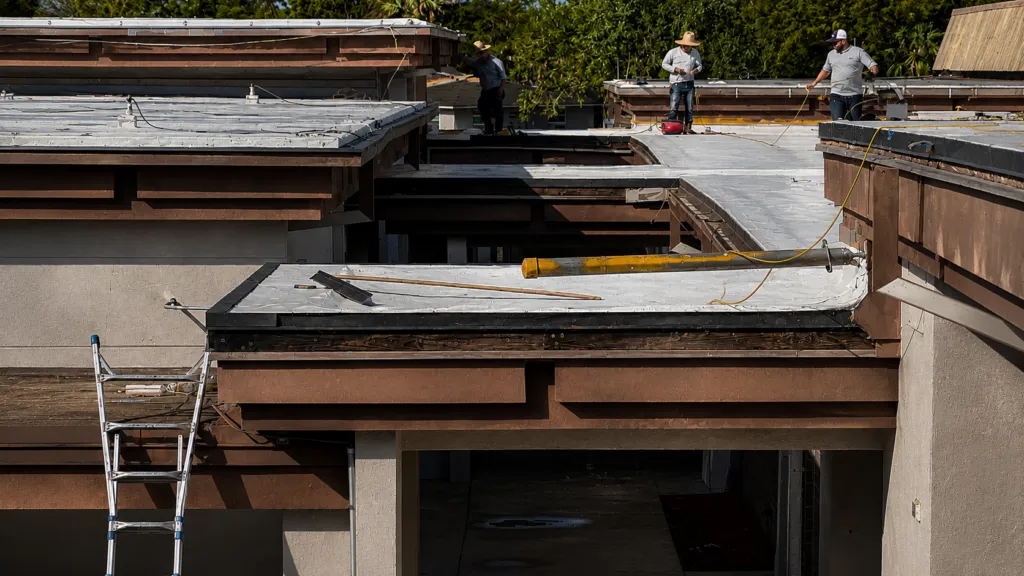
The Tampa “emergency roof” search results are full of promises but no one is a responsible commercial roofer who keeps the guaranteed two-hour arrival in any conditions, and crews tarping roofs at 1 a.m. in the middle of a storm. We will be straight with you. A contractor offering to put workers on your roof in the dark, in the wind, on a wet membrane is offering to do something unsafe. Falls are the leading cause of death in construction, and night work multiplies the risk. Responsible commercial roofers do not do it, and the ones who promise it are telling you something about how they operate.
Here is the model we actually run, and what a credible commercial roofer’s response looks like.
| Time of call | What happens |
| Business hours (Mon to Fri, 8 to 5) | Calls answered in real time, with the goal of same-day action and a same-day or next-day site visit |
| Nights, weekends, holidays | A 24-hour answering service fields the call, logs it, and prioritizes dispatch first thing the next business morning |
Our standard is same-day response and same-day or next-day site visits. We do not hand you a clock-time guarantee we cannot safely keep. Once it is light and safe to be on the roof, the crew moves fast to stabilize the damage. We serve Tampa and the wider Tampa Bay metro, along with Orlando and Sarasota, so a local crew is already in the area instead of driving in from out of state. Responsiveness is the part of this business we care about most, and it is built into how we run commercial roofing across Florida.
The emergency response process, step by step
Emergency commercial roofing runs on triage. The goal in the first 24 hours is to stop the water and protect the building, not to perform the permanent repair. That comes later, after the damage is fully assessed. Here is the sequence.
- Call answered. During business hours you reach us directly. After hours, the answering service logs your call for next-morning priority dispatch.
- Structural safety check. Before anyone walks the roof, the crew confirms the deck is sound. A spongy or visibly sagging deck can mean rotted decking and a fall-through risk, so crews stay off it until it is cleared.
- Stabilization and emergency dry-in. The crew stops the active water intrusion with temporary waterproofing, patching, or tarping anchored against wind uplift. This is the step that buys you time.
- Assessment and documentation. With the leak controlled, the crew maps the full extent of the damage, including hidden moisture that has migrated through the insulation, and builds the photo and report package your insurer will need.
- Permanent repair plan and proposal. We lay out what it takes to restore the roof properly, whether that is a localized repair, a coating or foam restoration, or a section replacement, with an honest read on which path fits your roof.
- Ongoing roof management. After the fix, annual maintenance keeps the roof and its warranty valid and catches small issues before they become the next emergency.
Emergency dry-in, explained
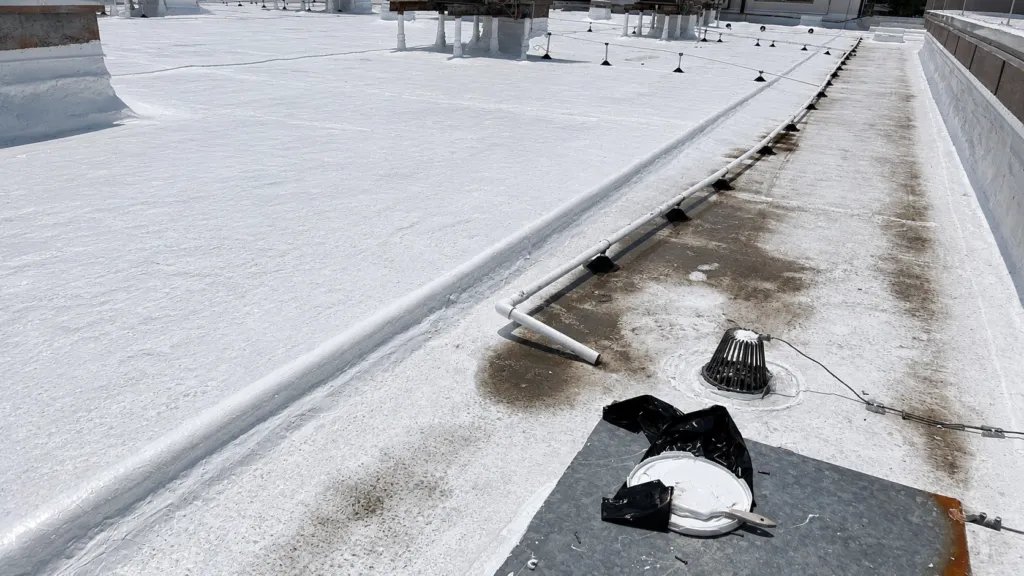
Emergency dry-in is the immediate protection that secures a damaged roof so no more water gets in while permanent repairs are planned. It matters for two reasons. It limits the damage, and your insurance policy effectively requires it. Commercial property policies carry a duty to mitigate, which means the owner has to take reasonable steps to prevent further loss after the initial event. Skip that step and let water keep pouring in, and the carrier can dispute coverage for the additional damage.
Our emergency dry-in includes:
- Interior and exterior dry-in protection
- Temporary waterproofing and water diversion
- Structural reinforcement where the situation calls for it
- Rapid drone-assisted damage assessment to survey the roof quickly and safely
- Full insurance documentation support
Drone-assisted assessment is how we survey a storm-damaged roof: it covers the whole surface and captures high-resolution imagery without the time and exposure of a full manual walkdown. When the readings point to hidden moisture inside the system, we bring out thermal imaging to find it, which is something most commercial roofers cannot do. If you want the detail on tracing a leak across a flat roof, our commercial roof leak detection service walks through it.
Insurance documentation: what protects your claim
A clean claim depends on documentation gathered at the right moments, starting before stabilization and continuing through the repair. A good contractor gives you a damage assessment, dated photographs, and detailed reporting, and helps you put together a proof of loss. Carriers generally want written notice of the loss within a short window after the event, so the photos and logs you capture in the first hour are not a formality. They are the evidence.
One distinction trips up a lot of commercial owners after a tropical storm wind-driven rain versus flood. They fall under different policies, and confusing them stalls claims.
| Type of water damage | What it means | Typically covered by |
| Wind-driven rain | Wind damages the roof covering, and rain enters through that breach | Standard commercial property policy (windstorm) |
| Floodwater | Water rises into the building from the ground up, from surge or flash flooding | Separate flood insurance (NFIP) |
Water that enters through a wind-breached roof is a windstorm claim, not a flood claim. For owners of flat commercial buildings, the Federal Emergency Management Agency’s guidance on low-slope roof systems and storm performance is worth a read. Detailed reporting from your roofer keeps the claim moving and keeps you on the right side of the duty to mitigate.
Can the roof be repaired, or does it need replacement?
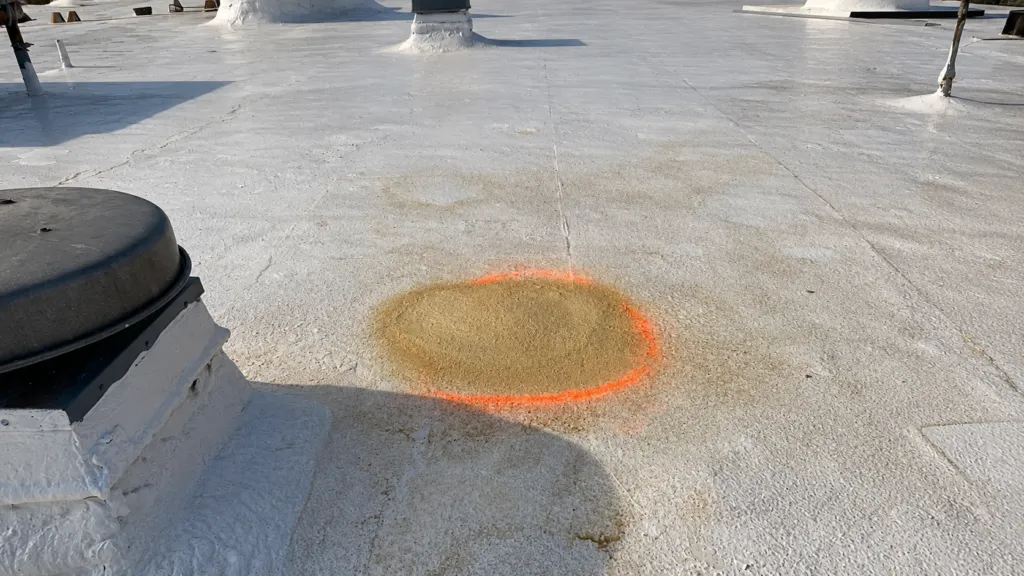
Once the roof is stabilized, the real question is repair, restoration, or replacement. The honest answer depends on how much of the roof is actually damaged and how it was originally permitted.
Florida used to enforce a strict “25% rule” that forced a full tear-off whenever more than 25 percent of a roof section was repaired or replaced within a 12-month period. That changed with Senate Bill 4-D, signed in 2022 and folded into the current Florida Building Code. For roofs built or last replaced in compliance with the 2007 Florida Building Code or later, only the damaged portion has to be brought up to code, even if the damage exceeds 25 percent of the section. The surrounding sound roofing stays. If the roof predates that compliance threshold, or has no closed permit to prove it, the older full-replacement rule can still apply. The percentage is based on the roof area worked on, not on how wet the roof is, and it should be calculated by a licensed professional for your specific building.
This is where an objective assessment earns its keep. Restoration with a coating or spray foam system can often extend the life of an aging flat roof without a tear-off, but only when the moisture trapped in the system is within range. We measure that with thermal imaging instead of guessing, so the call to repair, restore, or replace is grounded in data. When replacement is the right answer, our commercial roof replacement work in Tampa covers flat, low-slope, and metal systems.
How to choose a commercial emergency roofer
The contractor you call in a crisis is the wrong time to find out they were never built for commercial work. A few checks separate a true commercial roofer from a residential crew claiming commercial capability.
Confirm they are actually commercial. A lot of residential roofers now market commercial services. Ask what percentage of their work is commercial. A 100 percent commercial focus, like ours, means crews, equipment, and processes are all built for low-slope membranes, metal, foam, and coatings, not asphalt shingles on a sloped house.
Verify standalone workers’ compensation. This is a real liability most property owners do not know they carry. Some contractors use employee-leasing arrangements where the workers’ comp certificate covers a single office employee, while the crew on your roof has no coverage at all. If one of them is injured on your property, the liability can land on you. We carry a standalone workers’ compensation policy that covers every person on the roof. Ask any contractor for proof, and ask specifically whether their crews are covered, not just an office worker.
Check manufacturer certifications and warranty type. Certification is what lets a contractor offer a system warranty covering both labor and materials, instead of a thinner material-only warranty. We hold active certifications with 14 or more manufacturers and both a Certified General Contractor and Certified Roofing Contractor license in Florida.
Look for a local company, not a stormchaser. After a hurricane, out-of-state crews descend on Florida, do quick work, and leave. We are Florida-based and respond to storms that hit our own service area and existing customers, which means we are still here when you need warranty support a year later.
Two more markers worth confirming on any commercial roofer. First of all a real third-party track record and secondly real installed volume. Ours runs to an A+ BBB rating with zero complaints, a 4.9-star Google rating, a top 5 percent ranking among Florida licensed contractors per BuildZoom, 15 million square feet installed, and 125+ years of combined experience on the team.
Frequently asked questions
What is an emergency dry-in on a commercial roof?
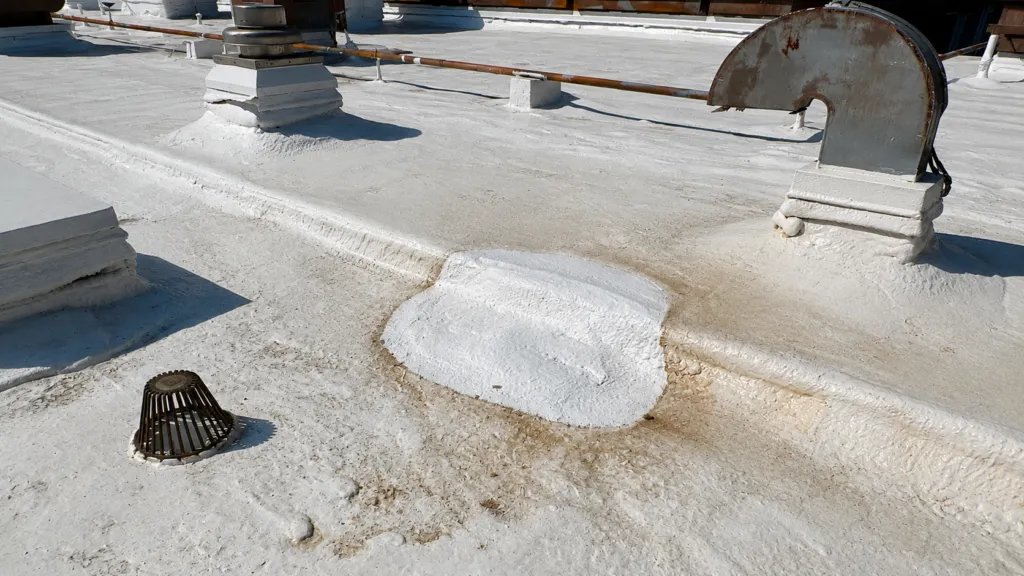
Emergency dry-in is temporary protection that secures a damaged roof to stop water intrusion until permanent repairs can be made. It includes interior and exterior dry-in, temporary waterproofing, water diversion, and structural reinforcement where needed, along with the documentation your insurance claim needs.
Does insurance cover emergency commercial roof repair?
In most cases, yes, when the damage results from a covered event such as a windstorm or a sudden breach. Your policy also requires you to mitigate further damage, which is exactly what emergency dry-in does. Water entering through a wind-breached roof is generally a windstorm claim under a commercial property policy, not a flood claim. Keep time-stamped photos and detailed reporting to support it.
How fast can someone respond to a commercial roof emergency in Tampa?
Our standard is same-day response and a same-day or next-day site visit. After-hours calls go to a 24-hour answering service and are prioritized for dispatch the next business morning. Responsible commercial roofers do not send crews onto roofs at night for safety reasons, so be cautious of any contractor guaranteeing nighttime arrival on a wet roof.
Can a commercial roof be repaired, or does it need full replacement?
It depends on the extent of the damage and how the roof was permitted. For roofs built to the 2007 Florida Building Code or later, only the damaged section usually has to be addressed. An objective assessment, ideally with thermal imaging to measure trapped moisture, determines whether a localized repair, a coating or foam restoration, or a section replacement is the right path.
Get a commercial roof emergency handled the right way
If your commercial roof is leaking or storm-damaged anywhere in the Tampa Bay area, Orlando, or Sarasota, we can get eyes on it fast and stop the damage before it spreads. Call CES Commercial Roofing at (813) 419-1918. We will answer, show up, and document everything your insurer needs.
CALL (813) 419-1918