

Metal is one of the longest-lasting commercial roofing systems you can put on a Florida building. A well-specified, well-installed metal roof can run for decades. The harder part of the decision is everything sitting under that headline: which configuration and metal fit your building and its exposure to salt air, the fact that lifespan is a conditional range rather than a single number, and the buyer-protection details that decide whether a roof reaches its full life or fails early. At CES Commercial Roofing, we have installed 15 million square feet of commercial roofing across Florida, and the metal roofs that hold up share one thing: the metal, the coating, and the installer were matched to the building from day one.
This guide covers the two metal systems we install, how metal and coating choices play out in Florida’s climate, the realistic lifespan ranges, the energy and code factors in play, and the questions worth asking before you sign. It also makes a case you will not hear from a contractor bidding a tear-off: for an aging but structurally sound metal roof, a foam or coating restoration is often the smarter move than a full replacement, at roughly one-third the cost.
The Two Commercial Metal Roofing Systems We Install
Commercial metal roofing comes in two main classes, and the difference comes down to how the panels attach to the building. That one detail drives longevity, wind resistance, and where leaks tend to start. We install commercial metal roofing in two configurations: standing seam and R-Panel.
Standing Seam (Concealed Fastener)
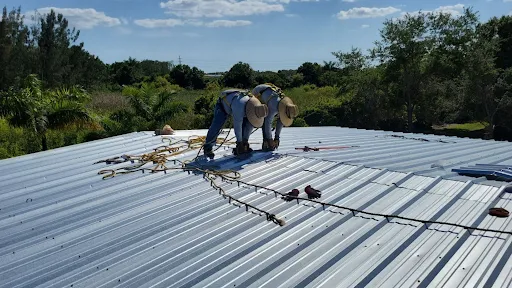
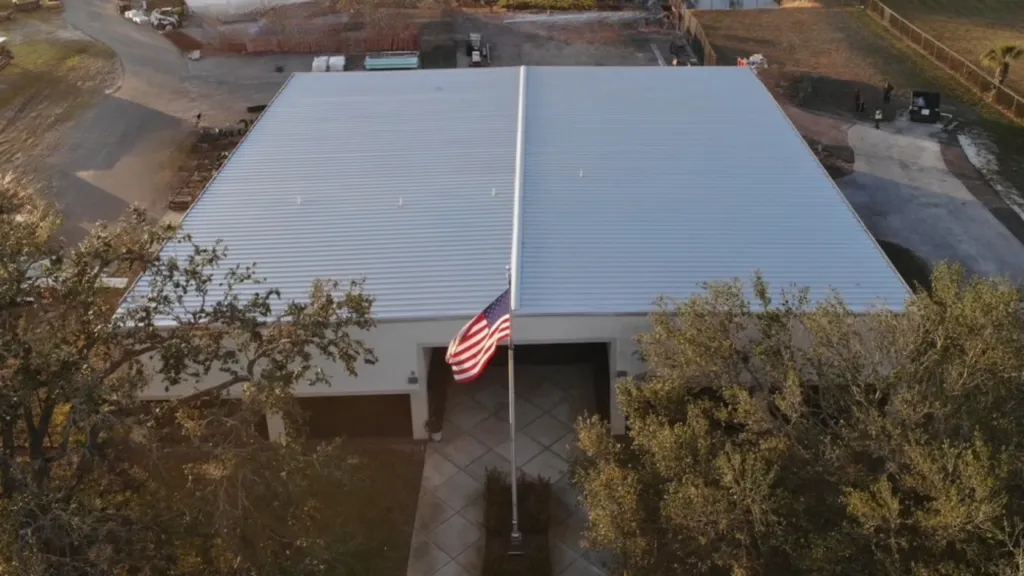
Standing seam uses long vertical panels that lock together along raised seams, usually rising one to three inches above the panel surface. The fasteners are concealed. Panels are secured with interior clips hidden inside the seams, so nothing penetrates the weathering surface. Those clips also let the panels float, which matters in Florida. Metal expands and contracts as the roof heats and cools through the day, and a floating panel absorbs that movement without straining its joints. The result is strong weathertightness and high resistance to wind uplift, which is why standing seam is the preferred configuration for commercial buildings exposed to severe weather.
R-Panel (Exposed Fastener)
R-Panel and similar exposed-fastener systems are face-fastened, meaning screws are driven directly through the panels into the structure below. Each screw carries a rubber washer to seal the hole. These systems cost less and have a long history on warehouses and industrial buildings, but they come with a built-in maintenance demand. Because the panels are pinned at every screw, they cannot float, so thermal cycling slowly works the screw holes loose. At the same time, sun and ozone dry out the washers until they crack. Over 10 to 20 years, those thousands of penetrations become the most likely place for water to get in, which is why an R-Panel roof needs a fastener and washer inspection program to reach its full life.
Standing Seam vs R-Panel at a Glance
| Factor | Standing Seam | R-Panel (Exposed Fastener) |
| Fasteners | Concealed clips, no holes through the surface | Screws through the panel face |
| Thermal movement | Panels float on clips | Panels fixed, screw holes strain over time |
| Weathertightness | Higher uplift resistance, few leak points | Thousands of sealed penetrations to maintain |
| Maintenance demand | Lower, periodic seam and flashing checks | Higher, ongoing fastener and washer service |
| Typical fit | Higher-value commercial, severe exposure | Warehouses, agricultural, budget-driven industrial |
| Localized repair | More complex, panels interlock | Easier, panel by panel |
You can see how each system fits different buildings and budgets in our overview of commercial metal roofing options.
Choosing the Right Metal and Coating for Florida’s Climate
The panel system is only half the decision. The metal itself and the paint on it determine how the roof holds up to humidity, UV, and salt air. Florida’s coast is one of the most corrosive environments in the country, and that has pushed the commercial market toward specific materials.
Galvalume Has Largely Replaced Galvanized Steel
Galvanized steel is coated in pure zinc, which protects the steel by corroding in its place. That works inland, but salt spray speeds the process up, and once the zinc wears thin the steel rusts fast. For that reason, galvanized has been largely phased out of Florida commercial use. The standard now is Galvalume, a steel coated with an alloy of roughly 55 percent aluminum and 45 percent zinc. The aluminum forms a stable barrier against moisture and salt, while the zinc still protects exposed cut edges. The Metal Construction Association reports that Galvalume outlasts galvanized steel by a factor of two to four in marine and industrial settings, which is why it has become the default for inland commercial buildings. You can review the underlying material research through the Metal Construction Association.
Aluminum for Buildings Close to Saltwater
For buildings within about 1,500 feet of saltwater, even Galvalume can develop edge corrosion over time. Solid aluminum is the standard for those high-exposure sites. Aluminum does not develop red rust at all. In salt air it forms its own tight oxide layer that stops further corrosion. The upfront material cost is higher, but for a building sitting near the water it usually carries the lowest lifecycle cost.
PVDF vs SMP Coatings
Bare metal degrades under intense sun, so commercial panels are coated with an oven-cured paint. The resin in that paint decides how well the color and finish survive the Florida solar index.
- PVDF (a fluoropolymer paint, also sold as Kynar 500 or Hylar 5000) has carbon-fluorine bonds that resist UV breakdown. It holds color and finish for decades and is the standard for higher-end commercial work, often backed by 40-year coating warranties.
- SMP (siliconized modified polyester) is a more economical paint. It resists scratching well, but its polyester binder breaks down under UV over long horizons, showing up as chalking, a white powdery residue that dulls the color and cuts the roof’s reflectivity.
For an architectural standing seam roof that needs to look right for decades, specifying PVDF over SMP is one of the more consequential line items in the spec.
How Long Does a Commercial Metal Roof Last in Florida?
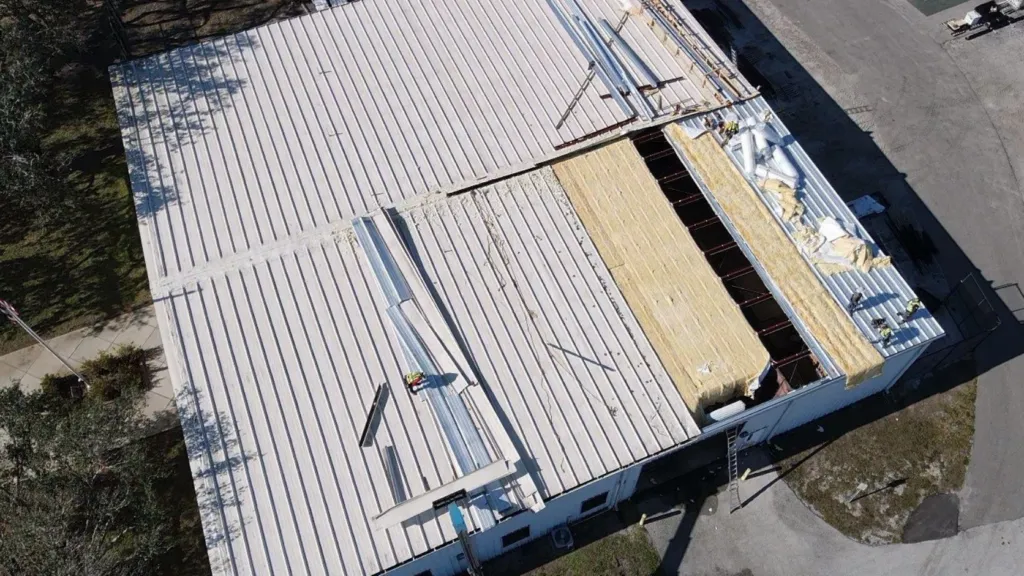
A commercial metal roof in Florida does not have a single lifespan number. Service life is a conditional range driven by metal type, coating system, installation quality, proximity to saltwater, and maintenance. Change any one of those and the range moves.
A well-built standing seam roof can reliably deliver 40 to 70 years. Inland, where salt exposure is low, high-quality PVDF-coated Galvalume or aluminum systems often exceed 60 years. Within about 1,500 feet of saltwater, a Galvalume standing seam roof may compress toward 30 to 45 years from edge wear, while a solid aluminum system tends to hold its 50-plus year projection under the same coastal conditions. Exposed-fastener R-Panel roofs run a tighter 20 to 30 years, and that shorter window is usually about the fasteners failing rather than the panels themselves.
| System and metal | Inland (low salt exposure) | Coastal (within ~1,500 ft of saltwater) |
| Standing seam, PVDF Galvalume | 40 to 70 years, often 60+ | roughly 30 to 45 years |
| Standing seam, solid aluminum | 50+ years | 50+ years |
| R-Panel, exposed fastener | 20 to 30 years | shorter without diligent fastener service |
Every figure here depends on the conditions above, so treat them as ranges, not promises. For a building on the water in Tampa, the maintenance schedule and the metal choice matter more than the headline number. We go deeper on this in our guide to how long metal roofs last in Florida.
Metal Roofs and Cooling Costs in Florida
Energy performance is a real part of the metal roofing case in Florida, where dark roof surfaces can hit 150 degrees or more on a summer afternoon. Metal reflects a large share of that heat, but reflectivity is only half of what makes a roof run cool.
Bare mill-finish metal reflects roughly 75 percent of incoming sunlight, yet it radiates very little of the heat it does absorb, so it stays hot to the touch and pushes heat into the building. Modern commercial metal roofs solve this with cool-pigmented paint finishes. Light colors reflect 60 to 90 percent of sunlight, and the painted finish raises the roof’s ability to shed the heat it does take on. According to the U.S. Department of Energy, a properly coated cool roof can run more than 50 degrees cooler than a dark surface on a hot afternoon, which trims peak air conditioning demand and eases wear on rooftop HVAC units. The agency’s overview of cool roofs lays out the supporting data.
The Florida 25 Percent Roof Rule and Metal Roofs
Florida’s building code includes a rule that catches owners off guard during repair decisions, and it is widely described wrong online. The 25 percent rule is triggered by the percentage of roof area worked on within a 12-month period, not by how much of the roof is wet, damaged, or in need of repair. If more than 25 percent of a roof section is repaired, replaced, or recovered in a 12-month window, the older version of the rule required the whole section to be brought up to current code.
Senate Bill 4-D, passed in 2022 and codified in Section 553.844 of the Florida Statutes, changed how this applies based on the roof’s age. The threshold date is March 1, 2009, when the 2007 Florida Building Code took effect.
- Roofs permitted and installed under the 2007 code or later are generally exempt from the mandatory full-replacement trigger, so an owner can repair only the damaged area.
- Roofs installed before that date still fall under the original rule, where crossing the 25 percent threshold on a section can force a full tear-off to current code.
The takeaway for a buyer is to pull the permit history before planning any major repair, because the install date can decide whether you are patching a section or replacing it. The full statutory language is available through the Florida Senate. Code requirements vary by jurisdiction, so confirm the specifics with your local building department.
Restore vs Replace: When a Foam or Coating System Beats a Full Reskin
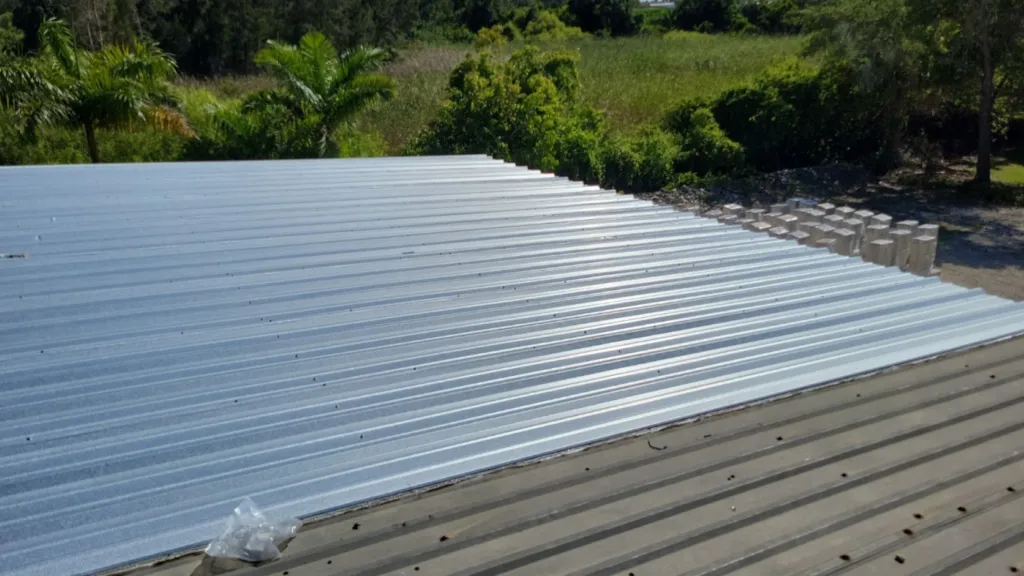
An aging, leaking, or oxidized metal roof does not automatically need to come off. If the structural deck and purlins underneath are sound, the roof is usually a strong candidate for a fluid-applied restoration, and in our experience metal is the best and easiest surface to restore.
A foam or coating restoration rebuilds the watertight envelope without removing the existing roof. The surface is cleaned and rust-treated, fasteners and seams are reinforced, penetrations and flashings are detailed with spray polyurethane foam (SPF, a sprayed-on insulating foam) or sealant, and a reflective topcoat is applied across the field to create a seamless membrane. A restoration can run roughly one-third the cost of a full replacement, and it avoids the tear-off waste, the risk of an open roof during a rainstorm, and the business downtime a reskin forces on tenants.
Our own projects show the gap in real numbers. We completed a $500,000 foam-and-coating restoration on a metal roof where a full reskin would have cost about $1.2 million, saving the owner roughly $700,000. On a separate job, we refurbished an 88,850-square-foot metal roof with a combination of foam and a hybrid system, finished with a high-solid silicone coating. We also foam-and-coated a 45,000-square-foot R-Panel roof in Orlando, completed during Florida’s rainy season without taking the building offline.
| Factor | Foam or Coating Restoration | Full Reskin (Replacement) |
| Relative cost | Roughly one-third of replacement | Highest capital cost |
| Tear-off waste | Minimal | Extensive |
| Business disruption | Low, building stays covered | Higher, interior exposure risk |
| Best candidate | Sound deck and purlins, dry insulation | Saturated insulation or failed structure |
| Warranty options | 10, 15, or 20-year renewable | New system warranty |
There is a tax angle worth raising with your accountant. Because coatings are often treated as maintenance rather than a capital improvement, the cost can sometimes be expensed in the year it is incurred rather than depreciated over a long schedule. Tax treatment depends entirely on your situation, so consult your tax advisor before counting on it. We break it down in our note on Section 179 and commercial roof coatings, and run the long-term math in our roof coating vs full replacement cost comparison.
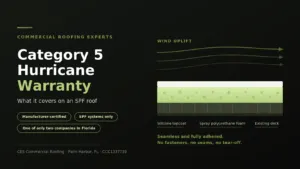
One note specific to foam: a metal roof restored with a foam-and-coating system becomes an SPF system, which can qualify for the same manufacturer warranties as a new SPF roof, including a renewable leak-proof warranty. CES Commercial Roofing is one of only two companies in Florida authorized to offer a manufacturer-certified Category 5 Hurricane Warranty on SPF systems. That warranty covers the foam system staying bonded to the substrate, and annual maintenance keeps it in force. It applies to the SPF system, not to a bare metal roof. Our commercial roof restoration page lays out the full scope.
What to Know Before You Buy a Commercial Metal Roof
A metal roof is a long-term capital asset, and a few decisions protect that investment more than the panel choice itself. These are the ones we tell owners to slow down on.
Material vs Workmanship vs Full-System Warranties
Not all roofing warranties cover the same thing, and the differences decide who pays when something goes wrong.
| Warranty type | Issued by | Covers | Key limitation |
| Material | Panel or coating maker | Metal or paint defects | Excludes labor, you pay to remove and reinstall |
| Workmanship | Installing contractor | Installation errors | Only as durable as the contractor’s business |
| Full-system (NDL) | Manufacturer | Material and workmanship together | Requires a certified installer and inspection |
A material warranty replaces a defective panel but leaves you paying the labor to swap it. A workmanship warranty holds up only as long as the contractor is still in business. The strongest protection is a manufacturer full-system warranty, often called No Dollar Limit (NDL), where the manufacturer covers both material and labor. To get one, the roof has to be installed by a manufacturer-certified contractor, built with single-source components, and inspected by the manufacturer’s representative. The National Roofing Contractors Association’s guidance on roof system warranties is a useful neutral reference.
The Crossover Crew Risk Most Owners Carry Without Knowing
One of the larger risks in the Florida market is a residential roofing company taking on commercial metal work. Commercial standing seam in particular needs specialized tooling, structural detailing, and heavy staging equipment that residential crews usually do not have. Crossover crews tend to use residential-grade profiles and skip details like high-temperature underlayment and metal closures. There is also an insurance exposure. If a contractor’s general liability or workers’ compensation coverage is thin, an injury or failure on your roof can land back on the property owner. Confirming that coverage is real and current is one of the simplest ways to protect yourself.
Questions to Ask Before You Sign
- Are you licensed as a Certified Roofing Contractor in Florida, and does that license cover the full scope you are quoting?
- Do you carry commercial general liability and full workers’ compensation, and can you show current certificates?
- Are you certified by the manufacturer whose system you are quoting, so a full-system warranty is even available?
- What metal and coating are you specifying, and why is it right for my building’s distance from saltwater?
- Is this roof a candidate for restoration instead of replacement, and what would each option cost?
Why Commercial Buildings Across Florida Choose CES Commercial Roofing
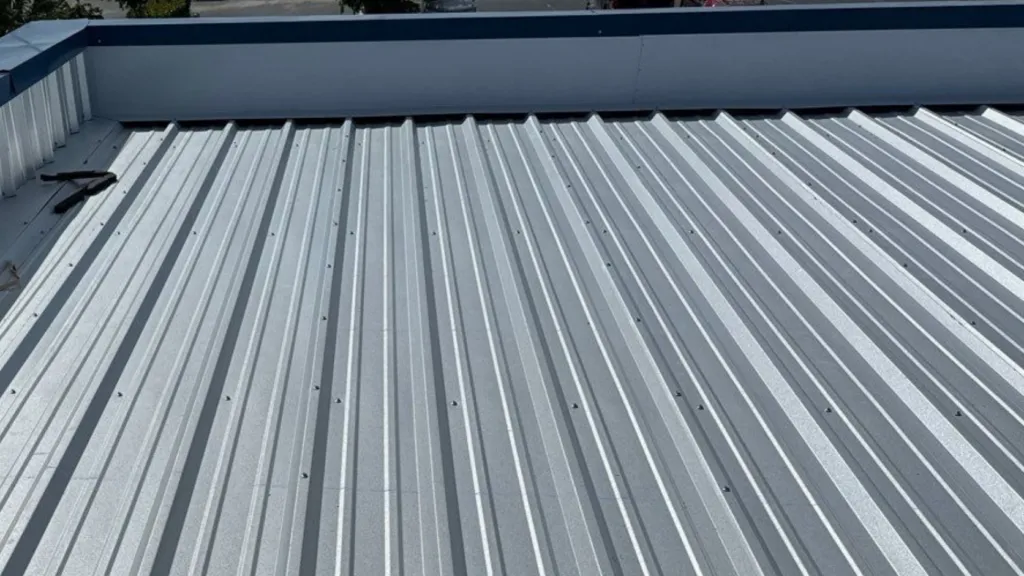
When an owner is weighing a metal roof, the crew behind it matters as much as the panel. We are a 100 percent commercial roofing contractor, so metal work is core to what we do rather than an occasional crossover job. We replace metal with metal every time a metal roof reaches end of life, and we run three dedicated SPF rigs for the restoration side of the business.
The track record behind that work includes more than 15 million square feet installed across Florida, over 125 years of combined experience, and more than 14 active manufacturer certifications that give building owners direct access to full-system warranties. We hold an A+ rating with the Better Business Bureau, a 4.9-star Google rating, and a BuildZoom score that places us in the top 5 percent of licensed Florida contractors. We hold an active Florida Certified Roofing Contractor license, CCC1337739, and we serve commercial properties across Tampa Bay, Orlando, Sarasota, St. Petersburg, and Clearwater.
Get a Free Roof Evaluation
Whether you are planning a new metal roof, replacing one that has reached the end of its life, or deciding between restoration and a full reskin, the right answer starts with seeing the roof. Our free roof evaluation includes an on-site inspection, with drone-assisted assessment and thermal imaging used as supplementary tools when moisture is suspected. We will tell you honestly whether your metal roof is a candidate for restoration or whether replacement is the better call, and what each path involves. CALL (813) 419-1918