

Comparing commercial roofing warranties comes down to a handful of questions that matter far more than the number of years printed on the cover. What does the warranty actually cover? Who stands behind it? Does your remedy shrink over time? Can it transfer if you sell the building, and what can void it before you ever file a claim? The three warranty types you will run into are material warranties, workmanship warranties, and full-system warranties, and the differences between them decide how much of a future repair bill lands on you.
At CES Roofing, we have installed more than 15 million square feet of commercial roofing across Florida, and some of the most common questions we field come from owners holding a proposal they cannot fully read. A warranty that looks generous on the first page can turn out to cover very little once you understand the terms. This guide lays out how the main warranty types compare, so you can weigh an offer on the dimensions that decide real-world protection rather than on headline length alone.
The three main types of commercial roof warranties
Most commercial roofing warranties fall into one of three categories. Understanding the category you are being offered is the first step in any real comparison.
A material warranty is the narrowest form of protection. It covers defects in the roofing product itself, such as a membrane or coating that fails because of a manufacturing flaw. It does not cover installation errors, and it usually does not cover the labor to tear out and replace the failed material. Many material warranties are also prorated, which means the amount the manufacturer will reimburse declines each year and is often capped at what you originally paid for the product.
A workmanship warranty comes from the contractor, not the manufacturer. It covers installation problems, like a seam that was welded incorrectly or flashing that was not sealed properly. This is separate from the manufacturer’s obligations for the product. There is no commercial industry standard for how long a workmanship warranty lasts or exactly what it covers, so the terms depend entirely on the contractor. A workmanship promise that is vague, verbal, or missing from the written contract is a warning sign.
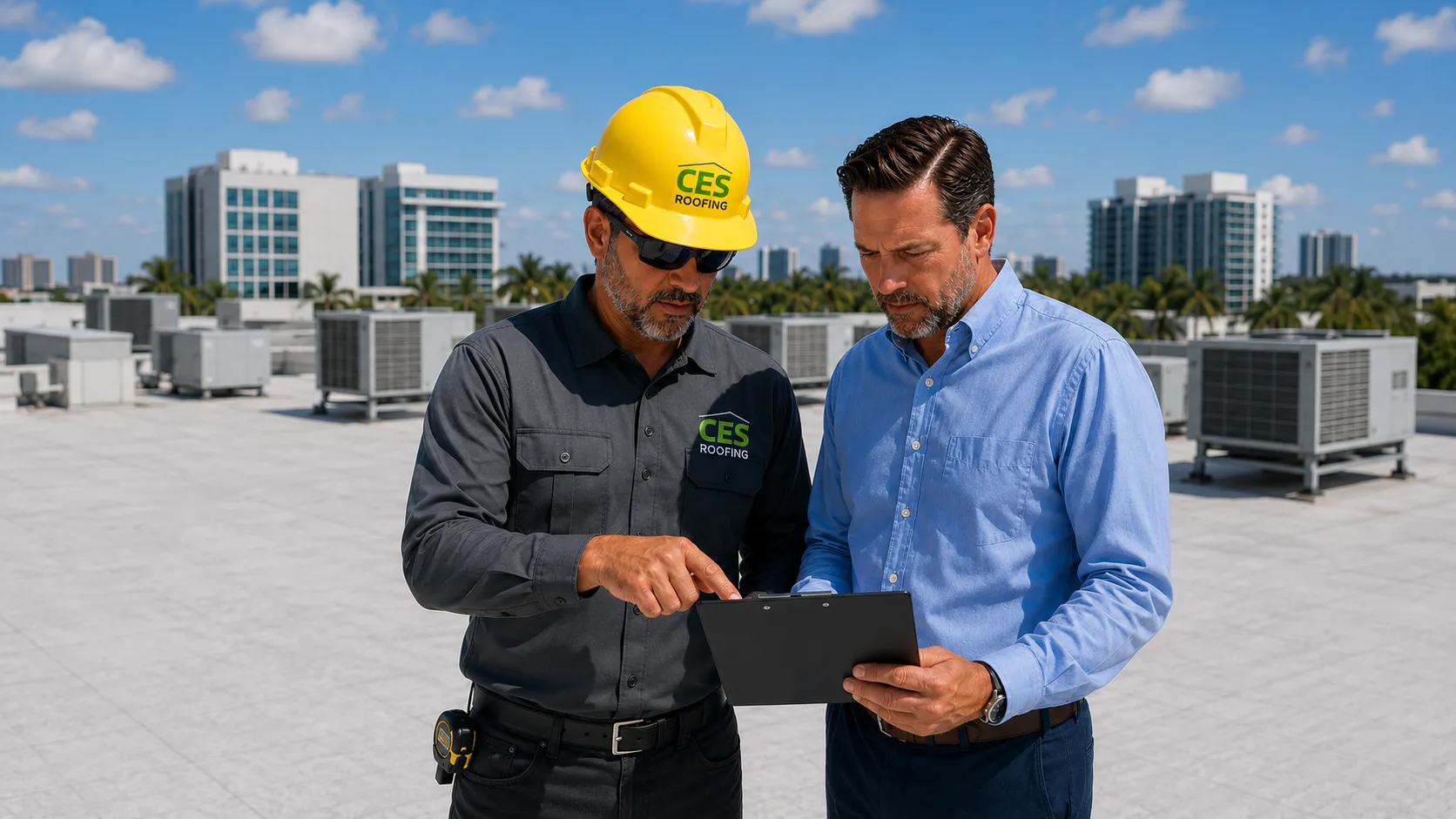
A full-system warranty is the broadest of the three. It comes from the manufacturer and covers the entire installed roofing system, materials and the workmanship of the installation together, including the labor to repair covered leaks. The catch is that a system warranty is only available when the roof is installed by a contractor who holds active certification with the manufacturer of the products being used. A non-certified contractor cannot issue a system warranty, no matter what they promise. We hold active certifications with more than 14 manufacturers, which is what allows us to offer manufacturer-backed system warranties rather than material coverage alone.
Commercial roof warranty comparison table
The table below compares the main warranty types on the dimensions that determine how well you are actually protected. Terms vary by manufacturer, product, and roofing system, so treat these as general patterns rather than fixed promises.
| Warranty type | Who backs it | What it covers | Labor to fix covered leaks | Repair cost cap | Typical commercial term |
| Material warranty | Manufacturer | Defects in the roofing product only | Usually not included | Often prorated and capped at the product’s original purchase value | Shorter and weaker; varies by product |
| Workmanship warranty | Contractor | Installation errors by the installer | Yes, performed by that contractor | Set by the contractor; no industry standard | No industry standard; contractor-specific |
| Full-system warranty | Manufacturer, through a certified installer | The whole installed system, materials and covered workmanship | Yes | Varies by tier | Commonly 10 to 30 years on qualifying systems |
| System warranty with No Dollar Limit (NDL) | Manufacturer, through a certified installer | The whole system, with no dollar cap on covered repairs | Yes | No dollar limit on covered repairs | Among the longest terms, on qualifying assemblies |
Material warranty vs. system warranty: the distinction that decides your coverage
If you remember one thing from this comparison, make it the difference between a material warranty and a system warranty, because it is the distinction that decides how much protection you walk away with.
A material warranty covers the product. A system warranty covers the product and the installation together. The gap between them is large, because many roofing problems trace back to installation and detailing rather than a defective product coming off the manufacturing line. If your coverage is material-only and a leak develops at a poorly installed penetration, the manufacturer’s warranty may not help you at all.
The reason this matters when you compare contractors is that a system warranty is tied to certification. Manufacturers only authorize their stronger system and No Dollar Limit warranties for contractors they have certified or approved to install their products. That is a documented requirement across the major manufacturers, not a marketing preference. A contractor who is not currently certified with the manufacturer of the products on your roof can install the roof, but they cannot give you a manufacturer-backed system warranty. At most they can offer their own workmanship promise plus whatever material coverage the product carries.
Before you accept a proposal that promises system or NDL protection, ask the contractor which manufacturers they are certified with and confirm that the certification is current. It is a fair question, and a certified contractor will have a straight answer.
What “No Dollar Limit” (NDL) coverage means
No Dollar Limit, usually shortened to NDL, is one of the most misunderstood terms in commercial roofing warranties. NDL means there is no monetary cap on what the manufacturer will spend to repair a covered leak. It does not mean the warranty covers every possible roof problem.
An NDL warranty still applies only to the causes and system components the warranty lists as covered. It does not turn the warranty into an all-risk policy. It will not pay for storm damage, faulty building design, neglect, or components that are not part of the warranted system. What NDL does is remove the spending cap on covered repairs, which protects you against rising repair and replacement costs during the covered term.
This is also where prorated coverage becomes important. A prorated warranty reduces the manufacturer’s obligation as the roof ages, so the older the roof, the less of a covered repair the manufacturer pays. NDL and non-prorated coverage do not step down that way within the covered term. When you compare two proposals, a longer prorated material warranty can be worth less in practice than a shorter system warranty with no dollar limit, because the prorated coverage shifts more of the real cost back to you later in the term.
What voids a commercial roof warranty
A strong warranty on paper protects you only if it stays valid. Across the major manufacturer documents, the same conditions show up again and again as things that can suspend, cancel, or void coverage.
- Skipped maintenance. Regular inspections, maintenance, and record-keeping are express owner obligations in most manufacturer warranties, not suggestions. Miss them, and coverage can be jeopardized or voided. For most commercial roofing warranties, annual maintenance is mandatory, and it is written into the terms by the manufacturers. Our own maintenance program is built around this. After each visit, we issue a certificate confirming your warranty remains valid. You can read more about that on our commercial roof maintenance and repairs page.
- Unauthorized repairs and modifications. Manufacturers commonly require that any repair or alteration to the roof be performed by a certified contractor. A well-meaning fix by a handyman or an HVAC crew cutting into the membrane can void the warranty.
- Uncontrolled rooftop access. Foot traffic from maintenance staff, solar installers, and equipment vendors damages roofs. Several warranties restrict how the roof may be accessed and can be voided by unauthorized traffic or penetrations.
- Missed claim and transfer deadlines. Many warranties require written notice to the manufacturer within a short window, often 30 days, after a leak. Notice to your contractor is frequently not the same as notice to the manufacturer.
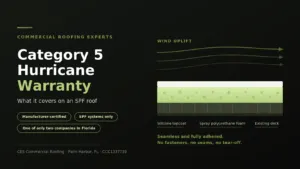
Most standard manufacturer and workmanship warranties also exclude storm and wind damage, which is usually an insurance question rather than a roof-warranty question. Some manufacturers offer enhanced programs with separate hail or wind allowances, so this varies by system and assembly. One exception worth knowing about is our Category 5 Hurricane Warranty, a manufacturer-certified warranty available on our SPF (spray polyurethane foam) systems. CES is one of only two companies in Florida authorized to offer it. If storm coverage is your main concern, that topic deserves its own treatment, and we cover it in depth separately.
How to read a warranty offer
Warranties are often marketed more aggressively than they are written. The headline sits on the front page, and the terms that actually decide your protection sit in the fine print. A few patterns are worth watching for when you evaluate any commercial roofing proposal.
A “lifetime” headline does not always mean a free new roof decades later. Some lifetime warranties are steeply prorated after a short initial period, and some require paid renewal to stay in force. If a warranty is described as lifetime or renewable, ask exactly what renewal requires, how often, and what happens if a renewal or a maintenance step is missed. For example, our own Manufacturer Lifetime Renewable Leak-Proof Warranty, which applies to SPF and coating restorations, is renewable on defined terms, and we are direct with owners about what keeps it active.
A verbal promise of a system warranty from a contractor who is not currently certified is another pattern to watch. As covered above, a system warranty depends on active manufacturer certification, so a spoken assurance without the certification behind it does not hold up.
Finally, look for who must be notified if a leak occurs. A proposal that never states the claim process or the notice window leaves you exposed at the moment you most need the coverage to work. When you compare two proposals, matching the scope, product, and warranty coverage is what makes it a true apples-to-apples comparison.
Warranty terms by roofing system
Warranty length and structure depend heavily on the roofing system, the manufacturer, and the certification level of the installer. Any figures below are ranges tied to conditions, not universal promises. Actual roof longevity and warranty terms depend on the system, installation quality, climate exposure, and maintenance.
- SPF (spray polyurethane foam): A spray-applied, seamless foam system, typically finished with a protective coating. SPF and coating restorations can be eligible for a Manufacturer Lifetime Renewable Leak-Proof Warranty on labor and materials, renewable on defined terms. Our SPF roofing guide explains how the system works.
- Silicone coating restoration: A liquid-applied coating that restores an existing roof rather than replacing it. When the structure underneath is sound, a coating restoration can extend a roof’s service life at roughly one-third the cost of a full replacement, with a full manufacturer warranty. Coating restorations are commonly offered with 10, 15, or 20-year manufacturer warranties.
- TPO (thermoplastic polyolefin): A single-ply membrane widely used on flat and low-slope commercial roofs. TPO can be eligible for up to a 30-year No Dollar Limit warranty when it is installed by a certified contractor. Our TPO roofing page has more detail.
- Modified bitumen: A multi-ply asphaltic membrane system used on many commercial buildings. Warranty terms vary by manufacturer and assembly.
Across our manufacturer-backed system warranties, terms are commonly offered in 10, 15, and 20-year lengths, covering both labor and materials. During the first two years, our “10 and 2” structure means we cover leaks caused by our workmanship or materials directly, at no charge to you. After year two, the manufacturer carries the remainder of the system term.
What documents to keep to protect your warranty
Owners who keep good records have a far easier time when a claim comes up, because most manufacturers require documentation before they confirm coverage. Keep the following in one place for each roof:
- The warranty certificate and its full written terms
- Installation documents and the specification for the system that was installed
- Maintenance logs and inspection reports, including photos
- A log of anyone who accessed the roof and any repairs made
- Repair and service invoices
- The manufacturer’s claim contact and the required notice window
Regular inspections are the backbone of that record, and they also catch small problems before they become expensive ones. Our roof inspection services include drone-assisted assessments and thermal imaging when moisture may be trapped beneath the surface.
Is a material-only warranty ever the right choice?
Sometimes, yes. A well-designed, well-installed roof may reduce the practical value of paying extra for the broadest coverage, and industry guidance is clear that warranty length should not drive system selection on its own. In a budget-constrained project, an owner who understands and accepts the installation risk may reasonably prefer lower-cost material coverage. No single warranty type is always the right answer. The goal of this comparison is to help you understand exactly what you are getting, so the decision is yours to make.
Frequently asked questions
Is a longer roof warranty always better?
No. Warranty length is a weak decision criterion on its own. What matters more is how the warranty is written, who backs it, whether the remedy is prorated or has no dollar limit, and what owner obligations keep it valid. A shorter, well-written system warranty can protect you better than a longer prorated material warranty. The National Roofing Contractors Association makes the same point in its guidance for owners.
Does a commercial roof warranty cover hurricane or wind damage?
Usually not. Standard manufacturer and workmanship warranties commonly exclude storm and natural-disaster damage, which is typically handled through property insurance rather than a roof warranty. Some manufacturers offer enhanced programs with separate wind or hail allowances, and coverage varies by system. Our Category 5 Hurricane Warranty is a manufacturer-certified exception available on SPF systems, and we treat storm coverage in depth in a dedicated article.
Can a commercial roof warranty transfer to a new owner?
Often, but rarely automatically. Transfer is usually allowed only if the new owner completes formal steps within a short window after the sale, passes an inspection, and pays a transfer fee. A transferable warranty can add real value in a sale, refinancing, or acquisition, but only if the transfer process is followed on time.
Get a straight answer on your roof’s warranty
If you are holding a roofing proposal and are not sure what the warranty actually covers, we are glad to walk through it with you. For commercial property owners in Tampa and Orlando, the warranty on a new roof or restoration is often the deciding factor, and it should be one you understand completely. We offer free, no-obligation roof evaluations that include a clear picture of your options and the coverage each one carries. Call us at (813) 419-1918 or learn more about why property owners choose CES. We will give you a straight assessment of what your roof needs and the coverage that comes with each option.