

Florida does not have a single “roofing law.” For a commercial building, the rules that govern your roof come from several places at once: the current Florida Building Code, the repair-versus-replace threshold created by Senate Bill 4-D, the statewide product-approval system, local permitting requirements, and state contractor-licensing law. Together, those rules decide whether a reroof passes inspection and holds up with your insurance carrier.
At CES Commercial Roofing, we have installed more than 15 million square feet of commercial roofing across Florida, and these are the questions building owners, property managers, and facility directors ask us most. This guide explains what the code and the statutes actually require of you as a commercial owner, current as of 2026, so you can get your compliance in order before a storm, an inspection, or an insurance renewal forces the decision.
This is general educational information, not legal advice. Codes and statutes change, and the details of any project depend on your building, your jurisdiction, and your roof’s history. Confirm current requirements with your local building department or a licensed professional before you make a decision.
What Counts as “Florida Roofing Law” for a Commercial Building
Most “Florida roofing laws” content online is written for homeowners, and it centers on insurance-claim disputes, assignment of benefits, and the wind-borne-debris rules for houses. Commercial owners need a different map. For a commercial or industrial roof, the legal framework is a combination of:
- The Florida Building Code (FBC). The current code sets the performance requirements for new roof assemblies, including wind, fire, drainage, and energy.
- The Florida Building Code, Existing Building. This governs reroofing and repairs on buildings that are already standing, which is most commercial roofing work.
- The statewide product-approval system. Roofing products and assemblies have to be evaluated and approved for the conditions they are installed in.
- Permitting law. Commercial roofing is a permitted activity, and someone has to be legally responsible for pulling that permit.
- Contractor-licensing law. State law defines who is allowed to contract for and self-perform roofing work.
- Insurance-adjacent rules. Coverage such as Ordinance or Law ties directly to the cost of meeting the code after a loss.
The rest of this guide walks through each of these in the order a commercial owner actually runs into them.
Which Florida Building Code Applies to Commercial Roofs in 2026?
The code in force in Florida is the Florida Building Code, 8th Edition (2023). It took effect statewide on December 31, 2023. Florida runs a three-year code cycle, and the 9th Edition (2026) is still listed as a draft, so it is not yet the operative code. If you have read older material that refers to the 7th Edition (2020) as current, that content is out of date.
For commercial roofs, the main chapter is Chapter 15, Roof Assemblies and Rooftop Structures. Chapter 15 covers weather protection, wind and fire performance, materials, roof coverings, insulation, and reroofing. Reroofing and repair of an existing roof are handled in the Florida Building Code, Existing Building, primarily in Section 706.
One practical tip before any repair or renewal is to find out which edition of the code your roof was last permitted under. That single fact changes how the repair-versus-replace rule below applies to you.
The Repair-vs-Replace Threshold: How the “25% Rule” Actually Works Now
The most-searched and most-misunderstood question in Florida commercial roofing is the “25% rule.” The old shorthand went like this: if you touch more than 25 percent of your roof, you have to bring the whole thing up to current code. For commercial roofs, that is no longer an accurate description of the law.
The governing statute is Section 553.844(5), Florida Statutes, added by Senate Bill 4-D, and the Existing Building code mirrors it in Section 706.1.1. What the statute actually says is narrower than the shorthand. If an existing roofing system or roof section was built, repaired, or replaced in compliance with the 2007 Florida Building Code or a later edition, and 25 percent or more of that system or section is repaired, replaced, or recovered, then only the repaired, replaced, or recovered portion has to meet the current code.
Two points matter for owners:
- The trigger is the percentage of roof area worked on within a 12-month period. It is not triggered by moisture, wet insulation, or how “worn out” the roof looks. The question the code asks is how much of the roof system or section is being repaired, replaced, or recovered.
- The relief is not automatic. It only applies if the roof section can be shown to have been built, repaired, or replaced under the 2007 FBC or later. If you cannot document that code history, the protective language may not be available to you, and a partial repair can turn into a much larger code-upgrade project.
That is why the paperwork matters. Permit records, product approvals, prior close-out inspections, and manufacturer system documentation can determine whether your next repair stays partial or becomes a full code upgrade.
When a roof qualifies, restoration is often the option that keeps a project partial. A commercial roof restoration using a coating or foam system can extend the service life of a sound roof at roughly one-third the cost of a full replacement, while keeping the work within the repaired portion.
Code-driven upgrades and restorations can also carry tax implications, such as treatment under Section 179. Tax treatment depends on your situation, so confirm the details with your tax advisor before you count on any deduction.
Florida Product Approval and Miami-Dade NOA: What an “Approved System” Means
Florida operates a statewide product evaluation and approval system under Section 553.842, Florida Statutes, with roofing products identified as an approved category. The active code version in the state approval portal is the 2023 Florida Building Code. Separately, Miami-Dade County issues its own Notice of Acceptance (NOA) through its Product Control system. An NOA is a county approval, but it is highly influential and is often referenced statewide.
For a commercial owner, “approved” carries a specific meaning, not a marketing one. An approved system is a tested assembly. The deck type, attachment method, substrate, insulation, fastener pattern, uplift pressures, and jurisdiction all have to match the approval documents. That means a roof is never simply “a TPO roof” or “a coating” in the abstract. The installed assembly has to trace back to the right approval paperwork and pressure tables for your building.
This is where a specialist contractor’s documentation earns its keep. CES holds more than 14 manufacturer certifications, which is what makes the correct approved assemblies and system warranties available on a given project.
The High-Velocity Hurricane Zone (HVHZ) and Where It Applies
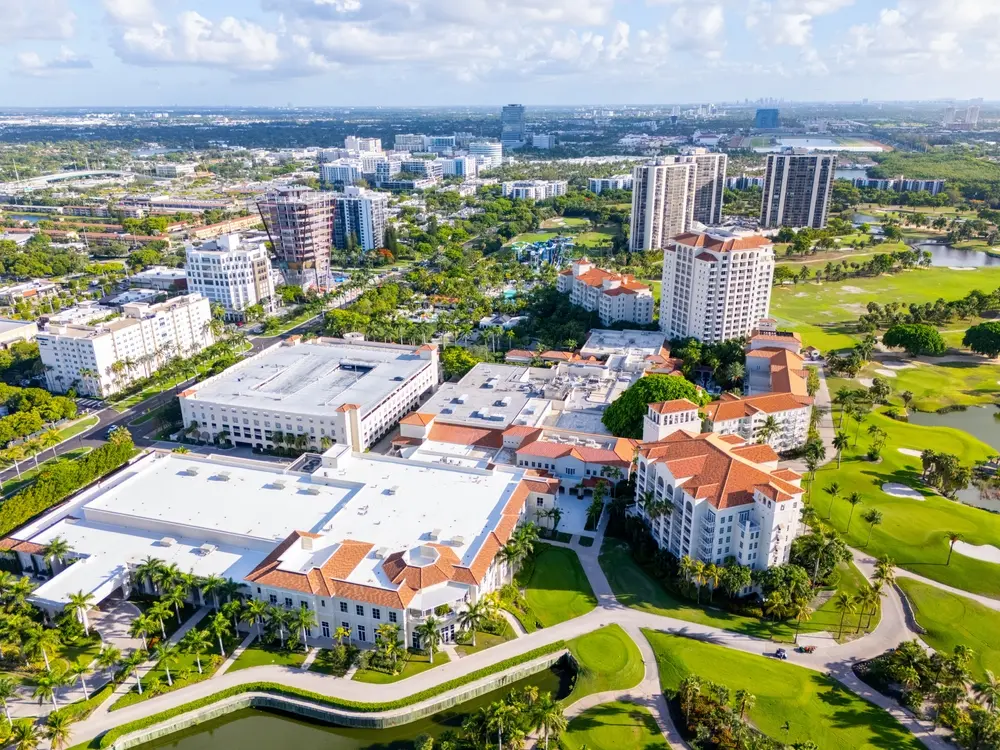
Florida’s High-Velocity Hurricane Zone is the strictest wind-design region in the code, and it is confined to two counties: Miami-Dade and Broward. Buildings there follow special HVHZ roofing provisions.
Our primary markets, Tampa, Orlando, and Sarasota, sit outside the HVHZ. A lot of hurricane-focused roofing content is written to the HVHZ rules, and those rules do not apply to buildings in those markets.
Outside the HVHZ does not mean simple wind design. Roofs still have to be engineered to the standard statewide framework. Wind loads are determined under Section 1609 and ASCE 7, Chapters 26 through 30. Construction documents have to identify the ultimate design wind speed (Vult), the risk category, and the wind exposure category. In coastal and higher-wind areas, wind-borne-debris-region rules can still apply outside the HVHZ. On a low-slope commercial roof, what matters is whether the selected assembly, its fastening pattern, and its corner and perimeter details match the project’s calculated design pressures and approval documents. A familiar brand name on the membrane does not answer that question by itself.
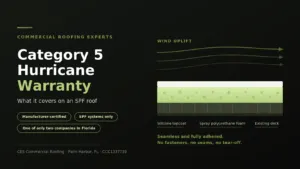
For owners weighing hurricane performance, our Category 5 Hurricane Warranty is a manufacturer-certified warranty that applies to sprayed polyurethane foam (SPF) systems only. CES is one of only two companies in Florida authorized to offer it. It is not available on silicone coatings or other membrane types.
Permits: Who Pulls Them and Why the Paper Trail Matters
Commercial roofing is a permitted activity in Florida. Under FBC Section 105.1, an owner or authorized agent has to apply to the building official and obtain a permit before constructing, altering, or repairing a building. Section 553.79, Florida Statutes, sets the same framework at the statute level. The code’s permit exemptions are narrow, and roofing is not broadly exempt.
The best practice for a commercial owner is to have a licensed commercial roofer pull the permit under its own license. That keeps the permit holder and the party performing the work aligned, which matters for inspections, for code compliance, and later for insurance and due-diligence review. CES has pulled 46 building permits totaling over $4.5 million, all under our own license.
Florida does allow an owner-builder path, but for commercial property it is narrow. Under Section 489.103(7), an owner can act as its own contractor on a commercial building only if the cost does not exceed $75,000, the building is for the owner’s own occupancy or use, and it is not offered for sale or lease. The owner has to personally sign the permit application and takes on legal and financial responsibility for the work. For most real commercial reroofs, that is a poor fit, which is another reason serious owners have a licensed roofer pull the permit.
Contractor Licensing: CCC vs CGC as an Owner Obligation
Florida law draws a clear line between a Certified General Contractor and a Certified Roofing Contractor, and the distinction is an owner obligation, not just a contractor detail. Under Section 489.105 and Section 489.113(3), a general contractor has a broad construction scope but has to subcontract roofing unless the company also holds a state certificate in the roofing category. A roofing contractor’s scope expressly includes roofing, waterproofing, and qualifying roof coatings.
In plain terms, a general-contractor license alone is not a roofing license. A company that self-performs commercial roofing should be able to show a roofing license, and you can confirm a contractor’s license class and status through the DBPR license search. Verify that the license class actually matches the scope being proposed and the permit holder on your job.
CES Commercial Roofing holds an active Florida Certified Roofing Contractor license, CCC1337739, which covers the full roofing scope statewide. We self-perform the roofing work rather than passing it to a separate qualifier, so the license on the permit is the license of the company doing the work.
Insurance is tied into licensing and permitting by statute. Section 489.114 requires proof of workers’ compensation coverage as a condition of a contractor’s license, and Section 489.113 allows a local government to deny or suspend a permit if the contractor will not show proof of required liability and workers’ compensation coverage. This is a real exposure for owners. Many contractors satisfy the requirement with an employee-leasing certificate, which can leave the actual workers on your roof outside that coverage. CES carries a standalone workers’ compensation policy covering every worker on the roof, which protects both those workers and your liability exposure as the property owner.
Verifying licensing, insurance, and permits is part of vetting a contractor before you sign. For a full walk-through of what to check, see our guide on how to choose a commercial roofing contractor in Tampa Bay.
Insurance and Code: Ordinance or Law Coverage
Code compliance and insurance meet at one endorsement in particular. Ordinance or Law coverage is the mechanism most directly tied to code-upgrade costs after a loss. The Florida Department of Financial Services describes it as generally covering three buckets: the value of the undamaged portion of a structure that has to be removed, the cost of demolition, and the increased cost to rebuild to current code. A related endorsement can cover business-income loss during the extra time needed to comply with building ordinances.
Even an owner who understands the current code perfectly can be badly exposed after a storm if the Ordinance or Law limits are thin. If a covered loss triggers a code upgrade, that endorsement is often what pays for the difference. Review those limits before you need them.
Florida Roofing Laws That Apply to Homes, Not Commercial Buildings
A lot of what gets published as “Florida roofing law” is really residential insurance law, and it does not map cleanly onto a warehouse, retail center, office, or industrial roof. A few of the most-cited examples:
- Section 489.147 (contractor conduct around insurance claims) is written in its current form with required notice language addressed to the “residential property owner.”
- Section 627.711 (the wind-mitigation inspection and premium-discount rule) applies to personal-lines residential property insurance. Commercial policies rely on a wider mix of forms and endorsements, so do not assume the homeowner-style inspection-and-discount process applies to your building.
- Section 627.7011 (the roof-age nonrenewal rule) is a residential provision.
The most relevant recent enacted change is Chapter 2025-40 (HB 715), effective May 19, 2025, which revised the statutory definition of a roofing contractor and adjusted certain emergency-period contract rules that remain largely residential. As of 2026, we did not find an enacted law that changes the core commercial framework described above. For a commercial owner, the takeaway is to be careful not to import homeowner rules into a commercial decision.
A Compliance Checklist for Florida Commercial Roof Owners
Before your next repair, renewal, or storm season, confirm the following:
- Know your code history. Find out which edition of the Florida Building Code your roof was last permitted under, since it determines how the repair-versus-replace rule applies.
- Keep your documentation. Retain permit records, product approvals, close-out inspections, and manufacturer system documentation.
- Confirm the license class. Make sure your contractor holds a roofing license, not just a general contractor license, for work they self-perform.
- Check who pulls the permit. Have the licensed roofer pull the permit under its own license.
- Verify insurance. Confirm standalone workers’ compensation coverage, not just a leasing-company certificate.
- Review your Ordinance or Law limits. Make sure your policy can absorb a code-upgrade cost after a loss.
- Match the wind design. Confirm the roof assembly and its attachment details match your building’s calculated design pressures and approval documents.
Frequently Asked Questions
Does the 25% rule mean I have to replace my whole commercial roof?
No. For a roof section built or reroofed under the 2007 Florida Building Code or later, only the repaired, replaced, or recovered portion has to meet the current code, even when 25 percent or more of that section is worked on within a 12-month period. The relief depends on being able to document that code history.
Are commercial roofs in Tampa and Orlando in the High-Velocity Hurricane Zone?
No. The High-Velocity Hurricane Zone covers only Miami-Dade and Broward counties. Buildings in Tampa Bay, Orlando, and Sarasota fall under the standard statewide wind-design framework, which is still demanding but follows Section 1609 and ASCE 7 rather than the HVHZ chapters.
Who is required to pull the permit for a commercial reroof in Florida?
Commercial roofing requires a permit under FBC Section 105.1, and the best practice is for the licensed commercial roofer to pull it under its own license. An owner-builder path exists but is narrow for commercial buildings and is limited to projects of $75,000 or less for the owner’s own use.
Does a general contractor license cover commercial roofing in Florida?
Not by itself. Under Section 489.113(3), a general contractor has to subcontract roofing unless the company also holds a roofing certificate. A company self-performing commercial roofing should be able to show a Certified Roofing Contractor license.
Get a Free Commercial Roof Evaluation
If you want a clear read on where your roof stands against these requirements, we can help. Our team can review your roof’s condition, its documentation, and its compliance picture so you know your options while you still have time to plan them. Schedule a free commercial roof inspection or call us at (813) 419-1918.